


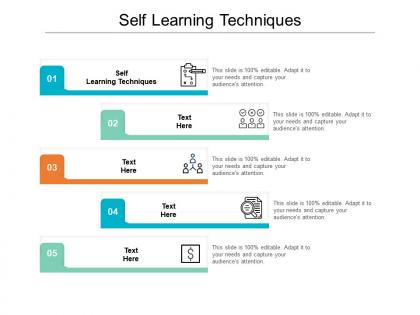
Self learning techniques ppt powerpoint presentation model example introduction cpb




Try Before you Buy Download Free Sample Product
 Impress Your
 Audience
 100%
100% Editable
 Save Hours
 of Time


Our Self Learning Techniques Ppt Powerpoint Presentation Model Example Introduction Cpb are topically designed to provide an attractive backdrop to any subject. Use them to look like a presentation pro.
People who downloaded this PowerPoint presentation also viewed the following :
Self learning techniques ppt powerpoint presentation model example introduction cpb with all 2 slides:
Use our Self Learning Techniques Ppt Powerpoint Presentation Model Example Introduction Cpb to effectively help you save your valuable time. They are readymade to fit into any presentation structure.
FAQs for Self learning techniques ppt powerpoint presentation model
Effective self-learning techniques include active recall, spaced repetition, deliberate practice, the Feynman technique, and microlearning sessions. These methods enhance skill acquisition by reinforcing memory retention, identifying knowledge gaps, and building competency through focused practice, with many professionals finding that combining multiple techniques accelerates mastery while maintaining long-term retention.
Tailoring self-learning strategies involves identifying your preferred learning style, whether visual, auditory, kinesthetic, or reading-based, then selecting complementary techniques like mind mapping, podcasts, hands-on practice, or written summaries. Successful learners often combine multiple approaches, with visual learners using infographics and charts, auditory learners leveraging discussion groups, and kinesthetic learners incorporating simulations, ultimately enhancing retention and comprehension.
Motivation serves as the primary driver for self-learning success, influencing goal-setting, persistence through challenges, and consistent engagement with learning materials. It enables learners to maintain focus during difficult concepts, seek additional resources when needed, and apply knowledge practically, with many professionals finding that intrinsic motivation ultimately delivers sustained skill development and competitive advantage.
Technology enhances self-learning through personalized learning paths, interactive content, real-time feedback, progress tracking, and flexible accessibility across devices. Apps and online platforms streamline knowledge acquisition by adapting to individual learning styles, offering multimedia resources, and enabling microlearning sessions, with many professionals finding that digital tools ultimately deliver faster skill development and more efficient educational outcomes.
Setting specific goals significantly enhances self-directed learning by providing clear direction, measurable milestones, and sustained motivation throughout the learning journey. These targeted objectives enable learners to prioritize resources effectively, track progress systematically, and maintain accountability, with many professionals finding that goal-oriented approaches deliver faster skill acquisition and higher completion rates, ultimately creating competitive advantages in increasingly dynamic career environments.
Learners can assess their understanding through self-testing, practice exercises, peer discussions, project applications, and regular reflection on learning objectives. These methods enable progress tracking by identifying knowledge gaps, reinforcing key concepts, and measuring skill development, with many professionals finding that consistent self-assessment ultimately delivers deeper comprehension and accelerated mastery.
Common obstacles to self-learning include lack of motivation, poor time management, information overload, absence of structured guidance, and difficulty maintaining consistency. These challenges can be overcome by setting specific goals, creating dedicated study schedules, curating quality resources, joining online communities for support, and breaking complex topics into manageable segments, ultimately delivering sustained knowledge acquisition and professional growth.
Incorporating social learning enhances self-study by combining collaborative discussions, peer feedback, and knowledge sharing with independent learning activities, creating accountability and diverse perspectives. Through study groups, online forums, and mentorship networks, learners accelerate comprehension, identify knowledge gaps more effectively, and maintain motivation, with many professionals finding that social accountability significantly improves retention and practical application.
Effective resources for specialized self-learning include professional online platforms like Coursera and LinkedIn Learning, industry-specific publications and journals, virtual conferences, mentorship networks, and hands-on project repositories. These platforms streamline knowledge acquisition by offering expert-led content, peer collaboration, and practical applications, with many professionals finding that combining multiple resources accelerates skill development and enhances career advancement opportunities.
Self-learning techniques enhance professional development through structured goal-setting, continuous skill assessment, peer collaboration, mentorship engagement, and strategic resource utilization. These approaches streamline career advancement by enabling targeted competency building, adaptive problem-solving, and knowledge retention, with many organizations finding that employees who embrace self-directed learning deliver improved performance, innovation, and competitive advantage.
Reflective practice enables learners to analyze their experiences, identify knowledge gaps, and adjust learning strategies for improved outcomes. Through systematic reflection, professionals in fields like healthcare, education, and business development can evaluate their decision-making processes, recognize patterns in their learning, and ultimately enhance their skill acquisition and problem-solving capabilities.
Creating a structured study plan involves setting clear learning objectives, breaking content into manageable modules, establishing consistent study schedules, and incorporating regular assessment checkpoints. This systematic approach enables learners to track progress effectively, maintain motivation through achievable milestones, and adapt their methods based on performance, with many professionals finding that structured frameworks ultimately deliver better knowledge retention and faster skill acquisition.
Curiosity serves as the primary motivational driver for self-directed learning, fueling persistent exploration, question-asking, and knowledge-seeking behaviors that sustain long-term educational engagement. This intrinsic motivation enables professionals to overcome learning obstacles, explore diverse subjects beyond immediate requirements, and maintain continuous skill development, with many organizations finding that curious employees demonstrate higher adaptability and innovation in increasingly dynamic business environments.
Learners can leverage feedback by actively seeking input from multiple sources, regularly self-assessing progress against learning objectives, and systematically incorporating constructive criticism into their study approaches. Through peer reviews, mentor guidance, and performance analytics, learners enhance retention rates, identify knowledge gaps more effectively, and accelerate skill development, ultimately delivering improved learning outcomes and greater professional competency.
Effective self-learning strategies include setting specific daily goals, creating structured schedules, breaking complex topics into manageable chunks, and establishing accountability systems through progress tracking. These approaches streamline knowledge retention by maintaining regular practice, minimizing overwhelm, and delivering measurable progress, with many professionals finding that consistent small efforts ultimately enhance skill development and competitive advantage more than sporadic intensive sessions.
-
Attractive design and informative presentation.
-
Excellent template with unique design.
-
Top Quality presentations that are easily editable.
-
It saves your time and decrease your efforts in half.
-
Easy to edit slides with easy to understand instructions.