

Self supervised learning ppt powerpoint presentation model objects cpb




Try Before you Buy Download Free Sample Product
 Impress Your
 Audience
 100%
100% Editable
 Save Hours
 of Time


Our Self Supervised Learning Ppt Powerpoint Presentation Model Objects Cpb are topically designed to provide an attractive backdrop to any subject. Use them to look like a presentation pro.
People who downloaded this PowerPoint presentation also viewed the following :
Content of this Powerpoint Presentation
Description:
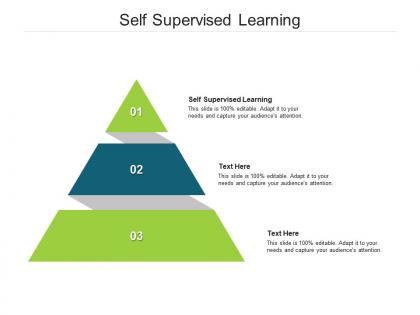
The image is of a PowerPoint slide titled "Self Supervised Learning," which likely pertains to a machine learning concept where a model is trained to understand the data structure without explicit human-provided labels. The slide is meant to be customized with specific information about self-supervised learning processes or principles at each level of the pyramid.
Use Cases:
This type of slide could be useful in industries that are leveraging machine learning and artificial intelligence for various applications:
1. Technology:
Use: Explaining AI development stages.
Presenter: AI Research Scientist
Audience: Developers, Data Scientists
2. Education:
Use: Teaching advanced machine learning concepts.
Presenter: Professor
Audience: Computer Science Students
3. Automotive:
Use: Discussing autonomous vehicle training methods.
Presenter: Machine Learning Engineer
Audience: Design Team, Automotive Engineers
4. Healthcare:
Use: Showcasing self-supervised learning in medical image analysis.
Presenter: Health Data Scientist
Audience: Medical Professionals, Research Teams
5. Finance:
Use: Illustrating fraud detection algorithms training.
Presenter: Data Analyst
Audience: Risk Management, Compliance Officers
6. Retail:
Use: Describing customer behavior prediction models.
Presenter: Marketing Analyst
Audience: Sales and Marketing Teams
7. Manufacturing:
Use: Detailing predictive maintenance using machine learning.
Presenter: Operations Manager
Audience: Maintenance Engineers, Factory Managers
Self supervised learning ppt powerpoint presentation model objects cpb with all 2 slides:
Use our Self Supervised Learning Ppt Powerpoint Presentation Model Objects Cpb to effectively help you save your valuable time. They are readymade to fit into any presentation structure.
FAQs for Self supervised learning ppt powerpoint presentation
Self-supervised learning operates on principles of generating supervisory signals from data itself, learning meaningful representations without manual labels, leveraging data structure and context for training, and creating pretext tasks that encourage feature discovery. These approaches enable organizations to utilize vast unlabeled datasets effectively, with companies in healthcare, finance, and retail finding significant cost reductions in data preparation while achieving competitive performance.
Self-supervised learning differs by using data's inherent structure to create labels automatically, while supervised learning requires manual labeling and unsupervised learning finds patterns without labels. This approach enables organizations to leverage vast unlabeled datasets for training robust models, with companies in healthcare, finance, and technology finding that self-supervised methods significantly reduce annotation costs while maintaining accuracy.
Self-supervised learning in NLP includes language modeling, text representation learning, machine translation, sentiment analysis, and question answering systems. These approaches enable models to learn from vast unlabeled text datasets by predicting masked words, next sentences, and contextual relationships, with organizations in finance, healthcare, and customer service finding significantly improved accuracy and reduced training costs.
Self-supervised learning enhances computer vision by enabling models to learn from unlabeled data through pretext tasks like image rotation, colorization, and contrastive learning methods. These approaches significantly reduce annotation costs while improving feature extraction, with applications in medical imaging, autonomous vehicles, and retail finding enhanced object detection, image segmentation, and ultimately faster deployment timelines.
Self-supervised learning frameworks commonly utilize transformer architectures, convolutional neural networks, autoencoders, contrastive learning models, and generative adversarial networks. These architectures streamline feature extraction by leveraging unlabeled data patterns, enabling organizations in healthcare, finance, and retail to enhance predictive accuracy, reduce annotation costs, and accelerate model development, ultimately delivering competitive advantages through more efficient AI implementations.
Contrastive learning serves as a fundamental framework in self-supervised learning by teaching models to distinguish between similar and dissimilar data pairs without labeled examples. Through techniques like SimCLR and MoCo, organizations in computer vision, natural language processing, and audio recognition enhance feature representations, reduce annotation costs, and achieve competitive performance, ultimately delivering scalable AI solutions with significantly lower data preparation overhead.
Researchers face challenges including designing effective pretext tasks, managing computational requirements for large-scale training, ensuring learned representations transfer well across domains, and addressing biases in unlabeled datasets. These obstacles require strategic approaches to data curation, model architecture optimization, and validation frameworks, with many institutions finding that collaborative research environments and robust computing infrastructure ultimately deliver breakthrough solutions and competitive advantages.
Self-supervised models significantly outperform traditional methods during data scarcity by learning meaningful representations from unlabeled data through pretext tasks, reducing dependency on costly manual annotations. These approaches enable organizations in healthcare, finance, and manufacturing to leverage vast amounts of existing data, ultimately delivering faster model deployment and competitive advantage when labeled datasets are limited.
Self-supervised learning significantly enhances data privacy by reducing dependence on labeled datasets, minimizing human annotation requirements, and enabling model training with less sensitive information exposure. While this approach streamlines privacy compliance across healthcare, finance, and retail sectors, organizations must still address potential bias amplification and ensure responsible algorithmic transparency, ultimately delivering stronger privacy protection and ethical AI deployment.
Self-supervised learning enhances transfer learning by creating robust, generalizable representations from unlabeled data, reducing dependence on expensive annotations while improving model adaptability across domains. These pre-trained models deliver superior performance when fine-tuned for specific tasks, with organizations in healthcare, finance, and manufacturing finding that self-supervised features transfer more effectively, ultimately accelerating deployment and reducing training costs.
Pretext tasks improve self-supervised learning by creating meaningful representations through data augmentation, contrastive learning, masking strategies, rotation prediction, and temporal ordering challenges. These tasks force models to understand underlying data structures, spatial relationships, and semantic patterns, with computer vision and natural language processing applications finding that well-designed pretext tasks significantly enhance downstream performance and reduce labeled data requirements.
Effective metrics for self-supervised learning models include downstream task performance, representation quality through linear probing, transfer learning accuracy, clustering metrics like silhouette scores, and visualization techniques such as t-SNE analysis. These evaluation approaches enable organizations in healthcare, finance, and retail to assess model effectiveness across specific applications like medical imaging and fraud detection, ultimately delivering improved accuracy and reduced labeling costs.
Emerging trends in self-supervised learning include multimodal foundation models, contrastive learning methods, masked language modeling extensions, and cross-domain transfer techniques. These approaches are revolutionizing sectors like healthcare, finance, and manufacturing by enabling more efficient model training, reducing labeled data requirements, and delivering enhanced performance across diverse applications, ultimately providing organizations with significant competitive advantages.
Self-supervised learning integrates into existing ML workflows through pre-training phases, feature extraction layers, and data augmentation pipelines that enhance model performance without requiring additional labeled datasets. Organizations across sectors like healthcare, finance, and retail are leveraging these techniques to improve model accuracy, reduce training costs, and accelerate deployment timelines, ultimately delivering more robust AI solutions.
Self-supervised learning will drive AI's future by enabling models to learn from vast unlabeled datasets, reducing dependence on costly manual annotation while improving scalability and generalization. This approach revolutionizes industries like healthcare, finance, and manufacturing by delivering more robust AI systems, faster deployment cycles, and significantly lower training costs, ultimately providing organizations with competitive advantages in an increasingly data-driven landscape.
-
Topic best represented with attractive design.
-
Great quality product.
-
Amazing product with appealing content and design.
-
Easily Editable.
-
Awesomely designed templates, Easy to understand.
-
Visually stunning presentation, love the content.