


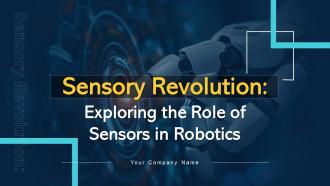
Sensory Revolution Exploring The Role Of Sensors In Robotics RB





Try Before you Buy Download Free Sample Product
 Impress Your
 Audience
 100%
100% Editable
 Save Hours
 of Time


Use our professionally designed comprehensive PowerPoint presentation Sensory Revolution Exploring the Role of Sensors in Robotics. It provides insights into challenges faced by companies due to limited automation and repetitive processes. Furthermore, it provides a solution overview of the implementation of sensors in operational areas with various applications, including autonomous vehicles, medical robotics, etc., that provide operational efficiency and precision. It also positively impacts driving innovations and transforming the industry, such as limited work errors, time-saving processes, etc. Transform your businesses by embracing the future of automation with our expertly crafted presentation. Get access now.
People who downloaded this PowerPoint presentation also viewed the following :
Content of this Powerpoint Presentation
Slide 1: This slide showcase title Sensory Revolution: Exploring the Role of Sensors in Robotics. State Your Company Name
Slide 2: This slide showcase Agenda.
Slide 3: This slide exhibit Table of content.
Slide 4: This slide exhibit Table of content that is to be discuss further.
Slide 5: This slide showcases operations of robots in daily life without sensors. It includes preprogramed set of instructions, limited adaptability, etc.
Slide 6: This slide showcases problems faced by robotics before integration sensors.
Slide 7: This slide showcases strategies for dealing with problems faced by organizations in absence of sensors.
Slide 8: This slide exhibit Table of content that is to be discuss further.
Slide 9: This slide showcases importance of sensors in industrial processes to do business with automation.
Slide 10: This slide showcases emerging trends increasing development of sensors at business levels.
Slide 11: This slide showcases sensor global market share throughout many years. It includes rapid expansion of technology across different industries.
Slide 12: This slide showcases division of market into logistics, defence, manufacturing, healthcare and others.
Slide 13: This slide showcases use of sensors enabling rise in augmented reality while making work more efficient.
Slide 14: This slide showcases convergence of technology across various regions of world likely to flourish in coming years.
Slide 15: This slide showcases sensors used in by robots by sensor type and applications. It includes drones, cameras, ultrasonic sensors, cobot, etc.
Slide 16: This slide showcases sensors used in robots by applications enabling greater adoption within robotics.
Slide 17: This slide showcases availability of sensors used in robotics aiming to accomplish required tasks. It includes light sensors, proximity sensors, etc.
Slide 18: This slide exhibit Table of content that is to be discuss further.
Slide 19: This slide showcases working of temperature sensor for measuring internal temperature of dams, bridges and power plants.
Slide 20: This slide showcases various types of sensors in IoT detecting changes in environment and collecting valuable data.
Slide 21: This slide showcases use cases of gripper sensors focusing on providing real time feedback on object detection, grasp force, and adaptive handling of objects.
Slide 22: This slide showcases identification and calculation of different gasses in specific region.
Slide 23: This slide showcases skin sensors designed to mimic sense of touch in robots and electronic devices. It includes sensing layer, substrate specimen, etc.
Slide 24: This slide exhibit Table of content that is to be discuss further.
Slide 25: This slide showcases applications of sensors in automotive mode for better working of vehicles.
Slide 26: This slide showcases widespread digitalization of medical facilities while improving healthcare services.
Slide 27: This slide showcases transformation of agricultural industry by using sensors on regular basis.
Slide 28: This slide showcases sensors used by buildings for maintaining ideal conditions within building premises.
Slide 29: This slide showcases working of aircraft with in-built automatic sensors in system.
Slide 30: This slide showcases various types of pressure sensors providing birds-eye view across autonomous parts of facility.
Slide 31: This slide showcases versatility of sonar sensors in various industries contributing to improved safety, automation, etc.
Slide 32: This slide exhibit Table of content that is to be discuss further.
Slide 33: This slide showcases planned budget for sensors based on factors such as brand, technology specifications, etc.
Slide 34: This slide exhibit Table of content that is to be discuss further.
Slide 35: This slide showcases impact of using sensors in robotics enabling robots to operate in diverse and complex scenarios.
Slide 36: This slide exhibit Table of content that is to be discuss further.
Slide 37: This slide showcases integration of sensors in robotics under healthcare industry.
Slide 38: This slide showcases implementation of sensors in farming resulting in creased crop yields and reduced resource wastage.
Slide 39: This slide exhibit Table of content that is to be discuss further.
Slide 40: This slide showcases dashboard for working of visual sensor in an organisation.
Slide 41: This slide showcases unified view of environment across multiple sensors & sensor readings.
Slide 42: This slide shows all the icons included in the presentation.
Slide 43: This slide is titled as Additional Slides for moving forward.
Slide 44: This is a Timeline slide. Show data related to time intervals here.
Slide 45: This is an Idea Generation slide to state a new idea or highlight information, specifications etc.
Slide 46: This is Our Vision, Mission & Goal slide. Post your Visions, Missions, and Goals here.
Slide 47: This slide provides 30 60 90 Days Plan with text boxes.
Slide 48: This is a financial slide. Show your finance related stuff here.
Slide 49: This slide depicts Venn diagram with text boxes.
Slide 50: This slide presents Roadmap with additional textboxes. It can be used to present different series of events.
Slide 51: This slide contains Puzzle with related icons and text.
Slide 52: This slide shows Post It Notes for reminders and deadlines. Post your important notes here.
Slide 53: This is a Thank You slide with address, contact numbers and email address.
Sensory Revolution Exploring The Role Of Sensors In Robotics RB with all 61 slides:
Use our Sensory Revolution Exploring The Role Of Sensors In Robotics RB to effectively help you save your valuable time. They are readymade to fit into any presentation structure.










FAQs for Sensory Revolution Exploring The Role Of Sensors
The sensory revolution encompasses advanced haptic feedback, immersive audio technologies, scent synthesis, taste simulation, and enhanced visual displays that create multi-dimensional experiences. These technologies streamline consumer engagement by delivering personalized interactions, reducing purchase hesitation, and enhancing brand loyalty, with retail, automotive, and entertainment industries finding that sensory-rich experiences ultimately drive significantly higher conversion rates and customer satisfaction.
Technology advancements enhance sensory marketing through augmented reality displays, haptic feedback systems, spatial audio technologies, scent diffusion devices, and interactive touchscreen interfaces. These innovations enable brands to create immersive customer experiences by engaging multiple senses simultaneously, with retail stores and automotive showrooms finding that multi-sensory campaigns increase engagement rates and purchase intent significantly.
Brands can leverage sensory marketing through visual design consistency, signature scents, tactile packaging materials, ambient soundscapes, and strategic taste sampling across touchpoints. These multisensory approaches enhance customer engagement by creating emotional connections, increasing brand recall, and differentiating products in competitive markets, with retail stores, hospitality venues, and automotive showrooms finding that integrated sensory experiences ultimately drive stronger customer loyalty and purchasing decisions.
The sensory revolution transforms product design by integrating haptic feedback, advanced acoustics, scent technology, and multi-sensory interfaces that create immersive user experiences. Through sensory-driven design, companies in automotive, consumer electronics, and retail deliver enhanced functionality, emotional connection, and competitive differentiation, ultimately driving customer satisfaction and market leadership.
Smell and taste technologies are transforming the food and beverage industry through digital scent transmission, flavor enhancement systems, synthetic aroma generation, and personalized taste profiling solutions. These innovations enable restaurants to create immersive dining experiences, help manufacturers optimize product development cycles, and allow beverage companies to test flavor combinations remotely, ultimately delivering enhanced customer satisfaction and competitive differentiation.
The sensory revolution addresses accessibility through adaptive interfaces, customizable sensory inputs, haptic feedback systems, noise-canceling technologies, and adjustable lighting controls. These innovations enable individuals with sensory processing disorders to modify their environments by reducing overwhelming stimuli, enhancing comfortable interactions, and providing alternative communication methods, ultimately delivering more inclusive experiences and greater independence.
Sensory manipulation in marketing raises ethical concerns including consumer consent, vulnerable population targeting, data privacy, subliminal influence, and transparency in sensory data collection. While these technologies enhance customer experiences and drive engagement, companies must balance persuasive marketing with responsible practices, ensuring consumers understand how sensory elements influence their purchasing decisions and maintaining trust through ethical implementation.
Cultural differences significantly influence sensory marketing effectiveness through varying color symbolism, scent preferences, texture associations, and sound interpretations across different societies. While red signifies luck in Chinese culture but danger in Western contexts, many global brands adapt their sensory strategies accordingly, with restaurants, retailers, and hospitality companies tailoring lighting, music, and aromatherapy to local cultural norms, ultimately delivering more resonant customer experiences.
Successful sensory strategy implementations include Singapore Airlines' signature scent, Starbucks' carefully curated soundscapes and aromas, Apple's distinctive packaging tactile experience, and Dunkin's in-store coffee aroma systems. These brands enhance customer engagement by creating memorable multi-sensory touchpoints, building emotional connections, and differentiating their offerings, with many finding that strategic sensory branding increases customer loyalty and brand recall significantly.
Data analytics measures sensory marketing effectiveness through customer behavior tracking, engagement metrics, sales conversion analysis, and neurometric feedback assessment. These methods enable retailers and hospitality brands to quantify emotional responses, optimize sensory touchpoints like lighting and music, and ultimately deliver enhanced customer experiences while maximizing campaign ROI.
Future sensory experience trends include haptic feedback integration, scent-enabled digital environments, taste simulation technologies, spatial audio advancement, and cross-sensory AR/VR platforms. These innovations streamline customer engagement by delivering immersive retail experiences, enhancing remote collaboration, and personalizing entertainment consumption, with many businesses finding that multi-sensory integration significantly increases user retention and competitive differentiation.
Multisensory marketing integrates sight, sound, touch, smell, and taste to create immersive brand experiences that enhance memory retention, emotional connection, and purchase intent. Retailers like Apple stores combine sleek visuals, ambient sounds, and tactile product interactions, while hotels use signature scents and curated music, ultimately delivering deeper consumer engagement and stronger brand loyalty across competitive markets.
Companies face challenges including high implementation costs, maintaining consistency across touchpoints, measuring sensory impact effectiveness, and navigating cultural preferences across global markets. While sensory branding presents complexity in execution and resource allocation, many organizations find that strategic sensory integration ultimately delivers enhanced customer engagement, stronger brand differentiation, and increased loyalty in increasingly competitive retail environments.
The sensory revolution intersects with sustainability through smart sensors that optimize resource consumption, reduce waste, and enhance energy efficiency across manufacturing, agriculture, and urban planning. These technologies enable precision farming that minimizes water usage, smart building systems that reduce carbon footprints, and automated recycling processes, with many organizations finding that sensor-driven sustainability initiatives deliver both environmental benefits and significant cost reductions.
Businesses should start by understanding their target audience's sensory preferences, defining clear objectives for each sensory touchpoint, and implementing gradual changes rather than overwhelming transformations. Begin with one or two senses like scent or sound in retail environments, test customer responses systematically, and scale successful elements across multiple channels, with many companies finding that consistent sensory branding ultimately enhances customer loyalty and drives measurable sales growth.
-
Slideteam offers pocket-friendly products. As a college student this is a really necessary thing to look at while paying for something.
-
Innovative and Colorful designs.