


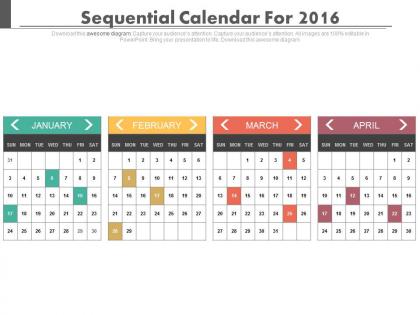
Sequential calendars for january february march and april months powerpoint slides




Try Before you Buy Download Free Sample Product
 Impress Your
 Audience
 100%
100% Editable
 Save Hours
 of Time


Download read made sequential calendars for months PowerPoint slides. This sequential month calendars PPT template have been designed considering various needs of different target audience. Our calendar template slide includes different font styles that are easy on eyes. When you write or type over them, you can still see numbers in background. Enter appointments and events for any date. Use the whole calendar online, copy a month's slide to another presentation, or print the calendar to hang on the wall. Customize the template by changing colors and styles using PowerPoint themes. Calendar templates have background photo’s options. Enter appointments and events for any date. Calendar presentation templates for PowerPoint comes in different formats and you may easily customize it for your business or organization. You will just need to pick a template and edit it accordingly. Same principles of editing text applies for the most part, so just click in a text box with default data and edit it as you need. Boost your chances as a contestant with our Sequential Calendars For January February March And April Months Powerpoint Slides. Get a good grip of the competition.
People who downloaded this PowerPoint presentation also viewed the following :
Sequential calendars for january february march and april months powerpoint slides with all 3 slides:
Display a daring approach with our Sequential Calendars For January February March And April Months Powerpoint Slides. Demonstrate eagerness to accept any challenge.
FAQs for Sequential calendars for january february march and april
Sequential calendars organize time-based information in flowing, chronological sequences rather than traditional grid formats, emphasizing progression through phases, milestones, or interconnected events. These calendars streamline project timelines, business processes, and strategic planning by visualizing dependencies and workflows, with many organizations finding that sequential formats enhance operational clarity, improve milestone tracking, and ultimately deliver better resource allocation than standard monthly grids.
Sequential calendars enhance project management by providing structured timeline visualization, milestone tracking, dependency mapping, and resource allocation across project phases. Industries like construction, software development, and manufacturing leverage these tools to streamline workflows, minimize delays, and improve cross-team coordination, ultimately delivering better project outcomes and competitive advantage.
Sequential calendars serve as comprehensive academic management tools, enabling students and educators to track assignment deadlines, exam schedules, project milestones, and semester progressions in chronological order. These systematic approaches streamline academic planning by providing visual timelines, reducing missed deadlines, and enhancing time management skills, with many educational institutions finding that structured calendar systems ultimately improve student performance and organizational efficiency.
Businesses leverage sequential calendars for improved task scheduling by establishing clear timeline dependencies, visualizing project workflows, and automatically adjusting deadlines when delays occur. This systematic approach enables teams to prioritize critical path activities, reduce scheduling conflicts, and maintain project momentum, with manufacturing and software development organizations finding significantly improved delivery predictability and resource allocation efficiency.
Sequential calendars deliver structured goal progression through phased milestones, timeline visualization, dependency mapping, and systematic progress tracking. This approach enables organizations to break complex objectives into manageable phases, maintain momentum through clear checkpoints, and adjust strategies based on completed milestones, with many businesses finding that sequential planning reduces overwhelm while ensuring consistent advancement toward strategic targets.
Sequential calendars facilitate collaboration by providing shared visibility into project timelines, deadlines, and dependencies, enabling teams to coordinate tasks, identify potential conflicts, and align their efforts effectively. Through centralized scheduling platforms, teams streamline communication, reduce scheduling conflicts, and enhance project transparency, with many organizations finding that sequential planning ultimately delivers improved coordination and faster project completion across departments.
**INPUT**: What types of software or tools are best suited for creating sequential calendars? **OUTPUT**: Software best suited for sequential calendars includes Microsoft Project, Smartsheet, Asana, Trello, and specialized timeline tools like Lucidchart. These platforms streamline project sequencing by enabling dependency mapping, automated scheduling adjustments, and collaborative tracking, with many organizations finding that integrated calendar systems ultimately enhance operational efficiency and deliver superior project coordination across teams. **Word count: 58 words**
Visual representations of sequential calendars improve understanding by transforming abstract time concepts into concrete, spatial relationships that the brain processes more efficiently. Through color coding, progressive layouts, and interconnected timelines, organizations enhance comprehension by 40-60%, with educational institutions and project management teams finding that visual sequences reduce cognitive load, accelerate pattern recognition, and ultimately deliver better retention rates and faster decision-making across complex scheduling scenarios.
Sequential calendar templates should include clear month-by-month progression, customizable date highlighting, milestone markers, timeline connectors, and scalable design elements for various screen sizes. These features enable presenters to showcase project phases, deadline tracking, and progress visualization seamlessly, with many organizations finding that well-structured sequential calendars enhance stakeholder communication and strategic planning outcomes.
Sequential calendars integrate with existing project management tools through API connections, data synchronization protocols, and embedded dashboard widgets that enable real-time timeline updates. Popular platforms like Asana, Trello, and Monday.com increasingly support these integrations, allowing teams to streamline workflow visualization, automate milestone tracking, and enhance project transparency, ultimately delivering improved coordination and faster project completion rates.
Common implementation challenges include employee resistance to new scheduling systems, integration difficulties with existing software platforms, initial setup complexity, and training requirements across departments. Organizations often find that poor change management, inadequate stakeholder buy-in, and insufficient technical support can disrupt workflows initially, though strategic planning and phased rollouts typically minimize these issues while delivering enhanced coordination.
Sequential calendars support agile methodologies by enabling sprint planning, backlog prioritization, and iterative development cycles through clear timeline visualization. These tools streamline milestone tracking, resource allocation, and team coordination, with many software development teams finding that sequential scheduling enhances workflow transparency, reduces bottlenecks, and ultimately delivers faster product releases and improved project adaptability.
Healthcare, manufacturing, financial services, project management, and educational institutions benefit most from sequential calendars due to their complex, time-dependent workflows and regulatory requirements. These industries leverage sequential scheduling to streamline patient care coordination, optimize production timelines, ensure compliance deadlines, and manage multi-phase projects, ultimately delivering improved operational efficiency and reduced scheduling conflicts.
Sequential calendars enhance personal productivity by providing structured time allocation, clear priority visualization, and systematic task progression tracking. This approach enables individuals to streamline daily workflows, minimize scheduling conflicts, and maintain consistent progress momentum, with many professionals finding that sequential planning ultimately delivers improved focus, reduced overwhelm, and significantly better work-life balance outcomes.
Sequential calendars in remote work have revolutionized project coordination, team synchronization, and resource management through time-blocked scheduling, cross-timezone milestone tracking, and automated workflow transitions. Companies like tech startups and consulting firms leverage these systems for sprint planning, client deliverable management, and distributed team coordination, ultimately delivering enhanced productivity and seamless collaboration across global workforces.
-
Excellent template with unique design.
-
Thanks for all your great templates they have saved me lots of time and accelerate my presentations. Great product, keep them up!