


Series a pitch deck land and expand strategy ppt formats




Try Before you Buy Download Free Sample Product
 Impress Your
 Audience
 100%
100% Editable
 Save Hours
 of Time


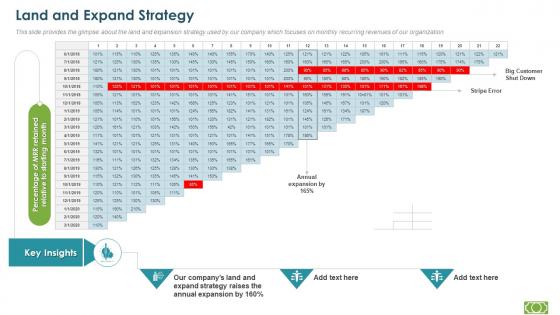
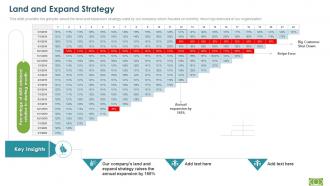
This slide provides the glimpse about the land and expansion strategy used by our company which focuses on monthly recurring revenues of our organization
People who downloaded this PowerPoint presentation also viewed the following :
Series a pitch deck land and expand strategy ppt formats with all 6 slides:
Use our Series A Pitch Deck Land And Expand Strategy Ppt Formats to effectively help you save your valuable time. They are readymade to fit into any presentation structure.





FAQs for Series a pitch deck land and expand
A successful Series A pitch deck includes problem identification, solution overview, market size analysis, business model clarity, traction metrics, competitive landscape, financial projections, team credentials, and funding requirements. These components work together by demonstrating market validation, revenue scalability, and growth potential, with many startups finding that strong traction data and clear unit economics ultimately deliver investor confidence and competitive positioning.
Startups can effectively communicate their unique value proposition by clearly articulating the specific problem they solve, demonstrating quantifiable market demand, showcasing competitive differentiation, and presenting measurable traction metrics. Through concise positioning statements and compelling customer testimonials, companies like fintech platforms and healthcare startups streamline investor understanding while ultimately delivering credible proof of scalable market opportunity and sustainable competitive advantage.
Series A pitch decks should include market size visualizations, customer journey maps, product screenshots or demos, traction charts, competitive positioning matrices, and team photos with credentials. These visuals enhance storytelling by transforming complex data into digestible narratives, with many startups finding that compelling charts and authentic product demonstrations significantly strengthen investor confidence and accelerate funding decisions.
Series A pitch decks require stronger market validation, detailed financial projections, and proven business models, while seed decks focus more on vision, team credentials, and market opportunity. Investors increasingly expect comprehensive revenue streams, customer acquisition metrics, and clear paths to profitability at Series A, with many finding that demonstrating scalable unit economics and competitive positioning becomes critical for securing larger funding rounds.
Series A pitch decks should highlight revenue growth trajectory, monthly recurring revenue (MRR), customer acquisition cost (CAC) to lifetime value (LTV) ratios, user engagement metrics, and market penetration rates. These metrics demonstrate scalable business models by showcasing consistent growth patterns, sustainable unit economics, and strong market validation, with many investors finding that diversified traction metrics across financial, operational, and strategic dimensions ultimately deliver the comprehensive growth story necessary for funding decisions.
Startups can tailor their pitch decks by researching investors' portfolio companies, investment thesis, and preferred sectors, then emphasizing relevant metrics, market positioning, and growth strategies that align with their interests. By customizing problem statements, competitive advantages, and financial projections to match each VC's focus areas, startups demonstrate strategic fit and understanding, ultimately increasing their chances of securing funding in an increasingly competitive landscape.
Common Series A pitch deck mistakes include unrealistic financial projections, insufficient market validation, weak competitive analysis, unclear go-to-market strategies, and overly technical product explanations. These missteps often stem from focusing too heavily on product features rather than business outcomes, with many entrepreneurs finding that investors prioritize scalable revenue models and clear paths to profitability over technical complexity.
Market analysis demonstrates market size, growth potential, competitive landscape, and target customer segments, establishing the foundation for your business opportunity. Through comprehensive research, startups validate their addressable market, differentiate from competitors, and showcase deep customer understanding, ultimately proving to investors that significant demand exists and the company can capture meaningful market share in an expanding sector.
Founders can effectively showcase their team by highlighting relevant experience, complementary skill sets, past achievements, advisory board strength, and clear role definitions. Through strategic positioning of team credentials, successful startups demonstrate domain expertise, execution capability, and market credibility, with investors increasingly recognizing that strong founding teams significantly reduce investment risk while accelerating growth potential.
Series A pitch decks should include three-year revenue forecasts, customer acquisition costs, lifetime value metrics, monthly recurring revenue growth, and detailed expense breakdowns. These projections demonstrate scalability by showing clear unit economics, realistic growth trajectories based on market validation, and path to profitability, with many investors finding that conservative estimates with strong underlying assumptions ultimately deliver greater confidence than overly aggressive forecasts.
Design and layout are crucial for Series A pitch decks, as investors review hundreds of presentations and need clear, compelling visual storytelling to quickly grasp your business potential. Best practices include maintaining consistent branding throughout, using clean typography with minimal text per slide, incorporating data visualizations that highlight key metrics, and ensuring logical flow from problem to solution to market opportunity. With many successful startups finding that professional design significantly enhances credibility and investor engagement, ultimately delivering clearer communication and competitive advantage.
A Series A pitch deck should follow a compelling narrative arc that begins with market opportunity identification, progresses through problem validation and solution demonstration, and culminates with traction evidence and scaling strategy. This storytelling approach engages investors by building logical momentum from market need to execution capability, with many successful startups finding that clear progression from vision to measurable results significantly enhances funding outcomes.
Startups should address competition by demonstrating clear market differentiation, competitive advantages, and strategic positioning rather than dismissing rivals. Through comprehensive competitor analysis, unique value proposition articulation, and defensible market strategy presentation, companies can showcase their understanding of the landscape while highlighting sustainable competitive moats, ultimately positioning themselves as informed market players rather than naive newcomers.
**Series A pitch deck evidence should include verifiable customer acquisition metrics, revenue growth trajectories, market penetration data, user engagement statistics, and competitive differentiation proof points. These substantiate claims through documented traction like monthly recurring revenue increases, customer retention rates, and total addressable market validation, with many investors finding that concrete performance indicators, partnership agreements, and pilot program results ultimately deliver the credibility necessary for funding decisions.** [Word count: 60]
Customer testimonials enhance Series A pitch decks by providing third-party validation, demonstrating product-market fit, showcasing measurable customer outcomes, and building investor confidence in market traction. Entrepreneurs should strategically feature testimonials that highlight specific metrics like cost savings or efficiency gains, with many successful startups finding that authentic customer voices significantly strengthen their credibility and differentiate their solutions in competitive funding landscapes.
-
Content of slide is easy to understand and edit.
-
Very well designed and informative templates.