


Service Brochure Daycare Trifold




Try Before you Buy Download Free Sample Product
 Impress Your
 Audience
 100%
100% Editable
 Save Hours
 of Time


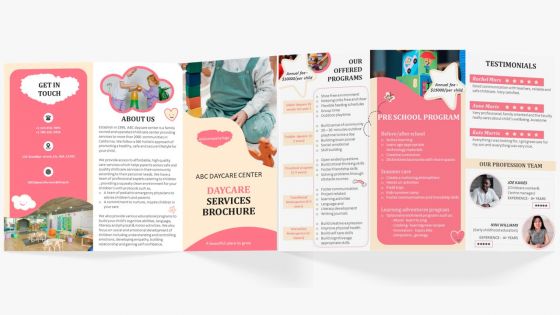
Advertise your child daycare business through our custom daycare service trifold brochure template. Use daycare service pamphlet presentation template to give a brief information about company information, contact, business hours, socials etc. With the assistance of the daycare service PowerPoint theme, you can talk about various programs offered by our business such as infant, toddler care, preschool program, transitional and interactive kindergarten. Leverage this daycare service brochure PowerPoint template to mention various additional services offered such as pre school programs, client testimonial and details about professional team to attract customers.
People who downloaded this PowerPoint presentation also viewed the following :
Service Brochure Daycare Trifold with all 1 slides:
Use our Service Brochure Daycare Trifold to effectively help you save your valuable time. They are readymade to fit into any presentation structure.
FAQs for Service
Essential elements include safety protocols, staff qualifications, curriculum quality, facility cleanliness, child-to-caregiver ratios, and communication practices. These factors work together to create nurturing environments that support developmental milestones, social skills, and learning readiness, with many parents finding that well-structured programs ultimately deliver peace of mind and enhanced early childhood development.
Staff-to-child ratios significantly impact daycare quality by enabling personalized attention, ensuring adequate supervision, and facilitating meaningful developmental interactions between caregivers and children. Lower ratios allow educators to respond quickly to individual needs, provide focused learning support, and maintain safer environments, with many facilities finding that optimal ratios ultimately deliver enhanced child outcomes and greater parent satisfaction.
Key indicators include secure entry systems, clean and child-proofed facilities, low caregiver-to-child ratios, background-checked staff, and clear emergency protocols. These safety measures work alongside nurturing practices like individualized attention, structured learning activities, and open communication with parents, with many families finding that quality daycares ultimately deliver peace of mind and enhanced child development outcomes.
Parents can effectively evaluate daycare curricula by examining age-appropriate learning objectives, hands-on activities, structured play components, and developmental milestone tracking systems. Through classroom observations and curriculum discussions with staff, many parents find that quality programs balance educational structure with creative exploration, ultimately delivering early learning foundations and school readiness skills.
Communication serves as the foundation for trust, transparency, and child development success between daycare providers and parents through daily reports, progress updates, behavioral observations, and developmental milestone tracking. This ongoing dialogue enables parents to reinforce learning at home while helping providers understand each child's individual needs, ultimately creating a seamless care environment that supports optimal growth and gives parents confidence in their childcare choice.
Parents should be aware of licensing requirements, staff-to-child ratios, background check policies, emergency procedures, vaccination requirements, and facility safety standards including childproofing and sanitation protocols. These regulations ensure comprehensive protection through trained supervision, health monitoring, and secure environments, with many daycare centers finding that transparent compliance builds trust while delivering peace of mind and safer developmental experiences for families.
Daycare facilities accommodate children with special needs through individualized education plans, specialized staff training, adaptive equipment, sensory-friendly environments, and structured behavioral support programs. These comprehensive approaches enable inclusive learning environments where children with diverse abilities receive personalized attention, therapeutic interventions, and developmental support, ultimately fostering growth while ensuring all children benefit from integrated social experiences.
Play-based learning in daycare programs enhances cognitive development, social skills, creativity, emotional regulation, and problem-solving abilities through structured activities and guided exploration. These approaches enable children to develop critical thinking and communication skills while building confidence, with many early childhood centers finding that play-based curricula ultimately prepare children more effectively for academic success and social interaction.
Daycare diversity enhances children's social development by exposing them to different cultures, languages, communication styles, and family backgrounds, fostering empathy and cultural awareness from an early age. Through multicultural interactions, children develop stronger problem-solving skills, adaptability, and inclusive mindsets, while building friendships across diverse communities, ultimately preparing them for increasingly global educational and professional environments.
A comprehensive daycare enrollment process should include clear fee structures, detailed daily schedules, staff qualifications and background checks, health and safety protocols, and transparent communication policies. These elements enable parents to make informed decisions while streamlining administrative workflows, with many childcare facilities finding that comprehensive transparency ultimately reduces parent concerns and enhances trust-building.
Different daycare philosophies cater to varied learning styles through distinct approaches, with Montessori emphasizing self-directed exploration and hands-on materials, Waldorf focusing on imaginative play and artistic expression, and HighScope promoting active learning through plan-do-review sequences. These methodologies enable children to develop through their natural preferences, whether kinesthetic, visual, or auditory learning, ultimately delivering personalized educational experiences that enhance cognitive development and social skills.
**INPUT**: What are the financial implications of choosing different types of daycare? **OUTPUT**: Different daycare types present varying financial implications, from expensive private centers and nanny services to more affordable family daycare and cooperative programs. While private facilities often require higher upfront costs, they frequently deliver enhanced educational resources, extended hours, and specialized programs, with many families finding that strategic daycare investment ultimately supports career advancement and long-term earning potential. [Word count: 58 words]
Technology integration in daycare programs includes interactive learning apps, digital storytelling tools, educational tablets, smart boards, and age-appropriate coding activities. These technologies enhance early childhood development by promoting cognitive skills, improving fine motor coordination, and fostering creative expression, with many daycare centers finding that strategic technology use, when balanced with hands-on play, delivers more engaging learning experiences.
Daycare providers can foster emotional resilience through establishing consistent routines, teaching emotion identification and coping skills, creating safe spaces for expression, implementing positive reinforcement strategies, and encouraging peer collaboration. These approaches work by building emotional vocabulary, providing predictability and security, and developing self-regulation abilities, with many childcare centers finding that structured emotional learning ultimately enhances children's social development and prepares them for future educational success.
Parents can encourage positive daycare behavior by establishing consistent routines, celebrating daycare achievements at home, maintaining regular communication with teachers, and implementing similar behavioral expectations across both environments. Through coordinated reinforcement strategies, families create seamless behavioral frameworks that enhance children's social development, academic readiness, and emotional stability, ultimately delivering stronger educational outcomes and smoother transitions.
-
The presentations are very helpful. I am always able to get appropriate templates for the different topics related to my profession.
-
Wide collection of templates available. SlideTeam has made it easier to create presentations in just a few minutes.