


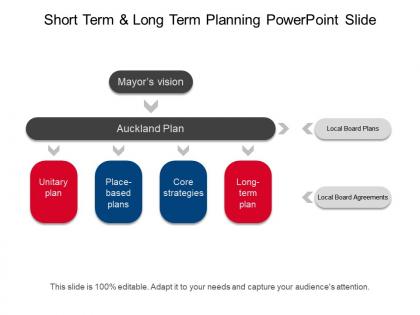
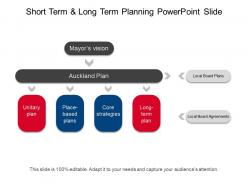
Short term and long term planning powerpoint slide




Try Before you Buy Download Free Sample Product
 Impress Your
 Audience
 100%
100% Editable
 Save Hours
 of Time


Get in harmony with our Short Term And Long Term Planning Powerpoint Slide. You will come up with coherent thoughts.
People who downloaded this PowerPoint presentation also viewed the following :
Short term and long term planning powerpoint slide with all 5 slides:
Create a conduit for ideas to flow with our Short Term And Long Term Planning Powerpoint Slide. It will help end the jam.


FAQs for Short term and long term
Key components include environmental analysis, vision and mission development, goal setting, strategy formulation, resource allocation, implementation planning, and performance monitoring systems. These elements work together by establishing clear direction, aligning organizational priorities, and creating accountability frameworks, with many organizations finding that systematic integration of these components delivers sustainable competitive advantage and measurable business outcomes.
Organizations align planning strategies with business goals by establishing clear objectives, conducting regular strategic reviews, implementing cascading goal frameworks, and ensuring cross-departmental communication. Through integrated planning processes, companies streamline resource allocation, enhance operational efficiency, and maintain strategic focus, with many finding that this alignment ultimately delivers improved performance, faster decision-making, and sustainable competitive advantage.
Market research provides essential insights into customer needs, competitive landscapes, industry trends, and emerging opportunities that inform strategic decision-making. Through comprehensive data analysis, organizations can identify market gaps, validate assumptions, and minimize risks, while developing targeted approaches that resonate with their audiences, ultimately delivering more effective resource allocation and sustainable competitive advantage in an increasingly dynamic business environment.
Businesses incorporate flexibility into planning strategies through scenario planning, modular goal structures, regular review cycles, cross-functional teams, and adaptive resource allocation. These approaches enable organizations to pivot quickly during market shifts, economic changes, or unexpected disruptions, with many companies finding that flexible frameworks ultimately deliver competitive advantages and sustained growth in increasingly dynamic business environments.
Teams can prioritize strategic initiatives using techniques like impact-effort matrices, weighted scoring models, value stream mapping, stakeholder analysis, and resource capacity assessments. These approaches enable organizations to systematically evaluate initiatives against business objectives, available resources, and potential returns, with many finding that combining multiple prioritization methods delivers clearer decision-making and stronger strategic alignment.
Successful companies measure planning effectiveness through key performance indicators, milestone tracking, budget variance analysis, timeline adherence, and stakeholder feedback assessment. These metrics enable organizations to evaluate strategic alignment, resource allocation efficiency, and goal achievement rates, with many finding that regular performance reviews and data-driven adjustments ultimately deliver improved operational outcomes and sustained competitive advantage.
Common pitfalls include overcomplicating objectives, neglecting stakeholder input, underestimating resource requirements, failing to build flexibility for market changes, and setting unrealistic timelines. These challenges often derail strategic initiatives, with many organizations finding that streamlined planning processes, regular stakeholder engagement, and adaptive frameworks ultimately deliver more sustainable outcomes and competitive advantage.
Technology enhances strategic planning through advanced analytics, real-time data integration, scenario modeling tools, collaborative platforms, and automated reporting systems. These solutions streamline decision-making by providing deeper market insights, enabling cross-functional team coordination, and delivering predictive forecasting capabilities, with many organizations finding that digital planning tools ultimately accelerate strategy development while improving accuracy and organizational alignment.
Stakeholder engagement improves planning strategies by incorporating diverse perspectives, identifying potential risks early, building consensus around objectives, and ensuring comprehensive resource assessment. Through collaborative workshops and feedback sessions, organizations streamline implementation timelines, enhance buy-in across departments, and minimize resistance to change, with many companies finding that engaged stakeholders ultimately deliver more robust, sustainable strategic outcomes.
Cultural factors significantly influence global planning strategies through varying communication styles, decision-making processes, risk tolerance levels, time orientations, and hierarchical structures across different regions. Organizations like multinational banks and retail chains adapt their strategic approaches by incorporating local customs, regulatory requirements, and stakeholder expectations, while maintaining core objectives, ultimately delivering more effective market penetration and sustainable competitive advantage.
Risk identification and analysis methods include SWOT analysis, stakeholder assessment, scenario planning, historical data review, and expert consultation sessions. These approaches enhance planning effectiveness by uncovering potential obstacles, evaluating probability and impact factors, and developing mitigation strategies, with many organizations finding that systematic risk analysis ultimately delivers more resilient project outcomes and competitive advantage.
Organizations can ensure their planning strategies encourage innovation by incorporating flexible frameworks, dedicated innovation budgets, cross-functional collaboration initiatives, regular brainstorming sessions, and risk-taking incentives. These approaches streamline creative processes by fostering experimentation, reducing bureaucratic barriers, and rewarding breakthrough thinking, with many companies finding that structured innovation planning ultimately delivers competitive advantages and accelerated growth.
Organizations should revisit planning strategies quarterly for tactical adjustments and annually for comprehensive strategic reviews, with additional revisions triggered by significant market shifts or organizational changes. This balanced approach enables companies to maintain strategic direction while adapting to evolving conditions, with many finding that regular assessment cycles enhance responsiveness and competitive positioning in increasingly dynamic business environments.
SMART objectives provide strategic planning with specific, measurable, achievable, relevant, and time-bound targets that enhance organizational focus and accountability. These structured goals enable teams to track progress systematically, allocate resources effectively, and maintain alignment across departments, with many organizations finding that SMART frameworks ultimately deliver improved performance metrics and faster strategic execution.
Visual aids like presentation templates enhance planning strategy communication by standardizing information hierarchy, improving data comprehension through charts and infographics, and ensuring consistent messaging across teams. These tools streamline complex strategic concepts into digestible formats, with many organizations finding that visual presentations increase stakeholder engagement and decision-making speed, ultimately delivering clearer alignment and faster strategy implementation.
-
Excellent products for quick understanding.
-
Excellent work done on template design and graphics.