


SIEM Cyber Security Kill Chain Flow Chart




Try Before you Buy Download Free Sample Product
 Impress Your
 Audience
 100%
100% Editable
 Save Hours
 of Time


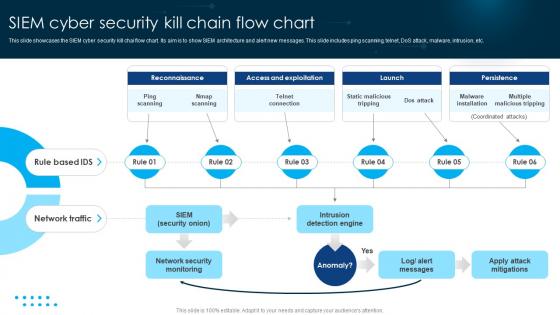
This slide showcases the SIEM cyber security kill chai flow chart. Its aim is to show SIEM architecture and alert new messages. This slide includes ping scanning, telnet, DoS attack, malware, intrusion, etc.
People who downloaded this PowerPoint presentation also viewed the following :
SIEM Cyber Security Kill Chain Flow Chart with all 9 slides:
Use our SIEM Cyber Security Kill Chain Flow Chart to effectively help you save your valuable time. They are readymade to fit into any presentation structure.








FAQs for SIEM Cyber Security Kill
SIEM is a comprehensive security platform that collects, analyzes, and correlates security data from across an organization's IT infrastructure in real-time. Within the cyber security kill chain, SIEM systems enhance threat detection by identifying suspicious patterns, streamlining incident response through automated alerts, and enabling security teams to disrupt attacks at multiple stages, ultimately delivering faster threat containment and improved organizational security posture.
The cyber security kill chain model helps organizations understand attack methodologies by breaking down intrusions into distinct phases like reconnaissance, weaponization, delivery, exploitation, installation, command and control, and actions on objectives. This structured approach enables security teams to identify attack patterns, implement targeted defenses at each stage, and develop proactive incident response strategies, with many financial institutions and healthcare organizations finding that understanding these phases significantly enhances their threat detection capabilities and reduces breach impact.
The cyber security kill chain includes reconnaissance, weaponization, delivery, exploitation, installation, command and control, and actions on objectives phases. SIEM systems enhance detection across these phases by correlating network traffic patterns, monitoring file executions, and analyzing user behaviors, enabling security teams to identify threats earlier in the attack sequence and respond more effectively before critical data compromise occurs.
SIEM tools enhance visibility across cyber security kill chain stages by aggregating logs from multiple sources, correlating events in real-time, and providing centralized monitoring dashboards. Through advanced analytics and threat intelligence integration, organizations can detect reconnaissance attempts, identify lateral movement patterns, and accelerate incident response times, ultimately delivering comprehensive threat visibility and enabling security teams to disrupt attacks before critical data compromise occurs.
Organizations should collect network traffic logs, endpoint activity data, email security logs, DNS queries, authentication records, and threat intelligence feeds in their SIEM systems. These comprehensive data sources enable security teams to detect reconnaissance attempts, identify malicious payloads, monitor lateral movement, and track data exfiltration across all kill chain phases, ultimately delivering faster incident response and enhanced threat visibility.
Threat intelligence integration into SIEM systems enhances kill chain defenses by providing real-time threat feeds, automated indicator matching, and contextual attack pattern recognition across network activities. Through advanced correlation engines, organizations streamline threat detection, accelerate incident response times, and proactively identify emerging attack vectors, with many financial institutions and healthcare providers finding that this strategic combination significantly reduces dwell time and strengthens overall security posture.
SIEM systems deliver real-time threat detection across reconnaissance, weaponization, delivery, exploitation, installation, command and control, and actions phases through continuous log analysis, behavioral monitoring, and automated alerting. These capabilities enable security teams to identify suspicious network traffic, detect malware signatures, and trigger immediate incident response protocols, ultimately preventing attackers from advancing through kill chain stages and minimizing potential damage.
Behavioral analytics within SIEM platforms detect kill chain anomalies by establishing baseline user and system behaviors, then identifying deviations that indicate reconnaissance, lateral movement, or data exfiltration attempts. These analytics enhance threat detection by correlating unusual login patterns, abnormal network traffic, and suspicious file access across multiple attack phases, ultimately enabling security teams to intervene before attackers complete their objectives.
Incident response serves as the critical defensive mechanism within the SIEM cyber security kill chain, enabling organizations to detect, analyze, and neutralize threats at each stage through automated alerts, forensic analysis, and coordinated containment strategies. This integrated approach streamlines threat mitigation by reducing response times, minimizing damage scope, and enhancing recovery protocols, with many enterprises finding that strategic SIEM-incident response integration ultimately delivers stronger security postures and operational resilience.
Historical incident data analyzed through SIEM enhances security posture by identifying attack patterns, revealing vulnerable entry points, and exposing gaps in detection capabilities across each kill chain stage. Organizations leverage these insights to strengthen preventive controls, refine monitoring rules, and accelerate incident response times, with many financial institutions and healthcare systems finding that data-driven security improvements significantly reduce breach likelihood and impact.
Organizations face challenges including complex integration with existing infrastructure, overwhelming alert volumes creating analyst fatigue, skill shortages for specialized SIEM management, and high implementation costs. While these systems enhance threat detection across kill chain stages, many enterprises find that inadequate tuning and limited contextual analysis can reduce effectiveness, ultimately requiring strategic planning and skilled personnel to deliver meaningful security improvements.
Automation and orchestration within SIEM systems streamline kill chain responses by automatically correlating threat indicators, triggering predefined response workflows, and executing containment measures without manual intervention. These capabilities enable security teams to block malicious IP addresses, isolate compromised endpoints, and update firewall rules within minutes rather than hours, ultimately delivering faster threat neutralization and significantly reducing the window of opportunity for attackers to advance through kill chain stages.
Key metrics include mean time to detection (MTTD), mean time to response (MTTR), false positive rates, attack progression blocking, and threat hunting success rates across kill chain stages. These measurements enable organizations to assess how effectively their SIEM identifies reconnaissance attempts, prevents lateral movement, and stops data exfiltration, ultimately delivering faster incident response and enhanced security posture.
Compliance requirements significantly influence SIEM implementation by mandating comprehensive logging, real-time monitoring, incident documentation, and threat detection capabilities across all kill chain stages. These regulations drive organizations in healthcare, finance, and government sectors to deploy advanced SIEM solutions that automatically correlate security events, generate audit trails, and ensure regulatory adherence, ultimately delivering enhanced threat visibility and streamlined compliance reporting.
Emerging SIEM trends include AI-powered threat detection, cloud-native architectures, behavioral analytics, automated response orchestration, and integrated threat intelligence feeds. These technologies enhance kill chain defense by enabling real-time anomaly detection, streamlining cross-platform visibility, and accelerating incident response times, with many organizations finding that predictive analytics ultimately delivers proactive threat mitigation and competitive security advantages.
-
Crisp and neat slides. Makes it fun and easier to curate presentations.
-
Nice and innovative design.