


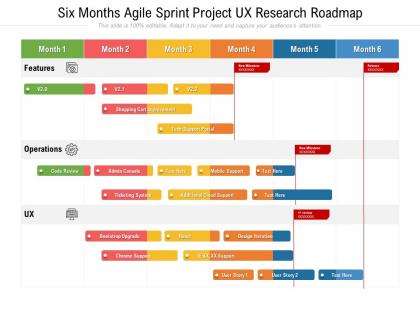
Six months agile sprint project ux research roadmap




Try Before you Buy Download Free Sample Product
 Impress Your
 Audience
 100%
100% Editable
 Save Hours
 of Time


Visualize your work plan and communicate your ideas impactfully with our pre designed Six Months Agile Sprint Project UX Research Roadmap. Showcase the detailed overview of the project, the key deliverables, and the milestones to be achieved with the help of our fully customizable PowerPoint layout. You can easily emphasize on the project goals and discuss all the activities involved in an easy to comprehend manner by utilizing our professionally designed PPT theme. This roadmap PowerPoint layout is a perfect strategic planning tool that can help in keeping the project on track. With our attractive PowerPoint theme, you can articulate the workflow, track the work progress, and have a clear vision of the goal to be achieved. Download this versatile Six Months Agile Sprint Project UX Research Roadmap and save your hours of work.
People who downloaded this PowerPoint presentation also viewed the following :
Six months agile sprint project ux research roadmap with all 2 slides:
Give your audience a fulfilling experience. They will find our Six Months Agile Sprint Project UX Research Roadmap elevating.
FAQs for Six months agile sprint project
Agile UX research principles include iterative testing cycles, cross-functional collaboration, user feedback integration, rapid prototyping, and continuous improvement processes. These methodologies streamline research workflows by enabling faster decision-making, reducing development costs, and delivering user-centered solutions, with many design teams finding that this strategic combination ultimately enhances product usability and accelerates time-to-market advantages.
UX researchers can effectively collaborate with cross-functional Agile teams by participating in daily standups, sprint planning sessions, and retrospectives, while conducting rapid research methods like guerrilla testing and lightweight surveys. Through embedded collaboration approaches, researchers streamline feedback loops, align user insights with development cycles, and deliver actionable data that enhances product decisions, ultimately enabling teams to build more user-centered solutions.
Rapid UX research tools include usability testing platforms like UserTesting, analytics tools like Hotjar, survey platforms like Typeform, remote interview software like Zoom, and prototyping tools like Figma for quick feedback loops. These techniques enable teams to gather user insights through guerrilla testing, unmoderated sessions, and micro-surveys within sprint cycles, ultimately delivering faster product iterations and enhanced user experiences.
UX research integrates into Agile workflows through sprint-aligned research sprints, continuous user feedback loops, rapid prototyping sessions, and embedded research activities within development cycles. This strategic combination enables teams to gather insights during planning phases, conduct lightweight usability testing between sprints, and iterate based on real user data, ultimately delivering user-centered products while maintaining development velocity and ensuring competitive advantage.
User feedback serves distinct functions throughout the Agile UX research roadmap, including initial discovery insights, sprint validation, usability testing, and post-release optimization. This continuous feedback loop enables teams to validate assumptions early, refine features iteratively, and deliver user-centered solutions, with many organizations finding that structured feedback integration reduces development costs while significantly enhancing user satisfaction and product-market fit.
Prioritizing UX research in Agile requires focusing on high-impact, rapid methods like usability testing snippets, stakeholder interviews, and data analytics reviews that align with sprint goals. These streamlined approaches enable teams to gather critical user insights through quick guerrilla testing, competitive analysis, and user feedback integration, ultimately delivering better user experiences while maintaining development velocity and sprint commitments.
Best practices for synthesizing and sharing UX research findings with Agile teams include creating concise research summaries, developing visual insight dashboards, conducting brief stakeholder presentations, establishing regular research readouts, and maintaining shared documentation repositories. These approaches streamline communication by delivering actionable insights quickly, integrating seamlessly into sprint planning cycles, and ensuring development teams can immediately apply user feedback, ultimately enhancing product decisions and accelerating user-centered development processes.
Remote research methods integrate seamlessly into Agile UX through unmoderated usability testing, virtual interviews, digital surveys, and collaborative online workshops that maintain sprint velocity. These approaches enable continuous user feedback collection across geographically distributed teams, while tools like screen sharing and digital whiteboards facilitate real-time insights synthesis, ultimately delivering faster iteration cycles and more inclusive research participation.
Success metrics for Agile UX research initiatives include user satisfaction scores, task completion rates, time-to-insight, research velocity, and stakeholder engagement levels. These metrics enable organizations to track research effectiveness by measuring user experience improvements, reducing development cycles, and enhancing product-market fit, with many teams finding that consistent measurement ultimately delivers faster iterations and stronger competitive advantage.
Continuous learning in Agile UX research happens through regular retrospectives, iterative hypothesis testing, cross-functional feedback loops, and systematic documentation of insights across sprint cycles. Teams enhance their research process by conducting post-sprint reviews, maintaining shared research repositories, and adapting methodologies based on user feedback patterns, ultimately delivering more user-centered products and streamlined development workflows.
UX researchers face challenges balancing speed with depth, managing stakeholder expectations for rapid insights, and maintaining research quality under compressed timelines. While agile environments demand quick iterations, researchers must strategically prioritize methods, streamline processes through lean techniques, and communicate research value effectively, ultimately delivering actionable insights that support both product velocity and user-centered design decisions.
Storytelling enhances UX research presentations by transforming data into compelling narratives that connect user pain points to business outcomes, making findings more memorable and actionable for Agile stakeholders. Through structured narratives with clear user journeys, research teams help product managers, developers, and executives quickly grasp insights during sprint reviews, ultimately accelerating decision-making and fostering greater stakeholder buy-in.
Common pitfalls include skipping user validation due to sprint pressure, conducting research without clear objectives, failing to integrate findings into development cycles, and neglecting stakeholder alignment on research priorities. These challenges often arise when teams treat research as optional rather than essential, with many organizations finding that dedicating specific sprint capacity for research activities and establishing clear research-to-design handoffs ultimately delivers faster iteration cycles and stronger user experiences.
UX researchers can advocate for user-centered design within Agile frameworks by embedding research activities into sprint planning, conducting rapid usability testing during development cycles, and creating lightweight research artifacts that align with Agile timelines. Through collaborative workshops and regular stakeholder presentations, researchers demonstrate how user insights enhance product decisions, reduce development risks, and ultimately deliver better customer experiences while maintaining development velocity.
Iterative prototyping accelerates UX research by enabling rapid hypothesis testing, continuous user feedback collection, and real-time design validation throughout development cycles. In Agile environments, teams streamline research timelines, reduce costly late-stage revisions, and enhance user-centered decision making, with many organizations finding that this approach delivers faster product iterations and significantly improved user experiences.
No Reviews