


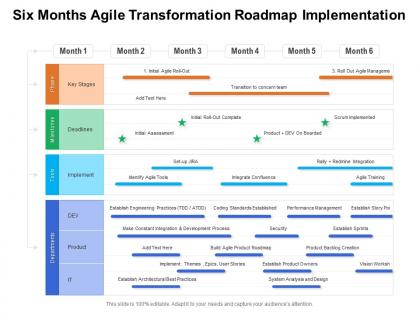
Six months agile transformation roadmap implementation




Try Before you Buy Download Free Sample Product
 Impress Your
 Audience
 100%
100% Editable
 Save Hours
 of Time


Visualize your work plan and communicate your ideas impactfully with our pre designed Six Months Agile Transformation Roadmap Implementation. Showcase the detailed overview of the project, the key deliverables, and the milestones to be achieved with the help of our fully customizable PowerPoint layout. You can easily emphasize on the project goals and discuss all the activities involved in an easy to comprehend manner by utilizing our professionally designed PPT theme. This roadmap PowerPoint layout is a perfect strategic planning tool that can help in keeping the project on track. With our attractive PowerPoint theme, you can articulate the workflow, track the work progress, and have a clear vision of the goal to be achieved. Download this versatile Six Months Agile Transformation Roadmap Implementation and save your hours of work.
People who downloaded this PowerPoint presentation also viewed the following :
Six months agile transformation roadmap implementation with all 2 slides:
Give your audience a fulfilling experience. They will find our Six Months Agile Transformation Roadmap Implementation elevating.
FAQs for Six months agile
Key elements include leadership commitment, cultural change initiatives, team training programs, process redesign frameworks, and continuous improvement mechanisms. These components work together by establishing clear vision alignment, fostering collaborative mindsets, and implementing iterative delivery practices, with many organizations finding that strategic phasing ultimately delivers faster time-to-market and enhanced operational agility.
Organizations can assess their Agile maturity through comprehensive evaluations including team collaboration metrics, delivery frequency analysis, customer feedback integration, process documentation reviews, and stakeholder engagement assessments. These evaluations enable leadership to identify transformation priorities, establish baseline measurements, and create targeted improvement strategies, with many companies finding that thorough maturity assessments accelerate successful Agile adoption and minimize implementation risks.
Leadership and management drive Agile transformation by establishing vision, removing organizational barriers, fostering collaborative culture, and modeling Agile behaviors throughout the organization. They enable successful adoption by providing necessary resources, empowering cross-functional teams, and creating psychological safety for experimentation, with many enterprises finding that committed leadership accelerates transformation timelines and delivers sustainable competitive advantages.
Common pitfalls include insufficient leadership buy-in, inadequate training, rushing implementation without cultural preparation, maintaining rigid hierarchies, and neglecting continuous feedback loops. Organizations avoid these challenges by securing executive sponsorship, investing in comprehensive team training, implementing gradual cultural shifts, and establishing clear communication channels, with many companies finding that phased approaches ultimately deliver sustainable transformation and enhanced operational agility.
Aligning Agile transformation goals with business objectives requires establishing clear success metrics, mapping Agile practices to specific business outcomes, and creating cross-functional governance structures that connect development teams with strategic priorities. Organizations achieve this alignment by implementing value stream mapping, regular business-IT alignment sessions, and outcome-based performance measurements, ultimately delivering faster time-to-market and enhanced customer satisfaction.
Strategies for encouraging team buy-in include transparent communication about transformation benefits, involving team members in planning decisions, providing comprehensive training and support, celebrating early wins, and addressing concerns through open dialogue. These approaches work by building trust, reducing resistance, and demonstrating value, with many organizations finding that empowered teams who understand the "why" behind changes become champions of the transformation process.
Organizations should measure Agile transformation success through delivery metrics like cycle time and throughput, team health indicators including engagement and collaboration scores, and business outcomes such as customer satisfaction and time-to-market improvements. These measurements work together by tracking both process efficiency and strategic value delivery, with many companies finding that combining quantitative performance data with qualitative cultural assessments ultimately delivers comprehensive transformation visibility and sustained competitive advantage.
Best practices for Agile training include comprehensive role-based education, hands-on workshops with real project simulations, continuous coaching support, and cross-functional collaboration exercises. These approaches enhance team adoption by building practical skills, fostering Agile mindsets, and establishing sustainable practices, with many organizations finding that combining formal certification programs with ongoing mentorship ultimately delivers faster project delivery and improved team collaboration.
Organizations can effectively handle resistance by fostering transparent communication, providing comprehensive training, involving skeptical team members in planning processes, and demonstrating quick wins through pilot projects. Through gradual implementation and consistent leadership support, companies in manufacturing, healthcare, and financial services streamline adoption rates, enhance employee buy-in, and ultimately deliver sustainable cultural transformation while maintaining operational efficiency.
Scrum, Kanban, SAFe, LeSS, and Spotify Model are the most effective frameworks for guiding Agile transformations, each offering distinct advantages for different organizational contexts. While Scrum excels in small teams and product development, SAFe delivers enterprise-wide coordination and Kanban streamlines workflow visualization, with many organizations finding that combining frameworks strategically enhances scalability and accelerates transformation success.
Organizations can create a continuous improvement culture by establishing regular retrospectives, empowering cross-functional teams to identify process bottlenecks, implementing feedback loops at every sprint cycle, and celebrating incremental wins. Through structured learning sessions and fail-fast methodologies, companies across industries streamline operations while enhancing team collaboration, ultimately delivering faster product iterations and improved customer satisfaction.
Tools enhancing Agile collaboration include project management platforms like Jira and Trello, communication software such as Slack and Microsoft Teams, video conferencing solutions, and real-time documentation tools like Confluence. These technologies streamline workflow visibility, facilitate daily standups and retrospectives, and enable seamless remote collaboration, with many organizations finding that integrated toolsets significantly reduce communication gaps and accelerate sprint delivery.
Stakeholder involvement is critical for Agile transformation success, as it ensures alignment, reduces resistance, and accelerates adoption across organizational levels. This engagement can be achieved through regular communication sessions, cross-functional workshops, leadership sponsorship programs, and involving stakeholders in planning sessions, with many organizations finding that early and continuous involvement ultimately delivers smoother transitions and stronger buy-in.
Feedback loops serve as critical steering mechanisms in Agile transformation roadmaps, enabling continuous course correction through regular retrospectives, stakeholder input, customer feedback, and performance metrics analysis. These mechanisms allow organizations to identify bottlenecks, celebrate wins, and pivot strategies in real-time, with many companies finding that systematic feedback integration accelerates transformation success and ensures alignment with evolving business objectives.
Organizations sustain post-transformation agility through continuous improvement practices, regular retrospectives, embedded coaching programs, and cultural reinforcement mechanisms that maintain adaptive behaviors. By establishing agile governance structures, ongoing training initiatives, and performance metrics focused on collaboration and responsiveness, companies like Spotify and ING prevent regression while building resilient, self-improving teams that deliver sustained competitive advantage.
No Reviews