


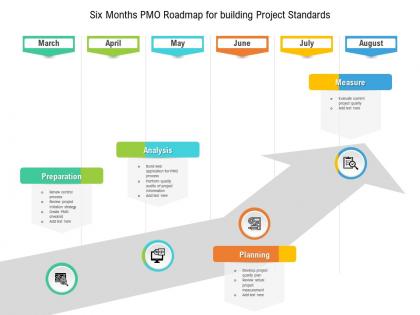
Six months pmo roadmap for building project standards




Try Before you Buy Download Free Sample Product
 Impress Your
 Audience
 100%
100% Editable
 Save Hours
 of Time


A cohesive work plan is essential for achieving the desired target. Communicate your vision and lay a firm ground in front of your audience with our PowerPoint layout. Align your project milestones, budgets, deliverables, deadlines, and all the requisite information for a dynamic presentation by employing this amazingly designed Six Months PMO Roadmap For Building Project Standards. Maximize team efficiency and streamline a work plan efficiently by introducing our ready made roadmap PowerPoint theme. You can quickly establish coordination between different activities across the organization and present an insight to your colleagues by utilizing this useful business tool. Color code specific tasks, prioritize, and keep a close eye on the deadlines with the help of our eye catchy PowerPoint template. Download our Six Months PMO Roadmap For Building Project Standards for excelling at productive management.
People who downloaded this PowerPoint presentation also viewed the following :
Six months pmo roadmap for building project standards with all 2 slides:
Use our Six Months PMO Roadmap For Building Project Standards to effectively help you save your valuable time. They are readymade to fit into any presentation structure.
FAQs for Six months pmo roadmap for
Key components of an effective PMO roadmap include governance frameworks, standardized processes, resource allocation models, performance metrics, and stakeholder communication protocols. These elements work together by establishing clear project oversight, streamlining delivery mechanisms, and enabling consistent reporting across initiatives, with many organizations finding that structured roadmaps ultimately deliver improved project success rates and enhanced strategic alignment.
Aligning the PMO roadmap with organizational strategy requires mapping project portfolios to strategic objectives, establishing clear governance frameworks, and implementing performance metrics that track strategic contribution. Through regular stakeholder reviews and quarterly alignment assessments, organizations streamline resource allocation, enhance project prioritization, and ensure portfolio decisions directly support business goals, ultimately delivering measurable strategic value and competitive advantage.
PMO roadmap success metrics include project delivery rates, budget variance, resource utilization, stakeholder satisfaction scores, and strategic alignment percentages. These measurements enable organizations to track operational efficiency, financial performance, and business value delivery, with many enterprises finding that combining leading indicators like risk assessments with lagging indicators ultimately delivers enhanced project outcomes and competitive advantage.
PMO roadmaps should be reviewed quarterly and updated based on organizational changes, strategic shifts, and project portfolio evolution. Many enterprises find that regular quarterly assessments enable them to adapt to market conditions, resource availability, and business priorities, while annual comprehensive reviews ensure long-term strategic alignment and competitive positioning.
Common PMO roadmap challenges include stakeholder alignment, resource constraints, unclear governance structures, resistance to standardized processes, and balancing strategic objectives with operational demands. These obstacles often stem from competing departmental priorities, insufficient executive sponsorship, and lack of change management support, with many organizations finding that early stakeholder engagement and phased implementation approaches help overcome initial resistance while delivering measurable improvements.
Stakeholder engagement in PMO roadmaps involves regular communication touchpoints, feedback collection mechanisms, collaborative planning sessions, and transparent progress reporting throughout implementation phases. Through structured workshops and periodic reviews, organizations can align stakeholder expectations with PMO objectives, minimize resistance to change, and ensure buy-in from leadership, ultimately delivering smoother transformations and enhanced project success rates.
Technology serves as the backbone of modern PMO roadmaps, enabling automation of routine tasks, real-time project tracking, advanced analytics for decision-making, and seamless collaboration across distributed teams. Through AI-powered project management platforms and data visualization tools, organizations streamline resource allocation, enhance stakeholder communication, and accelerate project delivery timelines, ultimately delivering competitive advantage in increasingly complex business environments.
The PMO roadmap accommodates changing priorities through flexible frameworks, regular review cycles, dynamic resource allocation, and agile methodology integration. These approaches enable organizations to quickly realign project portfolios with strategic shifts, reassign resources efficiently, and maintain delivery momentum, with many PMOs finding that quarterly roadmap reviews and priority-based scoring systems deliver enhanced responsiveness and competitive advantage.
**INPUT**: What best practices should be followed when communicating the PMO roadmap to the organization? **OUTPUT**: Effective PMO roadmap communication requires tailored messaging for different stakeholder groups, regular progress updates, visual presentations using dashboards and timelines, and transparent reporting on milestones and challenges. These practices enhance organizational alignment by establishing clear expectations, facilitating cross-departmental collaboration, and building stakeholder confidence, with many organizations finding that consistent communication ultimately delivers improved project success rates and strategic buy-in.
The PMO roadmap facilitates resource allocation by providing strategic visibility into project priorities, timelines, and dependencies, enabling managers to optimize talent deployment across initiatives. Through centralized planning and forecasting, organizations can identify resource gaps, prevent bottlenecks, and balance workloads, ultimately delivering improved project outcomes and operational efficiency across portfolios.
Short-term PMO goals typically focus on establishing foundational processes, standardizing project methodologies, and delivering immediate operational improvements within 6-12 months. Long-term goals emphasize strategic portfolio optimization, advanced analytics implementation, and organizational maturity development over 2-3 years, with many organizations finding that this phased approach enables sustainable PMO evolution while demonstrating early wins.
Risk management integrates into PMO roadmaps through systematic risk identification frameworks, continuous monitoring protocols, mitigation strategy development, and stakeholder communication processes. These approaches enable organizations to proactively address project uncertainties while maintaining strategic alignment, with many enterprises finding that embedded risk management ultimately delivers improved project success rates and enhanced organizational resilience.
PMO roadmap visualization tools include Gantt charts, timeline templates, strategic dashboards, milestone mapping software, and presentation frameworks like PowerPoint or specialized project platforms. These tools streamline roadmap communication by displaying project phases, dependencies, and timelines clearly, with many organizations finding that visual roadmaps enhance stakeholder alignment, accelerate decision-making, and ultimately deliver better project outcomes.
Lessons learned inform PMO roadmap development by identifying process gaps, resource allocation patterns, stakeholder engagement strategies, and risk mitigation approaches from previous initiatives. These insights enable organizations to build more robust frameworks, streamline project methodologies, and enhance governance structures, with many companies finding that incorporating historical data significantly reduces implementation timeframes and increases stakeholder adoption rates.
Essential PMO skills include project management methodologies, strategic planning, data analysis, stakeholder communication, and change management capabilities. These competencies enable professionals to align initiatives with business objectives, track progress through meaningful metrics, and facilitate organizational adoption, with many enterprises finding that PMOs equipped with both technical and leadership skills deliver significantly higher project success rates and strategic value.
-
Great product with highly impressive and engaging designs.
-
Easy to edit slides with easy to understand instructions.
-
Helpful product design for delivering presentation.