


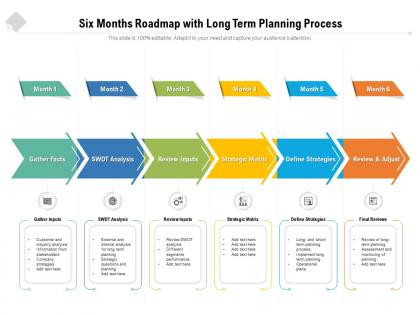
Six months roadmap with long term planning process




Try Before you Buy Download Free Sample Product
 Impress Your
 Audience
 100%
100% Editable
 Save Hours
 of Time


The success rate of business plans is hugely dependent on the plan of action, and this editable Six Months Roadmap With Long Term Planning Process rightly serves the purpose. Encapsulate all the information related to the project in a well structured manner to obtain maximum efficiency by incorporating our stunning PowerPoint theme. State the critical deliverable, steps involved, time frame, workforce allocation, and lots more in an easy to understand manner by utilizing this pre designed roadmap PowerPoint layout. You can also prioritize your tasks and discuss the problem areas with your colleagues by incorporating this tailor made PPT layout. Empower your work plan by employing this professionally designed PPT theme. Entrepreneurs can download Six Months Roadmap With Long Term Planning Process as a beneficial communication tool that facilitates in collaborating with different tasks and achieve targets.
People who downloaded this PowerPoint presentation also viewed the following :
Six months roadmap with long term planning process with all 2 slides:
Use our Six Months Roadmap With Long Term Planning Process to effectively help you save your valuable time. They are readymade to fit into any presentation structure.
FAQs for Six months roadmap with long
Key components include strategic goal alignment, stakeholder input gathering, priority assessment, resource allocation planning, and timeline development with clear milestones. These elements work together by ensuring comprehensive market analysis, cross-functional collaboration, and flexible adaptation mechanisms, with many organizations finding that structured roadmap processes deliver enhanced project visibility, improved resource efficiency, and stronger competitive positioning in increasingly dynamic business environments.
Roadmapping improves strategic alignment by creating shared visual frameworks that connect daily operations to long-term objectives, ensuring all departments understand priorities, timelines, and interdependencies. Through structured roadmaps, organizations streamline decision-making, reduce conflicting initiatives, and enhance resource allocation, with many finding that clear visual alignment ultimately delivers faster execution and stronger competitive positioning.
Effective roadmap creation tools include Roadmunk, ProductPlan, Aha!, Microsoft Visio, and Lucidchart, each offering drag-and-drop functionality, timeline visualization, and collaborative features. These platforms enhance strategic planning by enabling real-time updates, stakeholder alignment, and customizable templates, with many organizations finding that visual roadmaps streamline communication and accelerate decision-making processes.
Prioritizing roadmap tasks requires evaluating initiatives based on strategic alignment, customer impact, resource requirements, revenue potential, and implementation complexity. Organizations typically use frameworks like value versus effort matrices, customer feedback analysis, and competitive positioning assessments, with many finding that regular stakeholder input and market validation help ensure roadmaps deliver maximum business value while maintaining operational efficiency.
Stakeholder engagement ensures roadmap alignment with diverse business needs, priorities, and constraints through regular feedback, collaborative planning sessions, and transparent communication channels. This strategic involvement helps organizations identify potential roadblocks early, secure necessary resources and buy-in, and ultimately deliver more realistic timelines and outcomes that drive measurable business value.
Common roadmap pitfalls include setting unrealistic timelines, lacking stakeholder input, ignoring resource constraints, failing to prioritize features, and creating overly detailed long-term plans. These challenges can derail project success by creating misaligned expectations, resource conflicts, and inflexible planning, with many organizations finding that regular reviews and stakeholder engagement ultimately deliver more achievable outcomes.
Agile methodologies transform roadmap planning by emphasizing iterative development, continuous feedback loops, and adaptive prioritization based on changing market conditions. This approach enables organizations to pivot quickly when customer needs shift, incorporate stakeholder input throughout development cycles, and deliver value incrementally, ultimately reducing time-to-market while maintaining strategic alignment.
Key roadmap success metrics include milestone completion rates, budget adherence, stakeholder satisfaction scores, resource utilization efficiency, and strategic objective achievement percentages. These measurements enable organizations to assess progress transparency, identify bottlenecks early, and adjust priorities dynamically, with many project teams finding that regular metric tracking ultimately delivers improved decision-making and enhanced competitive positioning.
Roadmaps should be reviewed quarterly and updated based on market changes, customer feedback, strategic shifts, and resource availability. Through regular assessment cycles, organizations can adjust priorities, reallocate resources, and respond to competitive pressures, while maintaining long-term vision alignment, ultimately ensuring roadmaps remain relevant and actionable in dynamic business environments.
Product roadmaps focus on long-term strategic vision, feature development, market positioning, and customer value delivery across multiple releases. Project roadmaps concentrate on specific deliverables, timelines, resource allocation, and task completion within defined scope and duration, with many organizations finding that product roadmaps guide overall direction while project roadmaps ensure tactical execution and milestone achievement.
Cross-functional teams collaborate effectively during roadmap planning by establishing shared objectives, conducting regular alignment sessions, and implementing transparent communication channels. Through collaborative workshops and unified planning tools, teams from product, engineering, marketing, and sales streamline decision-making, minimize resource conflicts, and accelerate time-to-market, ultimately delivering cohesive strategies that enhance competitive advantage.
**INPUT**: What strategies can be employed to communicate roadmaps to various audiences? **OUTPUT**: Effective roadmap communication strategies include audience-specific presentations, visual storytelling with clear timelines, executive summaries for leadership, and detailed technical documentation for implementation teams. These approaches enhance stakeholder alignment by tailoring messaging complexity, emphasizing relevant outcomes for each group, and maintaining consistent updates across departments, with many organizations finding that strategic communication accelerates project buy-in and resource allocation. [Word count: 58 words]
Balancing long-term vision with short-term execution requires strategic milestone mapping, iterative delivery cycles, and regular priority reassessment based on market feedback and resource constraints. Through quarterly reviews and agile frameworks, organizations streamline development timelines, enhance stakeholder alignment, and maintain strategic flexibility, with many teams finding that incremental progress ultimately delivers sustainable competitive advantage.
Best practices for visualizing roadmap timelines include using Gantt charts, milestone markers, color-coded phases, progress indicators, and dependency arrows. These visualization techniques enhance clarity by distinguishing between deliverables, deadlines, and dependencies, while enabling stakeholders to quickly assess project status and resource allocation, ultimately delivering improved coordination and strategic alignment across teams.
Feedback loops enhance roadmap planning by enabling continuous refinement through stakeholder input, market data analysis, and performance metrics evaluation. These mechanisms allow organizations to adapt priorities dynamically, identify emerging opportunities or risks early, and maintain alignment between strategic objectives and execution realities, ultimately delivering more responsive planning and competitive advantage in rapidly changing markets.
-
Great designs, Easily Editable.
-
Best way of representation of the topic.
-
Great designs, Easily Editable.