


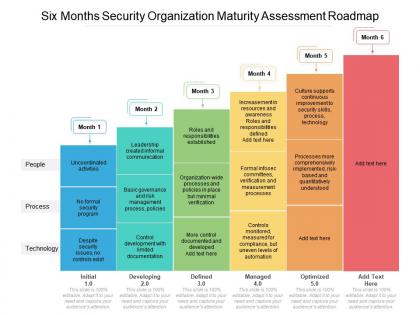
Six months security organization maturity assessment roadmap




Try Before you Buy Download Free Sample Product
 Impress Your
 Audience
 100%
100% Editable
 Save Hours
 of Time


The success rate of business plans is hugely dependent on the plan of action, and this editable Six Months Security Organization Maturity Assessment Roadmap rightly serves the purpose. Encapsulate all the information related to the project in a well structured manner to obtain maximum efficiency by incorporating our stunning PowerPoint theme. State the critical deliverable, steps involved, time frame, workforce allocation, and lots more in an easy to understand manner by utilizing this pre designed roadmap PowerPoint layout. You can also prioritize your tasks and discuss the problem areas with your colleagues by incorporating this tailor made PPT layout. Empower your work plan by employing this professionally designed PPT theme. Entrepreneurs can download Six Months Security Organization Maturity Assessment Roadmap as a beneficial communication tool that facilitates in collaborating with different tasks and achieve targets.
People who downloaded this PowerPoint presentation also viewed the following :
Six months security organization maturity assessment roadmap with all 2 slides:
Give your audience a fulfilling experience. They will find our Six Months Security Organization Maturity Assessment Roadmap elevating.

FAQs for Six months security organization
Key components include governance frameworks, risk management processes, incident response capabilities, security awareness programs, and continuous monitoring systems. These elements work together by establishing clear policies, identifying vulnerabilities, enabling rapid threat response, and fostering security-conscious cultures, with many organizations finding that integrated approaches deliver enhanced protection and operational resilience.
Organizations benchmark their security maturity through established frameworks like NIST Cybersecurity Framework, ISO 27001, and CMMI for Security, which provide structured assessment criteria across governance, technology, and processes. These frameworks enable companies to identify gaps, prioritize investments, and measure progress against industry peers, ultimately delivering enhanced risk management and competitive positioning in increasingly regulated business environments.
Risk assessments serve as foundational components in security maturity evaluation by identifying vulnerabilities, measuring threat exposure, analyzing control effectiveness, and benchmarking current security posture against industry standards. These assessments enable organizations to prioritize security investments, track improvement progress, and demonstrate compliance readiness, with many financial institutions and healthcare organizations finding that regular risk evaluations accelerate their security maturity advancement.
Businesses can measure security training impact through incident reduction metrics, phishing simulation success rates, compliance audit scores, employee security awareness assessments, and behavioral change indicators. Many organizations track quarterly improvements in threat detection response times, policy adherence levels, and security culture surveys, ultimately finding that comprehensive measurement frameworks deliver measurable risk reduction and enhanced organizational resilience.
Organizations should avoid conducting superficial assessments that only check compliance boxes, relying solely on technical metrics while ignoring human factors, and comparing themselves against unrealistic benchmarks. Many companies also fail to engage stakeholders across departments, focus too heavily on current threats rather than emerging risks, and neglect to establish clear improvement timelines, ultimately missing opportunities to build comprehensive security resilience.
Security maturity assessment results inform strategic investments by identifying capability gaps, prioritizing resource allocation, and establishing measurable improvement roadmaps across people, processes, and technology domains. These assessments enable organizations to focus budgets on high-impact areas like infrastructure upgrades, staff training, and compliance frameworks, ultimately delivering enhanced risk posture and operational resilience while maximizing security ROI.
A continuous improvement approach in security maturity delivers enhanced threat detection, reduced vulnerabilities, optimized resource allocation, and stronger compliance posture. This iterative methodology enables organizations to adapt rapidly to evolving cyber threats, with many financial institutions and healthcare providers finding that regular assessments ultimately strengthen their defensive capabilities while minimizing operational disruptions.
Organizations can prioritize security gaps by evaluating risk severity, business impact, regulatory requirements, implementation complexity, and available resources during maturity assessments. Through risk-based frameworks, companies systematically address critical vulnerabilities first, enhance compliance postures, and allocate budgets strategically, with many finding that phased approaches deliver measurable security improvements while maintaining operational continuity.
Effective security maturity assessment frameworks include NIST Cybersecurity Framework, ISO 27001, COBIT, CIS Controls, and CMMI for cybersecurity, each offering structured evaluation methodologies. These frameworks enable organizations to benchmark current security posture, identify capability gaps, and prioritize strategic investments, with many financial services and healthcare institutions finding that structured assessments ultimately streamline compliance efforts and enhance operational resilience.
Security maturity directly influences regulatory compliance by establishing structured frameworks, consistent monitoring processes, and comprehensive documentation practices that align with industry standards. Organizations with higher security maturity levels demonstrate better adherence to regulations like GDPR, HIPAA, and SOX, with financial services and healthcare sectors finding that mature security programs streamline audit processes while reducing compliance costs and regulatory risks.
Organizations should track metrics including incident response times, vulnerability remediation rates, security awareness training completion, compliance audit scores, and threat detection accuracy. These measurements enable businesses to identify gaps, optimize resource allocation, and demonstrate ROI on security investments, with many enterprises finding that consistent tracking across these areas ultimately delivers enhanced risk management and operational resilience.
Cross-departmental collaboration enhances security maturity assessments by bringing diverse perspectives, identifying blind spots across operational silos, and ensuring comprehensive risk evaluation from multiple business functions. When IT, finance, operations, and compliance teams collaborate, organizations achieve more accurate threat modeling, streamlined security protocols, and holistic vulnerability management, ultimately delivering stronger enterprise-wide security posture and strategic alignment.
Executive leadership involvement in security maturity assessments ensures strategic alignment, adequate resource allocation, and organizational commitment to implementing recommended improvements. When executives champion these assessments, organizations experience faster remediation timelines, enhanced cross-departmental cooperation, and stronger security cultures, with many enterprises finding that leadership engagement directly correlates with successful security transformation initiatives.
Security maturity significantly enhances incident response capabilities by establishing structured processes, automated detection systems, and trained response teams that can quickly identify, contain, and remediate threats. Organizations with higher security maturity demonstrate faster response times, better coordination between departments, and more effective recovery procedures, ultimately minimizing business disruption and reducing financial impact from security incidents.
Security maturity assessment findings should be communicated through tailored reporting formats, executive dashboards with risk prioritization, actionable roadmaps with timelines, and stakeholder-specific presentations addressing relevant concerns. These approaches enhance organizational buy-in by translating technical vulnerabilities into business impact scenarios, budget justifications, and competitive positioning insights, with many organizations finding that clear communication accelerates security investment decisions and strategic alignment.
No Reviews