


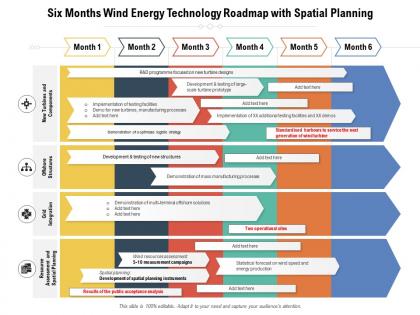
Six months wind energy technology roadmap with spatial planning




Try Before you Buy Download Free Sample Product
 Impress Your
 Audience
 100%
100% Editable
 Save Hours
 of Time


A well thought out action plan makes execution easier and increases the possibility of success significantly. Ensure hitting all the milestones within the deadlines by introducing our fully customizable Six Months Wind Energy Technology Roadmap With Spatial Planning. Streamline the work related information, budget, timeframe, key deliverable, landmarks, and major steps involved, all in one place to give an organized overview of the project by utilizing our PowerPoint theme. Minimize time lag and increase work efficiency by providing insight into the process with our comprehensively researched roadmap PowerPoint layout. Color coding helps in highlighting the process and grabs the attention of the audience. Download our handy Six Months Wind Energy Technology Roadmap With Spatial Planning to identify the possible problem areas in a much shorter time and propose solutions. Have a productive brainstorming session with your workforce by utilizing our action plan visualization tool.
People who downloaded this PowerPoint presentation also viewed the following :
Six months wind energy technology roadmap with spatial planning with all 2 slides:
Use our Six Months Wind Energy Technology Roadmap With Spatial Planning to effectively help you save your valuable time. They are readymade to fit into any presentation structure.
FAQs for Six months wind energy technology roadmap
Key components include wind resource assessment, site identification and feasibility studies, technology selection, grid integration planning, and environmental impact evaluations. These elements work together by ensuring optimal turbine placement, maximizing energy output, and streamlining regulatory compliance, with many energy companies finding that comprehensive roadmaps accelerate project timelines while minimizing costs and operational risks.
Local governments can align with national wind energy goals by streamlining permitting processes, updating zoning regulations to accommodate wind installations, offering tax incentives, and investing in grid infrastructure improvements. Through strategic policy coordination, municipalities enable faster project approvals, reduce development costs, and attract renewable energy investments, with many cities finding that proactive wind-friendly policies deliver economic growth, job creation, and enhanced energy independence while supporting broader climate objectives.
Grid integration of wind energy can be enhanced through advanced forecasting systems, smart grid technologies, energy storage solutions, flexible transmission infrastructure, and demand response programs. These strategic measures streamline grid stability by balancing supply fluctuations, optimizing energy distribution, and enabling real-time adjustments, with many utilities finding that comprehensive integration approaches ultimately deliver enhanced operational efficiency and sustainable energy transitions.
Common barriers to wind energy adoption include high upfront capital costs, grid integration challenges, regulatory complexities, public acceptance issues, and intermittency concerns. These obstacles can be addressed through government incentives and financing solutions, smart grid technologies and energy storage systems, streamlined permitting processes, and community engagement programs, with many utilities and developers finding that strategic partnerships and technological advances ultimately deliver cost-effective renewable energy solutions and enhanced grid reliability.
Technological innovation drives wind energy development through advanced turbine designs, smart grid integration, offshore floating platforms, and AI-powered predictive maintenance systems. These innovations enhance energy capture efficiency, reduce operational costs, and enable wind farms in previously inaccessible locations, with many energy companies finding that modern technologies deliver 40-60% higher output while significantly lowering maintenance expenses.
Community engagement serves as a critical foundation for wind energy project success, encompassing stakeholder consultation, transparent communication, local benefit-sharing agreements, and addressing environmental concerns early in development phases. Through collaborative planning processes, developers build essential trust with residents, secure faster permitting approvals, and minimize costly delays, while communities increasingly recognize wind projects as opportunities for job creation and sustainable economic development.
Wind energy installations create environmental impacts including noise pollution, bird and bat mortality, visual landscape changes, electromagnetic interference, and soil disruption during construction. While these installations present challenges, they ultimately deliver significant carbon emission reductions and air quality improvements compared to fossil fuels, with many utilities finding that proper site planning minimizes wildlife impacts while maximizing clean energy benefits.
Wind energy contributes to net-zero emissions targets by replacing fossil fuel-based electricity generation, reducing carbon footprints across industrial operations, and enabling electrification of transportation and heating systems. Through scalable wind installations, countries like Denmark and Germany achieve significant decarbonization while creating green jobs and energy independence, ultimately delivering cost-effective pathways to climate goals.
**INPUT**: What financing models are most effective for funding wind energy projects? **OUTPUT**: Effective financing models for wind energy projects include project finance, green bonds, power purchase agreements, tax equity structures, and public-private partnerships. These approaches streamline capital deployment by reducing investor risk, leveraging government incentives, and securing long-term revenue streams, with many developers finding that strategic combinations ultimately deliver lower costs and accelerated project timelines. **Word count: 54 words**
Geographical regions significantly influence wind energy potential through wind speed patterns, topography, climate conditions, and seasonal variations. Coastal areas and mountainous regions typically offer stronger, more consistent winds, with offshore locations like those in Northern Europe and the Great Plains in North America delivering optimal generation capacity, ultimately enabling higher energy yields and more reliable power production for regional grids.
Best practices for wind energy site selection include comprehensive wind resource assessment, environmental impact evaluation, grid connectivity analysis, land use compatibility studies, and community engagement protocols. These methodologies streamline project development by minimizing regulatory delays, optimizing energy output potential, and ensuring long-term operational viability, with many developers finding that thorough upfront site analysis ultimately delivers faster permitting and enhanced project returns.
Wind energy delivers competitive efficiency rates of 35-45% and costs $0.02-0.05 per kWh, comparing favorably to solar's 15-22% efficiency and hydroelectric's higher installation expenses. While wind requires consistent weather conditions, many utilities find that strategic combinations of wind with solar and storage systems ultimately streamline energy portfolios, reduce operational costs, and enhance grid stability across diverse geographic markets.
Latest advancements in turbine technology include larger rotor diameters, advanced blade materials, intelligent pitch control systems, direct-drive generators, and AI-powered predictive maintenance. These innovations enhance wind energy production by capturing more wind at lower speeds, reducing mechanical stress, and optimizing performance in real-time, with many utilities finding significantly improved capacity factors and reduced operational costs.
Education and awareness programs promote wind energy initiatives by showcasing environmental benefits, economic opportunities, and technological advancements through community workshops, school curricula, and public demonstrations. These programs enhance public understanding by addressing common misconceptions, highlighting job creation potential, and demonstrating cost savings, with many communities finding that informed residents become strong advocates for local wind projects.
International cooperation accelerates global wind energy advancement through shared technology development, standardized regulations, joint research initiatives, and coordinated financing mechanisms. Through multilateral partnerships, countries streamline cross-border renewable energy projects, harmonize grid integration standards, and facilitate knowledge transfer, with many nations finding that collaborative approaches ultimately deliver faster deployment timelines and reduced implementation costs.
No Reviews