

Sliding scale insulin table ppt diagrams




Try Before you Buy Download Free Sample Product
 Impress Your
 Audience
 100%
100% Editable
 Save Hours
 of Time


Elegantly composed, well imagined and professionally equipped is our sliding scale insulin table PPT diagrams. This PowerPoint diagram contains the concept of business sliding Scale and goal analysis. The icons and images used in the creation of these amazing layouts are of high quality to portray your ideas. The stages in this process are sliding scale, sliding bar and keeping in context that memorizing visuals Is much easier than words, therefore our specialists have made use of these unprecedented icons and symbols for better understanding and easy commemorating. All your hard work and magnificent ideas can be regularly displayed through this template. Download this incredible display to make the best of your business strategies and leave a remarkable impression on your viewers. Ease your vision and create a higher ambition. Get a chance to appear humble with our Sliding Scale Insulin Table Ppt Diagrams. Accept the applause with good grace.
People who downloaded this PowerPoint presentation also viewed the following :
Content of this Powerpoint Presentation
Descritpion:
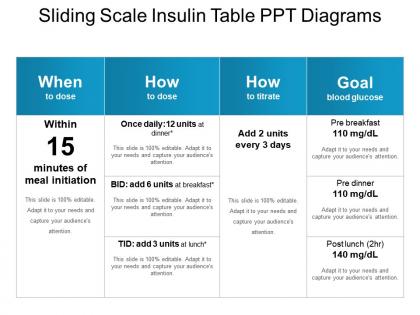
The image displays a PowerPoint slide titled "Sliding Scale Insulin Table PPT Diagrams," which is divided into three primary categories: When to dose, How to dose, and How to titrate, with a fourth column presenting the Goal blood glucose levels.
1. Starting with the first column, "When to dose," it specifies that dosing should occur "Within 15 minutes of meal initiation," indicating the timing for insulin administration relative to food intake.
2. The second column, "How to dose," breaks down insulin dosing times and amounts: "Once daily: 12 units at dinner," "BID: add 6 units at breakfast," and "TID: add 3 units at lunch." BID and TID are medical abbreviations for twice a day and three times a day, respectively.
3. The third column, "How to titrate," advises to "Add 2 units every 3 days," suggesting a method for the gradual adjustment of insulin dosage.
4. Lastly, the "Goal blood glucose" column presents target glucose levels: "Pre breakfast 110 mg/dL," "Pre dinner 110 mg/dL," and "Post lunch (2hr) 140 mg/dL," indicating the desired blood glucose readings at different times of the day.
Use Cases:
Potential industries where these slides can be applied include:
1. Healthcare:
Use: Educating patients on insulin administration
Presenter: Endocrinologist/Diabetes Educator
Audience: Diabetic patients and their caregivers
2. Pharmaceutical:
Use: Training sales teams on insulin products
Presenter: Sales Trainer/Product Manager
Audience: Pharmaceutical sales representatives
3. Medical Education:
Use: Teaching medical students about diabetic treatments
Presenter: Medical Professor
Audience: Medical students
4. Corporate Wellness Programs:
Use: Providing diabetes management workshops
Presenter: Corporate Health Educator
Audience: Employees with diabetes or at risk
5. Public Health Campaigns:
Use: Raising awareness about diabetes management
Presenter: Public Health Official
Audience: General Public
6. Health Insurance:
Use: Information sessions on managing diabetes for better health outcomes
Presenter: Health Insurance Advisor
Audience: Insured members, particularly those with diabetes
7. Non-Profit Health Organizations:
Use: Community workshops on diabetes management and education
Presenter: Non-Profit Health Advocate
Audience: Community members, especially those affected by diabetes
Sliding scale insulin table ppt diagrams with all 5 slides:
Take the smart route to success with our awesome Sliding Scale Insulin Table Ppt Diagrams. Their superb designs, color selection, content and layout will provide you with all the skills you need to impress everyone.



FAQs for Sliding scale insulin
So sliding scale is where you check blood sugar first, then give insulin based on whatever the reading is. There's usually a chart - like 2 units for 150-200, 4 units for 201-250, that kind of thing. Honestly it's pretty outdated compared to newer methods, but hospitals still use it sometimes. The problem? You're always chasing high numbers instead of preventing them. It's reactive, not proactive if that makes sense. Just make sure you're checking glucose often and writing down how patients respond so you can tweak the scale later.
Honestly, sliding scale works best for hospital patients who can't eat normally or are super sick. Post-op people, anyone throwing up, or patients who can't eat before procedures - that's when it makes sense. You've got nurses checking blood sugars constantly anyway. But for regular diabetics at home? It's kind of old school and not great since you're just reacting to high sugars instead of preventing them. Most docs prefer basal-bolus now because it's way more proactive. Random thought - I always wondered why it took so long to move away from sliding scale in outpatient care.
Look, sliding scale is basically playing catch-up with blood sugars instead of preventing them from going crazy in the first place. You're just reacting to whatever the glucose is right then - no planning ahead for meals or daily needs like basal-bolus does. Honestly, it's pretty old school at this point and kinda ineffective? With basal-bolus, you're actually working with how the body naturally needs insulin throughout the day. Way better control, less of those annoying sugar roller coasters. If you're still seeing sliding scale orders, maybe push for something more physiologic - your patients will thank you.
Most places are targeting 140-180 mg/dL now for regular hospital patients. Some still go for 80-140, but honestly the super tight control thing kind of backfired - more hypos, not much extra benefit. Your hospital probably has its own protocol though, so I'd check what they're actually using. ICU might be different depending on what's going on. You'll be checking sugars every 4-6 hours and following whatever sliding scale chart they have. Guidelines have changed a bunch lately so definitely worth double-checking your unit's current approach before you get started.
You gotta test at least 4 times daily - before each meal and bedtime. That's when sliding scale actually makes sense, not just random testing whenever. Get a decent glucometer and stick with the same routine (clean hands, rotate finger spots, all that). Honestly, timing is where most people mess up. Those pre-meal checks are crucial for getting your dose right. I'd keep a log too, or just use your meter's memory feature. Super helpful for spotting patterns when your numbers are all over the place. Being consistent with when you test is what'll show you if this sliding scale thing is actually working for you.
Your carb intake basically controls how much your blood sugar jumps around. Inconsistent eating means you're constantly playing catch-up with highs and lows - super draining honestly. Since sliding scale is reactive, timing becomes everything. I've found the best approach is teaching patients to count carbs and stick to regular meal times. Makes the sliding scale more like a backup plan instead of constantly putting out fires. Though let's be real, some people just hate tracking food no matter what you tell them. But when it works, it's way less stressful for everyone.
Yeah, so they'll want to cut their sliding scale doses before exercising and maybe grab some extra carbs if they're on the long-acting stuff too. Here's the annoying part though - you gotta plan ahead because blood sugar keeps dropping for hours after they're done, not just during the workout. I usually tell people to slash their rapid-acting dose by 25-50% before planned exercise, depending on how intense it'll be. CGMs are honestly a game-changer here since you can actually see what's happening in real-time. They should definitely check their levels before, during longer workouts, and several hours after to figure out their own patterns.
Look, the main thing people get wrong is thinking sliding scale actually *prevents* those crazy blood sugar swings. It doesn't - you're just playing catch-up after spikes already happen. People assume it's simpler than basal-bolus but honestly? You end up with this terrible cycle where you're high, then crashing low, then high again. Oh and here's another thing - sliding scale was designed for hospitals, not everyday life. I see way too many outpatients still stuck on it when they'd do so much better with something that actually works like a normal pancreas does.
Ugh, sliding scale is such a pain for hypoglycemia management. You're constantly chasing numbers that already happened instead of preventing problems. It's like - patient skips lunch but you already dosed them based on their pre-meal reading, then boom, they crash hard. The whole reactive thing means you miss early warning signs too because you're stuck following the schedule rather than watching actual patterns. I swear it feels like whack-a-mole sometimes. Try pushing for basal-bolus when you can - way less chaotic and your patients won't be on that glucose rollercoaster all day.
Yeah, sliding scale is super easy to follow and works well for hospital patients since you can adjust quickly based on blood sugar readings. Problem is, you're always playing catch-up instead of staying ahead of things. It won't prevent those crazy highs and lows - just reacts after they've already happened, which honestly seems backwards to me. Studies show way more glucose swings compared to basal-bolus approaches too. Plus it completely ignores meal timing. For long-term management, you'd probably do much better with scheduled insulin that actually mimics how your body should work.
Honestly, walk them through that sliding scale chart like they're five - I've watched so many people totally bomb this at home. Sit down and actually practice calculating doses together during the visit. Show them when to check blood sugar, how to read those ranges (especially the tricky in-between numbers), and role-play a few different scenarios. The timing part trips people up constantly. Give them a dumbed-down version of the chart they can actually understand, and definitely call them in about a week. Trust me, there's always something they'll mess up the first few days, but catching it early saves everyone a headache later.
CGMs are honestly amazing if you're doing sliding scale - Dexcom and Freestyle Libre give you real-time readings without all that finger pricking. MySugr and Glucose Buddy are solid apps for logging doses and tracking patterns. The newer CGMs sync right to your phone which is super convenient. Start with a basic logging app first though, see if you stick with it. Then maybe upgrade to a CGM if your regimen gets complicated - they're not cheap but worth it if you're checking frequently. My cousin swears by hers.
So sliding scale insulin is basically your backup plan when blood sugar gets crazy high despite your regular meds. It's not replacing your normal insulin or whatever else you take - just working alongside it. Honestly, I think of it like having jumper cables in your car trunk. You don't want to use them, but damn glad they're there when stuff goes wrong. The real trick is tweaking your baseline insulin and diet so you're not reaching for the sliding scale constantly. Keep track of when you use it most - that'll help you and your doc adjust the main stuff better.
Sliding scale insulin is pretty much outdated now - studies from the last decade show it actually makes blood sugar control worse. The RABBIT trials were huge on this, patients had way more glucose swings and stayed in the hospital longer. More hypoglycemic episodes too, which sucks. Honestly surprised some places still use it as the main approach. Both the ADA and endocrine societies basically say don't do sliding scale alone for hospitalized patients anymore. Way better to go with basal-bolus - you know, scheduled long-acting insulin plus doses with meals. It's just more physiologic and mimics what the body actually does.
Look at their insulin sensitivity first - someone who's never been on insulin needs way gentler dosing than a patient already on like 100 units daily. Blood sugar patterns matter too, plus their kidney function. Are they eating? NPO patients shouldn't get rapid-acting insulin stacked on them, that's asking for trouble. Whatever's going on medically (sepsis, steroids, you know) will mess with glucose control. Honestly sliding scales are pretty old school now, but if you're stuck using one, start conservative. I'd rather adjust up after watching their response over a day or two than crash someone's sugar.
-
Out of the box and creative design.
-
Really like the color and design of the presentation.