

Smart Action Plan For Customer Service




Try Before you Buy Download Free Sample Product
 Impress Your
 Audience
 100%
100% Editable
 Save Hours
 of Time


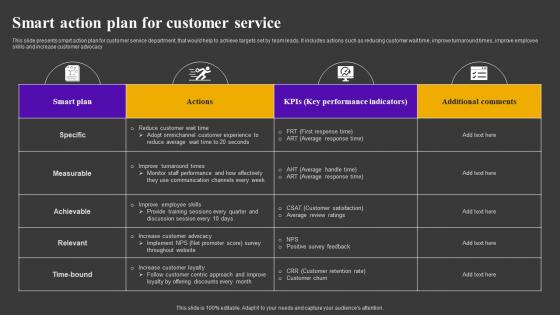
This slide presents smart action plan for customer service department, that would help to achieve targets set by team leads. It includes actions such as reducing customer wait time, improve turnaround times, improve employee skills and increase customer advocacy.
People who downloaded this PowerPoint presentation also viewed the following :
Smart Action Plan For Customer Service with all 6 slides:
Use our Smart Action Plan For Customer Service to effectively help you save your valuable time. They are readymade to fit into any presentation structure.





FAQs for Smart Action Plan
Honestly, start with setting clear standards - like what actually counts as good service at your place. Train your team properly so they're not just winging it when stuff goes sideways. Multiple ways for customers to reach you is huge too (some people hate phone calls, others won't touch chat). Give your staff power to fix things immediately instead of that annoying "let me ask my manager" runaround. And definitely track how you're doing with real feedback. Here's the thing though - don't try fixing everything at once. Look at what you've got now, find your weakest spot, and tackle that first. Way less overwhelming.
Track the basics first - CSAT scores, NPS, and how fast you're responding. First-call resolution is clutch too. Customer effort score matters way more than people think though - like, did you actually make their life easier or just waste their time? Numbers only tell half the story. I always dig into the actual feedback comments and check what people are saying on social. Oh, and watch your repeat contacts - if the same issues keep coming back, you're not really fixing anything. Just pick 3-4 key metrics for a monthly dashboard. Trust me, more data doesn't mean better insights.
Look, tech is pretty much everything in customer service now. Chatbots handle the basic stuff 24/7, which is honestly what people expect these days - nobody wants to wait until business hours for simple answers. CRM systems help you remember who customers are and what they've dealt with before. AI can even spot problems before they blow up. The trick is mixing automation with real humans. Handle your common questions with bots first, then let your actual staff focus on the messy, complicated issues that need a human brain. It's way more cost-effective than hiring a massive support team, plus customers get faster help most of the time.
Honestly, getting everyone on the same page is such a pain but totally necessary. Start with shared templates and knowledge bases that work across chat, email, phone - whatever. The hardest part? Actually getting teams to stick with the new systems instead of doing their own thing. Track the same metrics everywhere and do cross-training sessions regularly. Oh, and set up some kind of feedback system so you catch inconsistencies before your customers start complaining about getting different answers depending on who they talk to. It's one of those things that sucks to implement but makes everything smoother once it's working.
Honestly, role-playing works best - have them practice real scenarios they'll actually encounter. Pair new people with your top performers for the first couple weeks, that's huge. Interactive workshops are solid too, just skip the death-by-PowerPoint thing nobody pays attention to anyway. Regular feedback sessions keep everyone sharp. Oh and mystery shoppers are pretty effective if you can swing it. The main thing is making it hands-on instead of just dumping a bunch of info on them once. Scripts are whatever - you want them comfortable handling actual situations.
Stop treating feedback like a checkbox exercise. Multiple touchpoints work best - surveys, social monitoring, actual conversations with people. My old company was terrible at this, honestly. They'd collect everything then let it sit in some folder gathering dust. Here's what actually works: when someone complains, fix the issue AND circle back to tell them what changed. Monthly reviews are clutch - pick your top 3 problems and bake solutions right into how you operate. The whole point isn't just collecting opinions, it's letting that stuff reshape your entire game plan.
Look, your company culture is everything when it comes to customer service. When your team actually cares about solving problems and showing empathy, customers can tell immediately. But if everyone's just focused on call times and hitting quotas? Yeah, that comes through loud and clear too. Here's the thing though - your frontline people can only work with what they're given. Leadership loves saying "customer first" while only tracking speed metrics, which is honestly backwards. Your reps need the culture to actually support those values, not just talk about them. Want better service? Start rewarding the right behaviors, not just the fast ones.
Honestly, people just want to feel seen, you know? Use their name, bring up what they bought last time, remember if they hate phone calls and prefer email. It's wild how much that stuff matters. Like, instead of treating everyone the same, actually pay attention to how they talk to you and match that energy. Short responses for busy people, more detail for the chatty ones. I swear it makes customers way happier because they're not getting some cookie-cutter response. Makes them feel like a real person instead of just another complaint in your inbox.
Honestly, the worst thing you can do is try pleasing everyone at once - you'll just end up with a mediocre mess. Focus on what actually matters to your customers first. Training your team is huge too (I swear this gets overlooked constantly). Don't assume people will magically know what to do. Wrong metrics will kill you - like obsessing over response speed while your actual solutions suck. My advice? Survey customers about their biggest headaches first, then build around fixing those specific problems. Way better than guessing what they want.
Honestly, data analytics is your best friend here. Track your response times, satisfaction scores, and where customers are getting frustrated - that's where the real insights are. I'd start by looking at ticket volumes and which issues pop up most often. Peak contact hours are huge too - you'll probably find patterns you never noticed before. The trick is actually doing something with what you learn, like staffing up during busy times or maybe building better FAQs for those repetitive questions everyone asks. Don't try to fix everything at once though. Pick one thing and go from there.
Honestly, just stay calm and actually listen to what's really bugging them - not just their surface complaint. Say stuff like "I get how frustrating that must be" before you jump into fixing things. People usually just want to feel heard, which makes sense. Ask questions to figure out the real problem. Focus on what you CAN do instead of listing everything you can't. If you're getting overwhelmed (happens to everyone), grab your manager or say you need a minute to look into it properly. Oh and write everything down after - saves the next person dealing with them a huge headache.
So Gen Z customers want instant chat replies and social media responses, but older folks usually prefer calling and getting detailed explanations. Income matters too - budget shoppers need different solutions than people dropping serious cash. Time zones are huge if you're dealing with different regions, plus cultural stuff varies everywhere. Companies screw this up constantly though, which is honestly pretty frustrating to watch. You've gotta match your communication style and response times to what each group actually uses. Like, don't force a 70-year-old onto Instagram DMs, you know?
Focus on metrics your customers actually care about - response times, how well you solve their problems, fixing things on the first try. Don't just track what's convenient for you. Be realistic about what you promise or you'll constantly disappoint people (learned this the hard way). Build clear escalation steps for when stuff goes sideways. Here's the thing though - get customer input before you finalize anything. They'll straight up tell you what matters most to them, and it's usually different than what you'd expect.
So here's what I'd do - let bots handle the boring stuff first. Password resets, tracking orders, those same FAQs everyone asks. People actually like solving simple things themselves anyway, saves them from waiting on hold. But here's where it gets tricky: you need humans for anything complicated or when someone's genuinely upset. The handoff between bot and person has to be smooth though, otherwise you're just annoying people twice. I'd start by looking at your most common questions and automate those. Just make sure your team knows what the bot already told the customer so they're not repeating everything.
Honestly, chatbots are everywhere now and they're actually pretty good at handling the basic stuff. Frees up your real people for the messy problems. Most customers want to figure things out themselves anyway - knowledge bases, forums, all that. Oh and nobody calls anymore, it's all texting and social media. You'll want to be on whatever platforms your customers use. The smart companies are reaching out before customers even complain about issues. My cousin's company does this and it works great. Start by looking at what channels you're already using, then see where you can automate without making it feel robotic.
-
Excellent products for quick understanding.
-
Mesmerized with the fantastic collection! Super sleek, relevant infographics.