


Improvement Plan For Customer Service Department




Try Before you Buy Download Free Sample Product
 Impress Your
 Audience
 100%
100% Editable
 Save Hours
 of Time


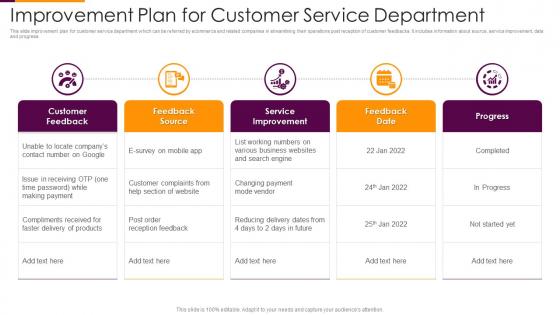
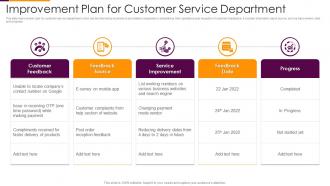
This slide improvement plan for customer service department which can be referred by ecommerce and related companies in streamlining their operations post reception of customer feedbacks. It includes information about source, service improvement, date and progress
People who downloaded this PowerPoint presentation also viewed the following :
Improvement Plan For Customer Service Department with all 6 slides:
Use our Improvement Plan For Customer Service Department to effectively help you save your valuable time. They are readymade to fit into any presentation structure.





FAQs for Improvement Plan For
So definitely focus on the big three: empathy, active listening, and solving problems fast. Start with acknowledging their feelings first - people literally just want to feel heard, it's crazy how much that helps. Then really listen to what they're saying, not just waiting for your turn to talk. Cover your response times and follow-up stuff too. But honestly? Skip the boring theory and do role-playing instead. Give them actual phrases they can use like "I totally understand how frustrating that must be" or "Let me fix this for you right now." Real scenarios stick way better than abstract concepts.
Track customer happiness with surveys (NPS works great), social media monitoring, and feedback from support tickets or reviews. But here's the thing - most companies just collect this stuff and do nothing with it. Don't be those guys. Actually analyze what you're hearing and make changes based on common complaints. Short, quick fixes can make a huge difference. Let customers know when their feedback led to improvements too. Oh, and start with just one metric instead of trying to measure everything - you'll actually get somewhere that way. Build up your system gradually.
Oh man, training is everything for customer service - seriously can't stress this enough. Your team needs to know how to communicate, solve problems, and actually understand what they're selling. I've watched entire departments flip from disaster to amazing just because they finally got proper training (which honestly should've happened way sooner). Skip the training and you'll end up with customers getting different answers every time they call, plus your staff will be miserable because they don't know what they're doing. Figure out where you're struggling most, then build training around fixing those specific issues first.
Dude, visuals are a game-changer for training. People remember stuff way better when they see it vs just hearing some manager drone on. I'd do flowcharts for escalation steps, infographics for key policies, screenshots of your actual systems. Trust me, nobody wants to sit through another PowerPoint with bullet points everywhere - been there, suffered through that. Your team needs something they can actually reference later when they're dealing with angry customers. Make simple one-page guides for your most common situations. Keep them short though - like something they can glance at quickly between calls.
Visual presentations work best - show omnichannel flows, AI chatbot trees, and personalized journey maps. Before/after slides are money, especially when you're highlighting faster response times or higher satisfaction scores. Interactive demos crush it too. Actually show stakeholders how that self-service portal works instead of just talking about it. Map your customer touchpoints first, then craft slides around how each innovation fixes a real problem. Honestly, the whole thing comes down to making complicated service stuff look dead simple on screen. Short demos beat long explanations every time.
Here's what works best when pitching tech upgrades for customer service - show them the money first. ROI is everything to these people. Get numbers on how chatbots cut wait times and free up your team for the tricky stuff. CRM systems make everything more personal, which customers actually notice. I'd definitely include before/after customer satisfaction scores because executives eat that up. Paint a clear picture: here's our messy current process, here's the streamlined future one. Don't forget the boring stuff like timeline and budget breakdown - they won't approve anything without seeing actual costs and how long it'll take.
Skip the generic "be nice to customers" stuff - it's basically worthless. What actually works is using real situations your team deals with daily. Role-playing helps a ton, plus video examples showing good vs bad interactions. I'm weirdly obsessed with showing the bad examples first because people learn faster that way. Interactive stuff like quizzes keeps everyone awake too. Most important thing? Address the actual complaints you're getting from customer surveys. Your team needs to leave knowing exactly what they'll do different tomorrow, not just feeling inspired.
During team meetings, share actual customer success stories - way better than those boring generic pep talks. Like when Sarah fixed that nightmare order in 10 minutes, or Mike somehow turned a furious customer into a 5-star review with one follow-up call. Those real examples show your team exactly what good service looks like. Point out the specific moves that worked so people can actually copy them. Oh, and rotate who tells the stories each week - keeps things fresh and gets everyone involved.
Honestly, AI integration is where it's at right now - everyone's scrambling to get that right. Personalization at scale is massive too, plus omnichannel stuff. Self-service is clutch, but like actually good chatbots and knowledge bases that don't make you want to throw your phone. Oh, and proactive outreach where you fix problems before customers even know they exist? That's getting big. Real-time sentiment analysis is way more doable now than it used to be. Here's the thing though - your employees being happy directly impacts how customers feel, so don't sleep on that. Pick maybe 2-3 of these instead of trying to do everything poorly.
Dude, dashboards are your best friend here. Real-time response times, satisfaction scores, ticket volumes - make them pop with clean charts and color coding. Heat maps are clutch for showing when your team gets slammed or which channels are causing headaches. Executives go crazy for before/after comparison charts, trust me on this one. Customer journey visuals help too - they show exactly where people hit roadblocks. Pick charts that make trends super obvious so your team can catch problems early and actually celebrate when things get better. Oh, and don't overthink the design part.
Dude, three things that actually work: tell customers upfront how long responses take, automate the boring stuff, and give your team decent tools. Most people just want to know you saw their message - seriously, a quick "we're on it" buys you so much goodwill. Chatbots handle the basic questions. Templates save time on repetitive issues. Make sure agents can see customer history because nobody wants to repeat their entire story again. Oh, and quick acknowledgment beats slow perfection every time. Customers chill out when they know you're not ignoring them.
Skip the boring stats and jump straight into real customer stories your team knows. Like actual scenarios where focusing on customers saved a deal or where ignoring them tanked one. People zone out during those generic "customer first" presentations - we've all been there. Get everyone sharing their own wins and disasters, make it interactive. Show concrete before/after examples and tie them to actual revenue numbers. The emotional stuff hits way harder than spreadsheets. Give them specific things they can try tomorrow, not vague advice.
Honestly, focus on the big three: slow response times, mixed messaging between different channels, and undertrained agents who just don't get it. Wait times are probably your strongest angle - nothing pisses customers off faster. I'd map out actual customer journeys showing where things go wrong, then hit them with before/after charts on response times. Maybe throw in some anonymized complaints that'll make the executives uncomfortable? Works every time. Side note - pairing hard numbers like satisfaction scores with real customer quotes is clutch. You need both the emotional gut punch and the data to back it up.
Okay so first thing - map it from the customer's view, not how your company sees it. I like using swim lanes to show different departments because you'll immediately see where things get passed around weirdly. Color the pain points red, good moments green. Don't make it pretty at first though - messy is honest! Throw in real customer quotes and how they're feeling at each step. The chronological story format works way better than those boring flowcharts. Trust me, once your team sees the actual customer journey laid out like this, all those hidden gaps become super obvious.
Role-playing is huge - have your team switch between being the customer and the rep. Gets them thinking differently. Share real customer stories in meetings too, not just made-up scenarios. Those "walk in their shoes" exercises always spark good discussions (maybe I'm biased but they work). Try having pairs practice reflecting emotions back like "sounds like you're frustrated because..." Video testimonials hit different than just reading feedback. Oh, and customer journey mapping shows pain points visually which people actually get. Don't overthink it - pick one thing and test it next week.
-
Excellent design and quick turnaround.
-
Amazing slides! Unique, attractive, and easy to understand.