


Introduction To Customer Service Edu Ppt




Try Before you Buy Download Free Sample Product
 Impress Your
 Audience
 100%
100% Editable
 Save Hours
 of Time


These slides contain information about the definition of customer service, the importance of customer service training, and the five pillars of a good customer service team, which are channel variety, proactive service, focus on satisfaction, usage of an internal and external knowledge base, and customer relationship management CRM tools.
People who downloaded this PowerPoint presentation also viewed the following :
Content of this Powerpoint Presentation
Slide 1
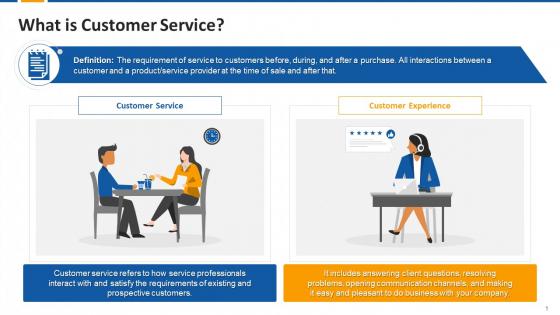
This slide covers
the definition of customer service, and it also depicts that customer
service includes answering client questions, resolving problems, and
opening communication channels.
Instructor’s Notes:
Why is customer
service important for the success of your business?
· Customer
service has a significant impact on the company's bottom line. Keeping existing
customers is less expensive than finding new ones. It is even predicted that
the cost of acquiring new customers is 6–7x higher than retaining one
· Customer
service can either create or ruin the company's reputation
· Support
is an essential component of the product experience
· Customers
are prepared to spend extra for a more satisfying experience
· Internal
Customers: are colleagues and departments within your organization
· External
Customers: are more likely to be consumers, users, and
stakeholders
Example – Starbucks
Coffee
· Internal
customers will be everyone from the company's Board of Directors
to the executives and team members that serve beverages at the customer
interface
· External
customers will be the everyday people that come to the coffee
shop and buy beverages for themselves and their friends
Slide 2
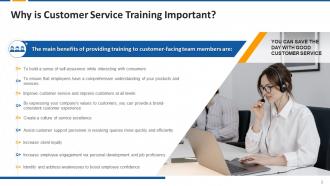
This slide covers
details on the importance of customer service training in the company. It also
depicts that training a customer-facing team will help them solve inquiries
faster and more efficiently.
Instructor’s Notes:
Instructor can ask
these questions to his classroom to initiate discussions:
· What do
you think would make a client satisfied and eager to remain around if they had
an urgent query about your product and approached your customer care team?
· Is it a
generic email response or a well-researched response from a service
professional who cares about their success?
Regardless of how
talented the new employees are, companies should conduct training that aligns
everyone on working together and best represent the company.
Slide 3
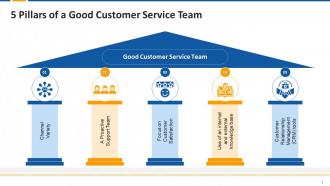
This slide covers
five pillars of the customer service team: channel variety, proactive customer
service team, focus on customer satisfaction, usage of an internal and external
knowledge base, and customer relationship management (CRM) tools.
Instructor’s Notes:
· Channel
variety: Social
Media, Live Chat, Email, Phone calls, Self-service, Omnichannel
· A
proactive customer service team: Willing to go the extra mile,
Empathetic, Patient, Responsive, and Positive
· A focus
on customer satisfaction: Focus on creating loyal customers, Training
to avoid poor customer service, Extra attention to new customers
· Use of
an internal and external knowledge base: Customer FAQ,
Onboarding or training FAQ, Customer service tips, External pages with
information for customers. Examples include web pages, blogs, video
content, and product guides
· Customer
relationship management (CRM) tools: Contact management,
Tracking interactions, Scheduling and reminders
Introduction To Customer Service Edu Ppt with all 19 slides:
Use our Introduction To Customer Service Edu Ppt to effectively help you save your valuable time. They are readymade to fit into any presentation structure.










FAQs for Introduction To Customer
Honestly, it comes down to actually listening to what they're saying - not just waiting for your turn to talk. Respond fast, even if it's "hey, got your message, looking into this now." Skip the corporate speak and just be real with them. Here's the thing though - don't jump straight into fix-it mode when someone's mad. Say something like "yeah, that sounds super frustrating" first. Then solve their problem. But here's what really matters: if you promise something, you better deliver on it. Most companies are terrible at follow-through. Going slightly above what they expected? That's where the magic happens.
Mix surveys with other stuff to get the real story. NPS and satisfaction scores give you solid numbers to track. But honestly, people are so over surveys now - keep them short. Social media monitoring catches what people actually say when they think you're not listening. Support tickets are goldmines too. Monthly reviews help you spot patterns before they blow up. Oh, and don't stress about every single negative comment. Trends matter way more than one-offs. Set up a simple dashboard so you're not drowning in data every week.
Honestly, training is everything when it comes to customer service. Your team needs to know how to actually fix problems instead of bouncing people around departments - God, I hate when that happens to me as a customer. Confident employees make such a difference too. Customers can totally sense when someone knows what they're doing versus when they're just winging it. Plus you'll get way more consistent service across your whole team. I'd start by figuring out where you're bleeding customers the most, then build training around those specific issues first.
Honestly, tech is a total game-changer for customer service. Chatbots can handle the basic stuff 24/7 so your team doesn't get swamped. AI helps route angry customers to the right people fast. CRM systems are clutch too - your agents can see someone's whole history instantly instead of playing twenty questions. Live chat and video support give customers options, which they love. Self-service portals work great if you set them up right. The automation alone will cut your wait times in half, maybe more. Don't go crazy though - pick one or two tools that'll actually solve your biggest headaches first.
Honestly, just stay calm and really listen to what's pissing them off - people mostly want to feel heard. I always say "I get why you're frustrated" instead of getting defensive (which is harder than it sounds lol). Try focusing on solutions rather than rehashing the problem. If they cross the line into being abusive, shut that down and call your supervisor over. Document everything too - you'll thank yourself later. The hardest part is remembering they're mad at the situation, not you personally. Though some customers are just jerks regardless.
Dude, personalization is everything now. Customers hate repeating their whole story to different agents - like, we've all been there, right? Your team needs quick access to customer history so they can actually reference past purchases and communication preferences. It builds real trust when someone remembers how you like to be contacted. Don't just pull up their data though. Train your people to adjust their tone and recommendations based on what they're seeing. Nobody wants cookie-cutter responses. Oh, and honestly? It's kinda wild how many companies still treat repeat customers like strangers.
Honestly, speed matters most - get back to them within 24 hours, tops. Thank them right off the bat (even the angry ones, which sounds weird but totally works). Don't dance around their actual complaint with corporate BS. Just address it head-on. Screwed something up? Own that mistake and tell them your fix. Got good feedback? Share it with your team - they need those wins too. Here's what trips up most people though: they forget to circle back and check if the problem's actually solved. That follow-up step is clutch.
Honestly, it starts at the top - if leadership doesn't actually care about customers (not just pretend to), you're screwed. Share customer feedback with everyone, not just support. Most people have zero clue how their job affects actual humans using your product, so train them on that connection. When hiring, look for people who naturally think about others first. Reward the team when they do something awesome for customers. Set up regular sessions where everyone hears real customer stories - the brutal ones too. Oh, and track customer satisfaction alongside your normal metrics. It's wild how many companies skip that part.
Honestly, multi-channel support is a game changer for customer experience. People can hit you up however they want - email, chat, phone, social media, whatever works for them. Nobody wants to be forced into using your preferred method, you know? The cool part is customers can start on Twitter, switch to email, then call if needed without retelling their whole story each time. Just don't mess this up by having different systems that can't talk to each other - your team needs to see the full conversation history or you'll annoy people way more than you help them. Trust me on that one.
Honestly, being small is your superpower here. Big corporations have layers of bureaucracy - you don't. You can actually remember Mrs. Johnson likes her orders a certain way and fix problems in minutes, not weeks. People are so beaten down by awful corporate service that basic kindness feels revolutionary now. I swear, just answering your phone with actual enthusiasm puts you ahead of 90% of businesses. Focus on quick responses and personal touches. While enterprise companies are shuffling customers between departments, you're building real relationships. That kind of loyalty? Priceless.
Focus on response times first - how fast you reply and resolve stuff. Customer satisfaction scores matter too, like CSAT and NPS. Ticket volume and first-contact resolution tell you if you're actually fixing things right away. Oh, and customer effort score is honestly underrated - shows how much work people have to do just to get help, which is annoying. The satisfaction numbers tell you what's working, but speed metrics show if you're keeping people happy in real time. Don't go crazy though - pick maybe 4 or 5 max so you'll actually look at them.
Oh man, this stuff is huge! Japanese customers usually want super detailed explanations and you gotta be patient. Americans? They want solutions fast - though honestly every person's different regardless of culture. Some places expect formal interactions, others are chill and casual. Communication styles vary tons too. Direct vs. people who kinda dance around the issue, you know? Best bet is figuring out who your customers actually are and training your team on it. Way better than just assuming everyone wants the same thing.
So CRMs basically put all your customer stuff in one spot instead of dealing with random spreadsheets everywhere. You can track who said what and when without playing detective. Your team stops asking "wait what happened with this client?" because everyone sees the same info. Honestly, the reporting part is pretty useful too - you'll spot patterns you missed before. Customer retention gets better since you can actually remember their preferences and follow up properly. My advice? Pick one messy area first, like lead tracking, and fix that before going crazy with features.
Honestly, proactive customer service is like being that friend who checks in when something feels off. You're catching issues before they blow up into angry emails or people jumping ship. Monitor how customers use your stuff, then reach out when you notice friction points. Maybe send a quick "how's it going?" message when their usage drops. I mean, it's way easier to fix small problems than deal with full meltdowns later. People actually trust you more when they see you care about their experience, not just grabbing their wallet. Figure out what usually makes customers complain, then create ways to jump in before those situations happen.
Honestly, empathy is everything in customer service. When someone's pissed off and you actually listen to what they're saying, it totally changes the vibe. You don't even need to fix their problem right away - just acknowledging how they feel makes a huge difference. Something like "wow, that sounds really frustrating" instantly defuses things. Then you can ask better questions and actually help them instead of making them feel like they're talking to a robot. I learned this the hard way, but reflecting their emotions back before trying to solve anything really works.
-
Requested a complete pitch deck. Delivered immediately and with high quality well researched content.
-
I was confident and well prepared for my presentation for the first time ever. With SlideTeam’s templates, I could deliver one of my best presentations. Will be coming back for more!