

Dealing with Difficult Customers Training Module on Customer Service Edu Ppt





Try Before you Buy Download Free Sample Product
 Impress Your
 Audience
 100%
100% Editable
 Save Hours
 of Time


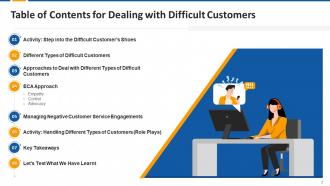
This training module covers the concept of dealing with difficult customers. This PPT deck contains the types of difficult customers and approaches to deal with them. It also includes ECA empathy, control, advocacy approach and managing negative customer service engagements. Further, it contains activities, key takeaways, and multiple-choice questions. The PPT deck also has additional slides on about us, vision, mission, goal, 30-60-90 days plan, timeline, roadmap, training completion certificate, energizer activities, detailed client proposal, and training assessment form.
People who downloaded this PowerPoint presentation also viewed the following :
Content of this Powerpoint Presentation
Slide 6
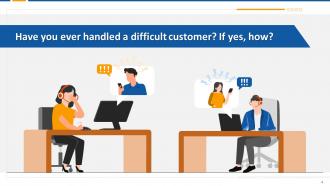
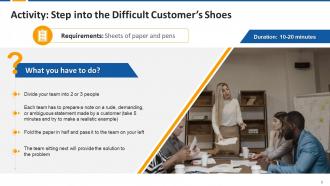
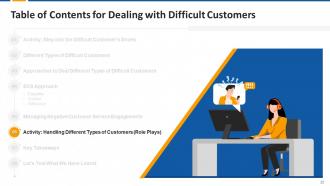
This slide depicts an activity that customer service executives can do during a training session to deal with a difficult customer.
Instructor Notes: This exercise is made to empathize customer care executives with difficult customers.
- The goal here is to explain why the customer became difficult to handle for example, the difficult customer may have had a bad experience
- Make the customer care executive step into the shoes of a difficult customer, so that they can relate better to the customer next time
- Allow groups to share the message, the backstory they created, and their appropriate customer service response
Takeaway- Customers are not typically rude, demanding, or vague. Typically, they will have had a negative experience that has caused them to be this way. It's important to remember that when you're confronted by one of these customers, there would have been a chain of events that led them to act the way they are. Knowing this will assist you in remaining objective and solution-focused when these customers seek your assistance.
Slide 9
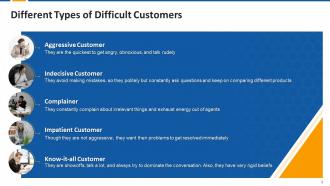
This slide provides information regarding the different types of difficult customers faced by service agents. The major categories are aggressive customer, complainer, indecisive customer, impatient customer, and know-it-all customer.
Slide 10
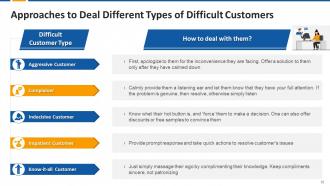
This slide tabulates the multiple types of difficult customers, such as aggressive customer, complainer, indecisive customer, impatient customer, and know-it-all customer. It also includes information regarding the different strategies to deal with them.
Slide 12
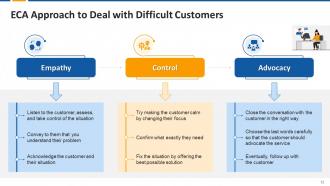
The purpose of this slide is to showcase the ECA framework to deal with difficult customers. The major components of the model are empathy, control, and advocacy.
Slide 14
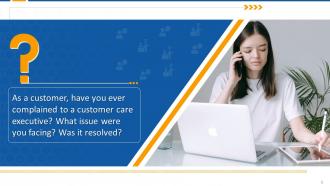
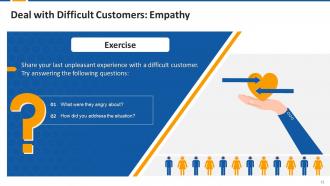
The purpose of this slide is to showcase the exercise for dealing with difficult customers with empathy.
Instructor's Notes:
The key objectives of the exercise are as follows:
- Analyze why difficult situations were developed
- To see what others have experienced and learn from their situations as well
Exercise is conducted to make the session more interactive. There are no right or wrong answers.
Slide 15
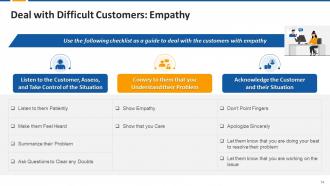
This slide highlights the checklist that agents can use to deal with difficult customers empathically.
Slide 17
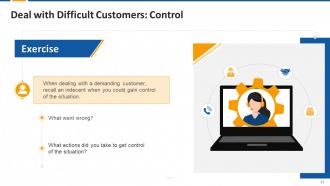
The purpose of this slide is to showcase the exercise to take control of a difficult situation to handle difficult customers.
Instructor's Notes:
Each person's answer will be unique. There are no correct or incorrect solutions in this exercise.
Slide 18
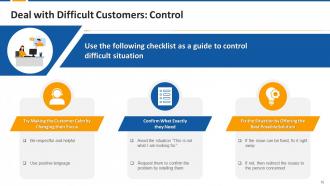
The slide contains a checklist to guide service agents on how to take control of the situation and deal with difficult customers.
Slide 20
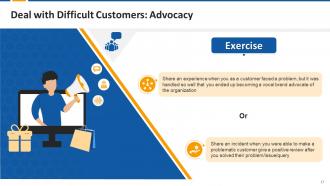
This slide showcases the question for training session attendees when they turned a challenging customer into brand advocate.
Instructor's Notes:
Each person's answer will be unique. There are no correct or incorrect solutions in this exercise.
Slide 21
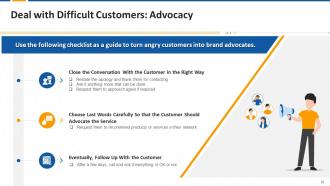
This slide provides information regarding the checklist to convert angry customers into brand advocates.
Slide 23
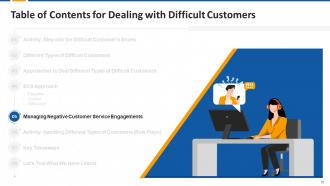
This slide provides information regarding the top reasons for bad customer service. It also includes details of approaches to fix them.
Slide 24
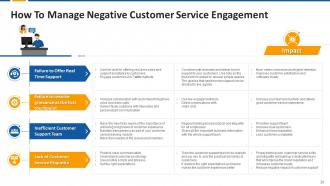
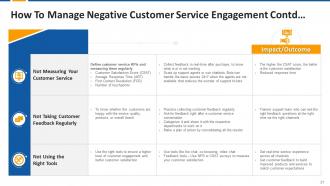
This slide showcases techniques to manage the poor customer service engagements along with the impact and outcome.
Instructor Notes:
The companies that miss out measuring customer service fail to gain the below benefits:
- Do not get insights into how your business is performing
- Unable to know your customers’ perception of your products & services
- Not able to identify the gaps between business and customers
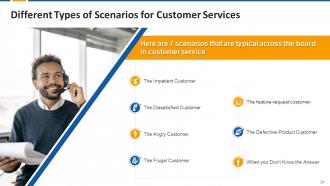
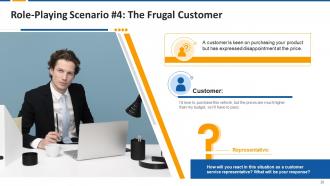
Slide 27
This slide presents seven customer services scenarios.
Instructor’s Notes:
The slide depicts the different role plays that will help to understand the customer service scenario
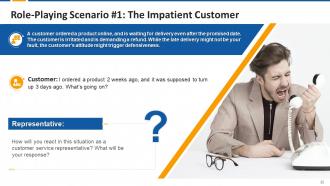
Slide 28
This slide covers an issue that the customer is facing after ordering the product. The customer has still not received the products
Instructor’s Notes:
The essential thing to do is apologize and convince them that you are trying to resolve the problem. Also, offer comprehensive and open information to the client as to why the cargo was delaying. A fantastic method to settle the problem is to provide the consumer with a discount on their next order or free delivery.
E.g.:
Representative: Please accept my heartfelt apologies. Late delivery may be pretty inconvenient. I can tell you that we are doing all in our power to fix this matter for you. The cargo was suspended due to a natural disaster at our fulfillment site in California. As an apology, we'd like to offer you a 10% discount on your next purchase.
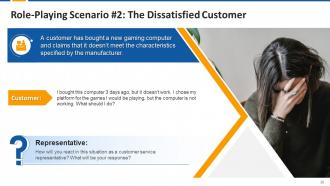
Slide 29
This slide covers the issues customer is facing in terms of specific characteristics in gaming computer
Instructor’s Notes:
The important thing to do was to convey customer to either return or exchange the computer and assure them that you will working on resolving the issue. A perfect way to resolve the situation is to offer a discount or exchange offers on the order or free shipping to the customer.
Representative: Hello! That is not an issue. Can I schedule your call with our technical expert wherein she can check and resolve the issue? If that doesn’t work, you can return the computer and take a new one. Many of our clients are enthusiastic gamers, and they praise this new model. Why don't you try talking to our technical expert and tell us what you think?
Slide 30
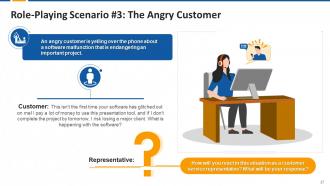
This slide covers the issues with the angry customer who is facing issues with his project due to software malfunction
Instructor’s Notes:
Must placate an angry customer. The representative mustn't react to the consumer and keep their cool before attentively listening to the customer and calming them down.
Scenario 1: Issue is on the client side
Sorry you’re experiencing this issue and we are sorry for your troubles. I’ve looked into your account and the problem seems to be that you’re still using the older version of the software on your system due to which you are creating this glitches and system failure. I can share a link from where you can download the new version
Scenario 2: Issue is on the company’s side
Sorry you’re experiencing this issue. Due to server wide issue, you are facing this issue, but we assure you that the issue will be fixed as soon as possible. You will receive a communication from us as soon as the issue gets resolved.
Slide 32
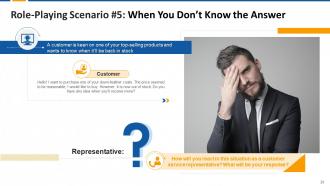
This slide covers the concern customer showed on a specific product and wants to know when will it return
Instructor’s Notes:
Customer Care representative should not provide incorrect information, but also not lose the customer. If she can think quickly on the feet, she can talk to the customer, gauge his/her preference and suggest a suitable alternative which is available.
Representative: Hello! We understand the concern about the product but we are short on supply due to supply issues that leads to late delivery of the product. But don’t worry we have a very similar range of products. You might want to have a look at model XXX, YYY. I have shared their links with you on the email. I am sure you will like them equally.
Slide 33
This slide covers the complaint customer did about the product purchased and showed the problem with the product
Instructor’s Notes:
A product flaw should be corrected immediately since it spoils the customer brand experience. We also risk losing the customer forever if we don’t fix it immediately. Alternately, customer life time value can significantly increase if any product flaw is fixed immediately
Representative:
We're disappointed to hear that. We don't hear about this problem often; therefore, it might have resulted from a manufacturing error. We are happy to send you a replacement immediately
Slide 34
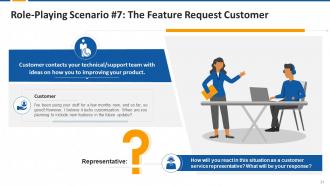
This slide covers the concerns from customer regarding new updates and features in the product
Instructor’s Notes:
Few consumers will proactively provide product recommendations, but when they do, they should be treated carefully. These ideas should be recorded by the customer service professional and forwarded to the appropriate authority within the company.
Scenario 1: Company can add more functionality
Greetings! Thank you for submitting your feature request. To improve our product, we are open to fresh suggestions from our consumers. Kindly inform us what particular flexibilities you are seeking so that we can serve you better.
Scenario 2: Company cannot add more functionality
Greetings! Thank you for your feature request. We appreciate every customer suggestion, but we cannot implement it soon due to limited resources. Several clients have made similar demands. As a result, we're taking it extremely seriously. You'll be alerted as soon as we're ready with an enhanced version.
Slide 36
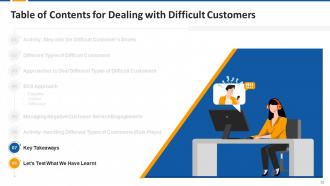
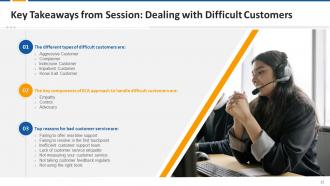
This slide depicts the summary of dealing with difficult customers training session.
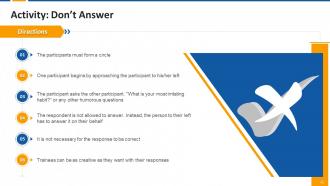
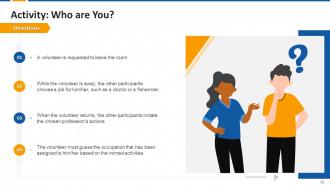
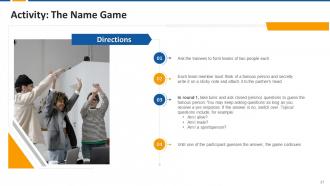
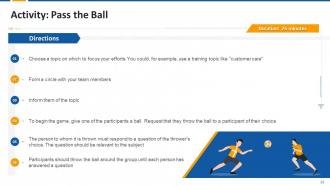
Slide 56 to 70
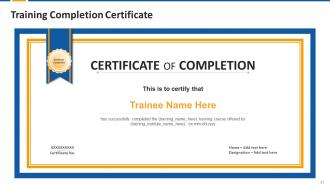
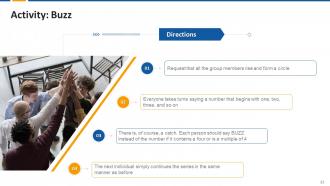
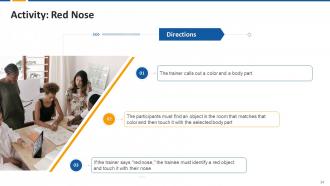
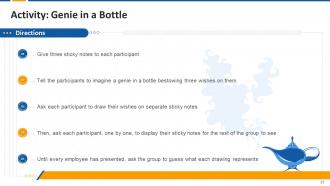
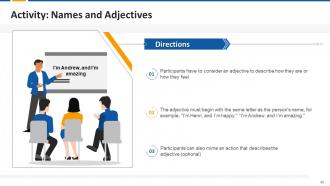
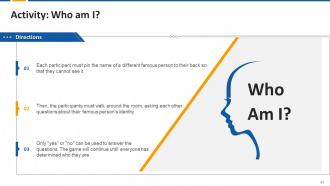
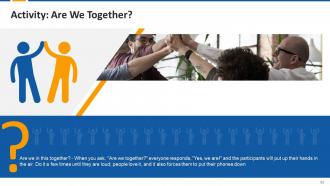
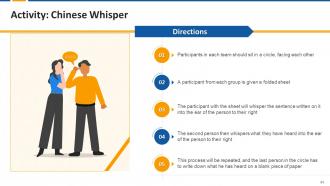
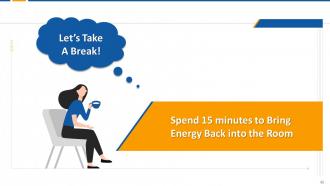
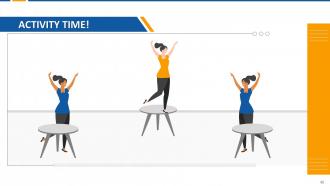
These slides depict the energizer activities to engage the audience of the training session.
Slide 72
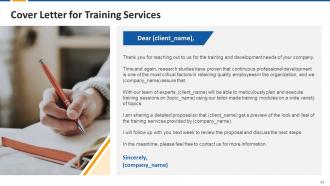
This slide highlights the cover letter for the training proposal. It includes details regarding what the company providing corporate training can accomplish for the client.
Slide 75
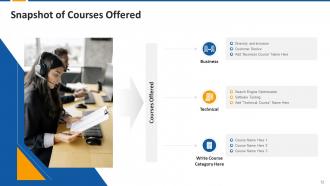
The purpose of this slide is to showcase the multiple types of courses offered by the training company.
Slide 77
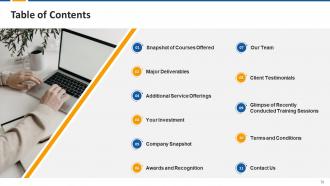
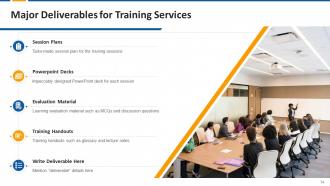
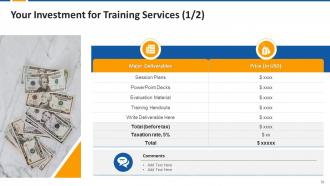
This slide indicates the major deliverables that the corporate training firm will provide to the client. The key deliverables highlighted are session plans, PowerPoint deck, evaluation material, and training handouts.
Slide 79
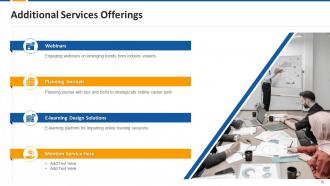
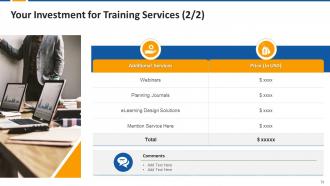
This slide represents the multiple additional services offered by the training firm to the client, such as webinars, planning journals, and e-learning design solutions.
Slide 81
This slide tabulates the major deliverables offered by the training company to the client along with their associated costs.
Slide 82
The purpose of this slide is to highlight the multiple additional services offered by the training firm along with their cost details.
Slide 84
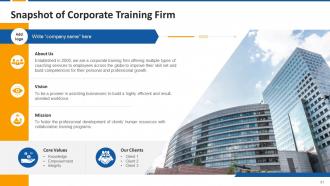
This slide provides an overview of the corporate training firm's vision and mission statements, core values, and key clients.
Slide 86
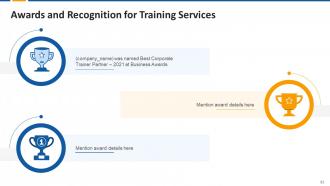
This slide highlights the major awards and recognition won by the training firm for their exceptional service to clients.
Slide 88
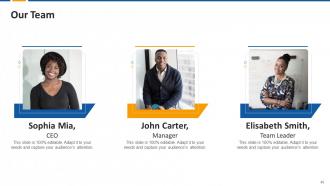
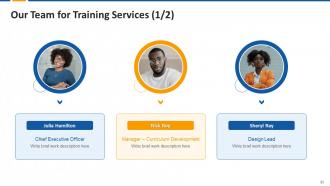
The slide provides information regarding the team members that would be providing the training services to the client. It includes details of the trainer and their respective designations.
Slide 89
The slide provides information regarding the team members that would be providing the training services to the client. It includes details of the employees’ names and their respective designations.
Slide 91
This slide provides information pertaining to testimonials given by satisfied clients of the training firm.
Slide 92
This slide highlights the testimonials from multiple satisfied clients of the training firm providing information regarding congratulatory messages, client name, and company details.
Slide 94
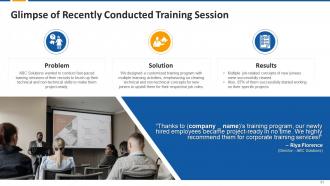
This slide showcases the case study for the training proposal. It includes information regarding the problem faced by the client and solutions offered by the training firm. It also covers details of the results and client testimonial.
Slide 96
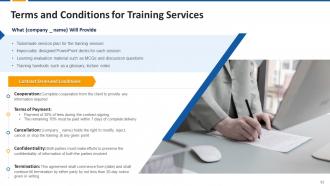
This slide provides information regarding the contract terms and conditions of the training proposal. It also includes details of deliverables that the training company will provide to the client.
Slide 98
The purpose of this slide is to provide the contact information of the corporate training firm. It includes the firm’s official address, contact number, and email address.
Slide 99
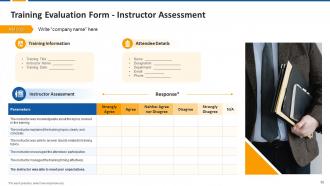
This slide highlights the training evaluation form for instructor assessment. It also includes sections to fill details of training information and attendee details.
Slide 100
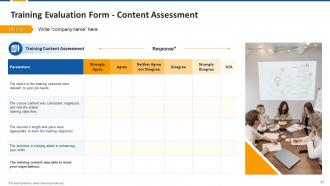
This slide showcases the questions for the assessment of the training content by the attendees.
Slide 101
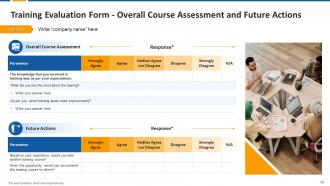
The slide indicates the evaluation form for course assessment. It also includes questions pertaining to the future actions of the attendees.
Dealing with Difficult Customers Training Module on Customer Service Edu Ppt with all 103 slides:
Use our Dealing with Difficult Customers Training Module on Customer Service Edu Ppt to effectively help you save your valuable time. They are readymade to fit into any presentation structure.















FAQs for Dealing with Difficult Customers Training Module on Customer
Don't get defensive, even when they're being totally unreasonable - just acknowledge what they're saying first. That alone cuts the tension in half. Listen to what's actually bothering them, not just what they're complaining about on the surface. Use their name a lot (people love hearing it) and ask questions to dig deeper. I always try to slow things down when someone's heated - rushing never helps. Keep your answers focused on solutions, not emotions. Oh and here's something that works: treat their complaints like they're giving you a chance to fix something. Way better than seeing it as an attack.
Honestly, yes - your slide design totally affects how customers see you. People are weirdly shallow about this stuff, but clean visuals make you look way more credible. Messy presentations? They'll assume your ideas are messy too, even if they're brilliant. With difficult customers especially, you want that polished look right off the bat so they can't dismiss you. Plus it shows you're not wasting their time with sloppy work. I'd stick with simple templates that don't compete with your message - just make sure your main points pop visually. Design won't save bad content, but it definitely helps good content land better.
Honestly, emotional intelligence is huge for dealing with nightmare clients. First thing - figure out what's actually bothering them. That person screaming about a delay? They're probably panicking about looking bad to their boss, not actually caring about the timeline itself. Once you get that, keep your own emotions in check. I swear, taking like a 2-second pause before responding is a game changer. Gives you time to respond with empathy instead of getting defensive (which is SO tempting). The goal is steering toward solutions rather than getting sucked into their drama spiral.
Honestly, I'd just bake those objection slides right into your deck from day one. Budget stuff, timing concerns, whatever usually sets them off - have backup slides ready to go. Hide them at the end so they don't mess up your flow. The transition's everything though. Like "Oh totally get that budget worry, actually let me pull something up..." then boom, you've got the perfect slide with data or case studies. I mean, beats standing there like a deer in headlights when they hit you with the tough questions. Just think through their usual complaints beforehand and you're golden.
Don't bulldoze through - just acknowledge their pushback right away. "I can see you're not sold on this" works great. Then flip it: ask what would actually work for them instead. People rarely expect that! Use their feedback to tweak your pitch on the spot. Shows you're actually listening, not just going through motions. When someone's being really stubborn, try "I get how you feel, others felt the same way, but here's what they discovered..." It's kind of cheesy but honestly works more than it should. Wrap up by nailing down next steps together.
Blues and greens are your best bet - they actually lower stress hormones, which is pretty cool. Clean up the clutter because messy spaces just make people more frustrated. Lighting's huge too, but skip those awful fluorescent lights that make everyone look like zombies. Clear signage prevents confusion (confused people get angry faster). Plants or wood touches help if you can manage it. Honestly, just decluttering your desk area and getting a warmer lamp can make conversations way less hostile. The whole point is not adding to whatever stress they're already carrying around.
Dude, your tone can totally save or tank your presentation with difficult clients. I learned this when I got way too defensive with this one nightmare client - big mistake! You want confident, not cocky. Lower your pitch a bit to sound more authoritative. Match their energy but stay calm - so if they're intense, be focused instead of panicked. Honestly, the best thing I ever did was practice my main points out loud beforehand. That way when they start grilling you, your voice still says "I've got this" instead of "please don't eat me alive."
Give them breathing room first - that's what I've learned works best. Shoot over a quick email within 24 hours asking what they think, but don't be pushy about getting answers right away. Let them pick how they want to respond too - email, call, whatever feels easier for them. Honestly, tough clients usually respect when you admit the presentation might've brought up stuff they need to mull over. Wait at least a week before circling back. When they finally do get back to you, just listen without getting all defensive. Even brutal feedback has something useful buried in there somewhere.
Honestly, stories work like magic for this stuff. When someone's pissed off, share a quick story about another customer who had the exact same problem - or hell, something that happened to you. It totally changes the vibe from "me vs you" to "we're figuring this out together." People are hardwired to connect with stories, right? I learned this the hard way after years of just apologizing and getting nowhere. Keep it under 30 seconds though - don't go into your whole life story lol. But seriously, try it next time someone's heated. The shift is wild.
Okay first thing - stay calm and acknowledge what they're feeling. Like "I can see you're really frustrated about this." Then set boundaries. When someone cuts you off, just say "let me finish and I'll get to your question." Don't take aggressive stuff personally (though honestly that's the hardest part). Keep your voice steady, let them vent for a sec, then redirect - "I want to help fix this, here's what we can do." If things get truly nuts though? Get your manager or security involved. You don't need to deal with that alone.
Dude, interactive stuff is your best friend here. Mockups they can click through, prototypes that actually work - anything visual that makes them feel involved. These clients eat up that collaborative vibe, honestly it's like 80% ego management. Don't bother with text-heavy documents because they'll just tear apart every sentence. Instead, bring materials where you can demo things live and make changes on the spot. Oh, and definitely prep extra slides beforehand. Trust me, they'll want to change something random halfway through and you'll look like a hero when you're ready for it.
Honestly, role-playing is like the best hack for customer service training. You get to practice all the nightmare scenarios - angry customers, impossible demands, people being total jerks - but without any actual consequences. Your coworkers can act out different personality types, which is weirdly fun sometimes. It's basically building muscle memory for staying calm when someone's yelling at you. The repetition really works though. When you finally face a genuinely difficult customer, you won't freeze up because you've already dealt with it before, just in practice. Way better than learning on the job!
Honestly, follow-up presentations can totally save your butt with tough customers. You're showing them you actually care about fixing things instead of just disappearing after they complained. Way better than those endless email chains that go absolutely nowhere, right? Make it collaborative though - don't just pitch at them again. Ask what they think, show how you changed stuff based on what they told you. Give them room to bring up whatever's still bugging them. Come with real solutions, not just "sorry we messed up." It's like a do-over but better.
Oh man, cultural stuff is SO important with difficult customers during presentations. I totally bombed this once by being too direct with a Japanese client - yikes. What feels assertive to Americans can come across as super rude in other cultures. Like, confronting someone head-on might work fine in Germany but it's basically insulting in places where saving face matters more. Your tone changes everything too, plus body language. Honestly, I always do a quick Google search on cultural norms before big presentations now. When you're unsure, just be more formal than you'd normally be.
Here's the thing - difficult clients can't really argue with solid numbers. Pull out metrics that hit their actual pain points: ROI percentages, cost savings, performance data from companies like theirs. Charts beat spreadsheets every time (honestly, who wants to stare at tiny cells?). Don't just throw random industry stats at them. Focus on data that answers their "what's in it for me?" question. Oh, and always have 2-3 backup data points ready. They'll definitely push back on your first argument - it's like they can't help themselves.
-
Thank you SlideTeam for such an excellent service.
-
“Immediate response, professional support, and effective solutions that were customized and immediately provided. Well done- Thank you!”