


Importance Of Good Customer Service Edu Ppt




Try Before you Buy Download Free Sample Product
 Impress Your
 Audience
 100%
100% Editable
 Save Hours
 of Time


This set of slides covers the importance of customer service for a business organization with examples and statistics. It also highlights the impact of poor customer service, such as shifting to another competitor and withdrawal of purchase.
People who downloaded this PowerPoint presentation also viewed the following :
Content of this Powerpoint Presentation
Slide 1
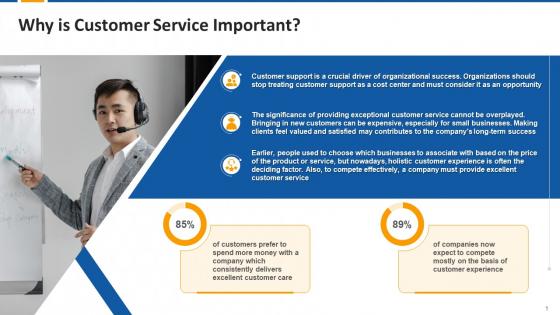
This slide covers information regarding
reasons why customer service is important to businesses. The reasons are
customer service helps in increasing revenue, to build a better reputation,
customer retention, and satisfaction etc.
Instructor’s Notes:
Ways to provide excellent customer service:
· Work
as a Team: Customer service is believed to be a
team sport
· Listen
to Customers: The more the customer care agents know
about its customers and their needs, the more of an asset those customer agents
are to both the company and customers
· Friendly,
Empathetic Support: Although robots are
fascinating, few people would prefer to interact with one. Show to customers
that you are not a machine. At the end of the day, it's all about how you make
customers feel
· Be
Honest: Nobody likes being deceived. A customer
won’t expect anything more than trust
· Be
Empathetic: Put yourself in the customer’s shoes,
especially in difficult scenario. Customers will appreciate it, and the empathy
will become a competitive advantage for the company
· Deep
product knowledge: “Training is the key”. The
more customer support team knows about the product, the better they’ll be at
servicing it
· Timeliness:
Customers dislike to wait. When the
customer service agents reply promptly and permanently fix
customer's problems, they acquire confidence and are more likely to
have a long-term relationship with the company
· Identify
ways to improve processes: A business must examine
what is unclear and update its knowledge base or FAQs. A company can reduce contacts
for repetitive issues and improve customer satisfaction by improving
communications
Slide 2
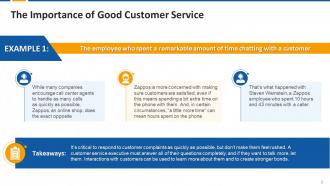
This slide covers an example of how
important a good customer care service is and the importance of resolving
customers’ complaints as quickly as possible for a long-term relationship.
Slide 3
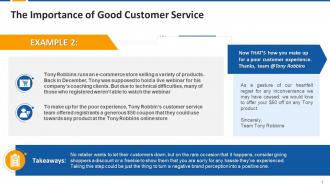
This slide covers an example of the
importance of compensating a customer for his/her poor customer experience.
Slide 4
This slide covers information regarding the
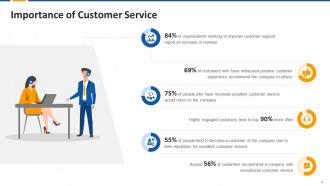
importance of customer service in businesses. The reasons are that customer
service helps increase revenue, build a better reputation, satisfy, retain customers,
etc.
Instructor’s Notes:
Reasons why customer service is important
are discussed below:
· Revenue
increases with good customer service:
Customer service is important as it correlates with revenue
· Happy
customers build a better reputation: Positive
reputation leads to higher growth
· Retention
correlates with customer satisfaction: Customer
retention carves the clearest path to business success
· Churn
decreases with more customer care: Customers churn
when they’re unhappy
· CLTV
improves with better customer service: A
highly engaged customer tends to buy more as compared to others
· Company
culture strengthens with improved customer sentiment: By
valuing customers and tirelessly working to serve them, a company creates a
culture of helpfulness
· Brand
awareness soars with positive customer experiences:
Positive customer support is important for brand awareness, as it leads to
“word of mouth” marketing
· Marketing
spend lessens with more customer advocates: Customer
marketing involves turning existing customers into advocates
· Business
longevity relies on satisfied customers: Satisfied
customers tend to provide stable revenue to the business
Slide 5
This slide covers information regarding the
power of great customer service, i.e., enhancing repeat customers and driving
customer’s loyalty towards a brand.
Slide 6
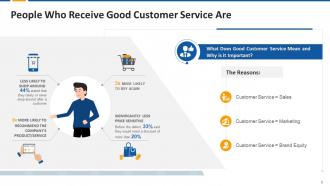
This slide covers information regarding the
importance of customer service, i.e., how customer service increases sales and
brand equity of the company’s product/service.
Slide 7
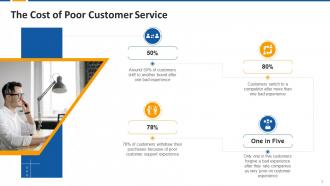
This slide covers information regarding the
cost of poor customer service to a company, such as shifting to another
competitor and withdrawing their purchase from the company.
Importance Of Good Customer Service Edu Ppt with all 23 slides:
Use our Importance Of Good Customer Service Edu Ppt to effectively help you save your valuable time. They are readymade to fit into any presentation structure.












FAQs for Importance Of Good Customer
Listen, it's mostly about actually caring and showing it. Quick responses help a ton. Know your stuff inside and out - you can't solve problems if you're clueless about policies or products. Honestly, patience is everything when customers are pissed off. I've seen reps who are super knowledgeable but come across as jerks, and it backfires every time. Active listening makes a huge difference too. Don't promise stuff you can't deliver on, but when you do make promises, follow through. Oh, and pick just one thing to work on first instead of trying to fix everything overnight.
Honestly, good customer service is what keeps people coming back - they feel heard and know you've got their back when something goes wrong. One awful support call though? They're out the door and probably blasting you on social media. I've watched businesses with great products tank because their support was garbage. Your customers turn into your biggest fans when your team is actually helpful and friendly. Train your people well and track those satisfaction scores. Sounds boring but those little wins really add up to keeping more customers around long-term.
Honestly, good customer service is like a sales multiplier. Happy customers buy more stuff and come back way more often. They also turn into walking billboards for your business - telling everyone they know without you paying a dime for ads. Here's what's wild: I've watched businesses literally double their revenue just by getting this right. It removes all the weird awkwardness from sales conversations too. People actually want to buy when they trust you. The move? Get your team thinking about every single customer chat as a chance to build something, not just fix problems.
Tech can totally transform your customer service game. Chatbots give instant responses, CRM systems track every customer interaction, and AI can actually predict what people need. Pretty wild stuff. Live chat and social media monitoring help too, plus self-service portals are huge now. But here's the thing - don't just throw technology at everything. Figure out where you're struggling most first. Maybe it's slow response times or forgetting customer details? Then pick tools that fix those exact problems. I've seen companies waste money on fancy tech that doesn't solve anything real.
Honestly, start with CSAT surveys right after customer interactions - that's your bread and butter for quick feedback. NPS and first-call resolution rates are solid too. Response times are obvious but don't obsess over them alone. I always check retention rates since customers who stick around are usually happy ones, plus support ticket trends tell you a lot. Oh, and here's the thing - any single metric can be totally misleading. Like, your CSAT might look great but if people aren't coming back, something's off. You really need to look at everything together to get the real picture.
Ugh, the usual suspects honestly - slow response times and staff who don't know how to actually fix anything. Quality's all over the place too depending which channel customers use. Plus everyone's setting expectations they can't meet, which just pisses people off more. Social media makes it worse since bad experiences go viral fast. What really gets me is how undertrained most support teams are - they just bounce customers around instead of solving stuff. Your best bet? Train people properly and give them clear steps for when things get messy. Makes everyone more confident.
So here's the thing - training is everything for customer service teams. Your reps will solve issues way faster when they actually know what they're doing. I've watched entire teams completely flip just from doing roleplay scenarios (sounds cheesy but it works). Don't just train during onboarding though - that's a huge mistake most companies make. Keep doing regular skill sessions so everyone stays sharp on products and communication stuff. Oh, and confident reps = happy customers who don't bail on you. Worth every penny you spend on it.
Look, good customer service makes people happy - it's pretty straightforward. Meet their expectations and they're satisfied. Be terrible and... yeah, you know how that ends. But here's the thing I've noticed - it's not just about fixing problems. How you treat people during the interaction matters way more than you'd think. Like, you could solve everything perfectly but act like a jerk, and they'll still hate you. Be genuinely helpful and quick to respond. Happy customers don't leave, and honestly they'll tell their friends about you too.
Look, it starts with leadership actually giving a damn about customers - not just the fake corporate speak. Hire people who genuinely like helping others, then show everyone how customer choices affect the bottom line. So many places just slap motivational posters on walls and think they're done (spoiler: they're not). Get customer feedback to the people who can actually do something about it. Share real stories in meetings, celebrate the wins when problems get solved. Oh, and give your front-line team power to fix stuff without needing seventeen approvals first.
First thing - actually listen and acknowledge how they're feeling. That alone does so much heavy lifting. Get back to them within 24 hours if you can, and definitely thank them for reaching out. I know it's hard, but don't get all defensive about it. Focus on fixing the problem instead of explaining what went sideways. Write everything down so you can catch patterns later - trust me on this one. Oh, and follow up afterward to make sure they're genuinely happy with how things turned out. Honestly, complaints are kind of a weird opportunity to show customers you actually care about them.
Look, social media basically turns customer service into this public stage where everyone can see how you treat people. When someone complains on Twitter, you can jump in fast and actually help them - way better than making them sit on hold forever. Plus other customers see you being responsive, which is honestly pretty powerful. You can catch problems early too before they spiral into bigger headaches. The trick is sounding like an actual human, not some corporate robot spitting out template responses. I'd start by checking your main platforms every day and maybe set up some alerts so you don't miss mentions.
Honestly, this is where being small actually rocks. Big chains can't move fast or get personal like you can. Use people's names, remember what they bought last time - that CEO at Target isn't gonna call anyone back, you know? Let your team fix problems right away without running to a manager first. I'd definitely start timing your responses and try to beat yesterday's speed. Follow up after sales, maybe throw in some handwritten notes. Sounds old school but it works. Build real relationships instead of just transactions.
Dude, engaged employees are like magic for customer service - I'm not even exaggerating. They'll actually problem-solve instead of just reading from a script. Plus they stick around longer, so your customers aren't constantly explaining their situation to someone new every time they call. Honestly, I've watched companies obsess over customer training programs when the real issue was that half their staff was checked out mentally. Happy employees naturally give better service. It's weird but true - fix your team's morale first and watch your satisfaction scores climb without doing anything else different.
Honestly, start with your CRM - track what customers bought before and how they like to communicate. Some people just want the quick fix, others need you to walk them through everything. Use their actual name when you talk to them. I always tell my team to ask specific questions instead of giving the same boring script to everyone. Oh and write down weird details - like if Mrs. Johnson hates phone calls and only wants emails. That stuff matters more than you'd think. You can start simple by grouping customers into basic types, then get more detailed as you figure out what actually works for your business.
Okay so three main things are happening. AI chatbots are getting crazy good, but people still want to talk to humans when stuff gets complicated - finding that sweet spot is key. Everyone expects omnichannel now too, like starting on Instagram then jumping to a phone call without repeating themselves. Self-service is massive - customers actually prefer fixing easy stuff themselves if your FAQ doesn't suck. Oh and the expectations just keep climbing, which is honestly exhausting for companies trying to keep up. I'd start by figuring out where people are getting frustrated in your current setup and tackle those spots first.
-
“Thank you to the SlideTeam. Your presentations look really skillful and have made my life so much easier.”
-
I loved the hassle-free signup process. A few minutes and, I had this giant collection of beautiful designs.