


Product Knowledge Training For Customer Service Edu Ppt




Try Before you Buy Download Free Sample Product
 Impress Your
 Audience
 100%
100% Editable
 Save Hours
 of Time


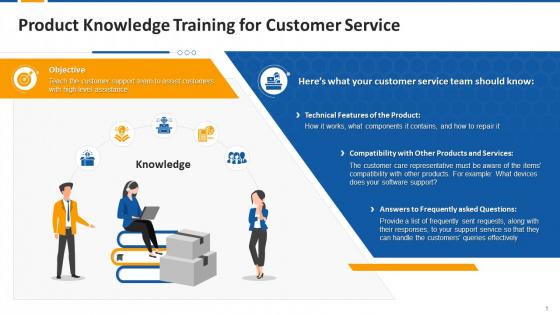
This slide covers information regarding the importance of teaching customer service executives about the product so that they can provide high level assistance to the customers.
People who downloaded this PowerPoint presentation also viewed the following :
Product Knowledge Training For Customer Service Edu Ppt with all 17 slides:
Use our Product Knowledge Training For Customer Service Edu Ppt to effectively help you save your valuable time. They are readymade to fit into any presentation structure.







FAQs for Product Knowledge Training For Customer
So basically you want your team to actually know what they're selling, right? Like, confident enough to answer questions without running to their manager every five minutes. Nothing's worse than a rep who's clearly winging it - customers can smell that from a mile away. You're also trying to cut down on those endless support tickets because people can't get basic info. When your team really gets the product, they can talk about real benefits instead of just reading off a spec sheet like robots. I'd probably figure out where the biggest knowledge gaps are first and tackle those.
Look, knowing your stuff inside and out makes all the difference in sales. You'll feel way more confident when customers throw tough questions at you. Trust me, people can tell immediately when you actually understand what you're selling versus just reading from a script. I've seen reps fumble so many deals because they couldn't explain basic features properly. Once you really get your products, conversations become natural - you're solving their actual problems instead of pushing random features. Objections don't throw you off anymore either. Honestly, just dedicate like 30 minutes weekly to learning something new about your lineup.
Dude, you really can't skip ongoing training - products change so fast it's crazy. I swear every few months there's new features, updates, competitor stuff happening. Without staying on top of it, you'll sound clueless talking to customers. Regular sessions keep you sharp and confident. Honestly, even 30 minutes weekly makes a huge difference - just reviewing updates or practicing your pitch. The repetition thing is key too because when you're stressed, that stuff needs to be automatic. Trust me, falling behind happens way faster than you think.
Honestly, you've gotta mix up your training approach because people learn so differently. Some need to see stuff - like demos and diagrams. Others learn better just by listening and talking through features. Your hands-on learners (and trust me, they usually make the best salespeople) won't get it until they can actually play with the product themselves. Then you've got people who need everything written down to really absorb it. Skip the endless PowerPoint slides though - nobody learns from those. Try doing a demo, then give them docs to review, maybe follow up with a group discussion. Way more effective than just lecturing at people.
Honestly, there's a bunch of stuff you could try depending on your budget. Cornerstone and TalentLMS are solid for formal training courses. But I'd go with something more interactive if I were you - product simulators or AR demos actually keep people engaged. Axonify does this microlearning thing that's pretty clever, breaks everything into small chunks. Loom's perfect for quick product walkthroughs too. Mix it up though, nobody wants to sit through the same format every time. I'd start by seeing what tools you already have lying around, then figure out where your team's actually struggling with product stuff.
So I'd do pre/post tests first - shows you actual knowledge gains. Track real stuff too like sales numbers or customer satisfaction scores. Quiz people later because honestly, they'll forget everything if they don't use it right away. Role-playing helps check if they actually retained anything. Customer feedback is probably your best indicator though - they don't lie about whether your team knows what they're doing. Oh, and don't just measure completion rates. That's basically useless. You need both the learning part AND whether they can actually apply it in real situations.
Honestly? Information overload kills most training programs. You dump everything on people and they just shut down. Plus half your product specs will change before you even launch the training - it's so frustrating but happens every time. Making technical stuff click for different skill levels is tricky too. Remote teams make it worse since you can't just walk over and show them something real quick. Break things into smaller pieces and plan for regular updates from the start. Real customer examples are what actually make it stick - way better than theoretical scenarios.
Pull real customer stories and support tickets - way better than boring spec sheets. Have your team role-play actual objections they'll hear. Build case studies from your biggest wins AND failures (the failures are honestly goldmines for learning). Mix up the practice sessions too - explaining features to a tech person hits different than talking to an end user. Breakout sessions work great for this. The whole point is making training feel like real situations they'll actually face, not just memorizing bullet points. Trust me, they'll remember the stories way longer than any feature list.
Honestly, gamification works because people are naturally competitive and love feeling like they're accomplishing something. Point systems and leaderboards make training way less boring - suddenly it feels like a game instead of mandatory work stuff. Progress bars are weirdly addictive too (I don't know why but watching that percentage go up just hits different). Instead of calling them quizzes, frame them as "levels to unlock" and watch engagement shoot up. Small wins throughout keep people hooked better than one big reward at the end. I'd start simple with just points and see how your team reacts before adding more bells and whistles.
Honestly, I'd focus on both the learning stuff and what actually moves the needle for business. Track completion rates and assessment scores, sure. But the real money is in measuring sales conversion, customer satisfaction, and how fast your support team resolves tickets. Course ratings are nice to have but leadership only cares about revenue impact - learned that the hard way at my last job. Start simple with maybe 3-4 metrics that match your goals. Time-to-competency is huge too if you're onboarding people. You can always add more once you've got solid baseline data.
Oh man, this is huge for product training success. Different cultures learn totally differently - some want relationship-building first, others just want the facts fast. US teams might love direct, quick sessions while other regions need way more context and discussion time. Language stuff is obvious but hierarchy matters too - like who can ask questions and when. Group learning vs solo work varies massively by region. I learned this the hard way once, honestly. Technology comfort levels are all over the place too. Definitely loop in local team leads from day one to help you customize everything instead of pushing some generic program that falls flat.
Ditch the lecture format completely - people zone out after like 5 minutes anyway. Break everything into smaller chunks and circle back to important stuff throughout the day (spaced repetition actually works). Get them doing role-plays and hands-on practice instead of just sitting there. Group discussions are gold too because they end up teaching each other. Oh, and definitely use that teach-back thing where they have to explain concepts back to you in their own words. The key is giving them real scenarios to practice with before they walk out the door. Nobody learns by just listening anymore.
Honestly, product training is a game-changer for customer service. Your reps get way more confident when they actually know what they're talking about. Questions get answered faster. No more awkward holds while they hunt down answers. Customers can smell BS from a mile away, so when your team knows their stuff, it shows. I've seen frustrated customers completely flip once someone solves their problem quickly - it's pretty wild actually. Oh, and start with whatever questions come up most often. That'll give you the biggest bang for your buck right away.
Honestly, knowing your product inside and out is huge for keeping customers happy. You can solve their problems way faster when you actually understand what you're selling. Plus customers can totally tell when you're clueless - it's so obvious and annoying. But when you really know your stuff? They trust you more and feel like you've got their back. You'll even catch issues before they blow up into bigger problems. My advice is to actually use whatever you're selling yourself (sounds basic but tons of people skip this). Makes a massive difference in how well you can help people.
Quarterly updates work best, plus anytime there's a big product launch. I used to think twice yearly was fine - boy was I wrong lol. Things move way too fast now. Monthly mini-refreshers help too, just quick stuff to stay sharp. Set up alerts for product changes and what competitors are doing so you're not caught off guard. Way better to be ahead of customer questions than playing catch-up later. Oh and don't wait for someone else to tell you it's time - just build it into your routine like everything else.
-
“One of the best experiences with SlideTeam for my presentation.Everything on time, communication is efficient and price is reasonable. All good in one place.”
-
You know what? I'm so glad I opted for this PPT design. It has been a total game-changer for me and my presentations. Thank you!