


Introduction to Customer Service Training Module on Customer Service Edu Ppt




Try Before you Buy Download Free Sample Product
 Impress Your
 Audience
 100%
100% Editable
 Save Hours
 of Time


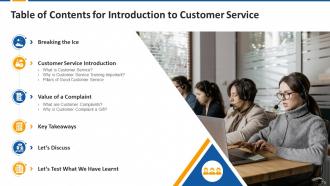
This training module provides a comprehensive introduction to customer service. The PPT deck includes the definition and pillars of customer service and the importance of undergoing customer service training. It also compares the difference between customer service and customer experience. Further, it includes the cause behind customer complaints and the multiple benefits they offer to a business. The PowerPoint deck also contains discussion questions, MCQs, and memes to make training sessions interactive. It also contains additional slides on about us, vision, mission, goal, 30-60-90 days plan, timeline, roadmap, training completion certificate, energizer activities, detailed client proposal, and training assessment form.
People who downloaded this PowerPoint presentation also viewed the following :
Content of this Powerpoint Presentation
Slide 5
This slide showcases a meme for customer service training to make the session humorous.
Slide 6
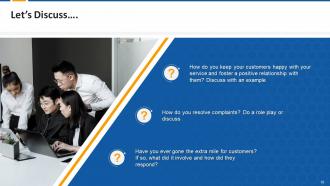
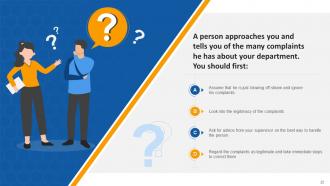
This slide shows questions for customer service training that a trainer can ask trainees to make the session more interactive.
Slide 7
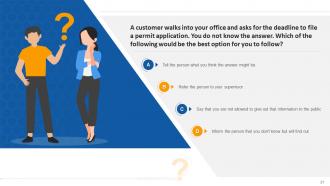
This slide shows a question for the customer service training session.
Slide 9
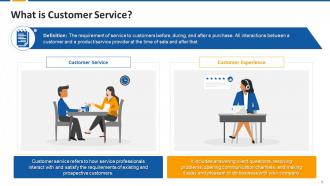
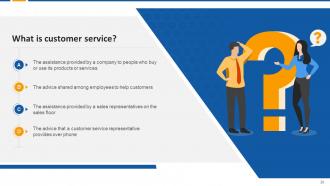
This slide covers the definition of customer service, and it also depicts that customer service includes answering client questions, resolving problems, and opening communication channels.
Instructor Notes:
Why is customer service important for the success of your business?
- Customer service has a significant impact on the company's bottom line. Keeping existing customers is less expensive than finding new ones. It is even predicted that the cost of acquiring new customers is 6–7x higher than retaining one
- Customer service can either create or ruin the company's reputation
- Support is an essential component of the product experience
- Customers are prepared to spend extra for a more satisfying experience
- Internal Customers: are colleagues and departments within your organization
- External Customers: are more likely to be consumers, users, and stakeholders
Example – Starbucks Coffee
- Internal customers will be everyone from the company's Board of Directors to the executives and team members that serve beverages at the customer interface
- External customers will be the everyday people that come to the coffee shop and buy beverages for themselves and their friends
Slide 10
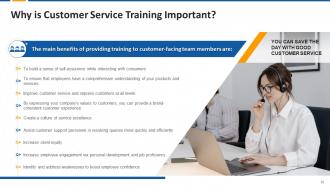
This slide covers details on the importance of customer service training in the company. It also depicts that training a customer-facing team will help them solve inquiries faster and more efficiently.
Instructor Notes:
Instructor can ask these questions to his classroom to initiate discussions:
- What do you think would make a client satisfied and eager to remain around if they had an urgent query about your product and approached your customer care team?
- Is it a generic email response or a well-researched response from a service professional who cares about their success?
Regardless of how talented the new employees are, companies should conduct training that aligns everyone on working together and best represent the company.
Slide 11
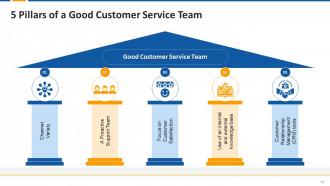
This slide covers five pillars of the customer service team: channel variety, proactive customer service team, focus on customer satisfaction, usage of an internal and external knowledge base, and customer relationship management (CRM) tools.
Instructor Notes:
- Channel variety: Social Media, Live Chat, Email, Phone calls, Self-service, Omnichannel
- A proactive customer service team: Willing to go the extra mile, Empathetic, Patient, Responsive, and Positive
- A focus on customer satisfaction: Focus on creating loyal customers, Training to avoid poor customer service, Extra attention to new customers
- Use of an internal and external knowledge base: Customer FAQ, Onboarding or training FAQ, Customer service tips, External pages with information for customers. Examples include web pages, blogs, video content, and product guides
- Customer relationship management (CRM) tools: Contact management, Tracking interactions, Scheduling and reminders
Slide 13
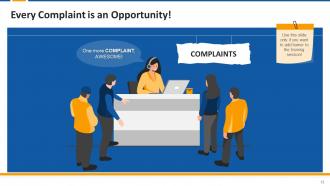
The purpose of this slide is to showcase a meme for customer complaints.
Slide 14
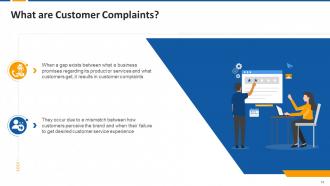
This slide provides information regarding the definition of customer complaints. It also contains details about why do they occur.
Slide 15
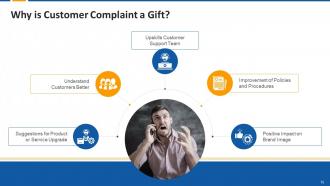
The purpose of this slide is to showcase the importance of customer complaints for business. It contains benefits details such as product or service upgrade, understands customers better, upskills customer support team, improvement of policies and procedures, and positive impact on brand image.
Instructor’s Notes:
The customer complaints are important for business due to the following reasons:
- Product/service upgrade: Customer complaints act as a reality check as it helps businesses identify substandard products or services and devise strategies for their improvement
- Understand customers better: Complaints help understand customers' expectations better to effectively structure product offerings, to win them back eventually
- Upskills customer support team: If customer complaints are due to the customer support team's improper skills, necessary training can be provided to upskill them
- Customer satisfaction enhancement: Customer complaints, if resolved appropriately, helps in improving their satisfaction levels, turning them into loyal customers
- Improvement of policies and procedures: Customers' negative feedback also highlights flaws in the company's internal processes and provide suggestions to improve them
- Positive impact on brand image: Resolved customer complaints enhances brand image as customers act as advocates of superior service provided by the organization
Slide 17
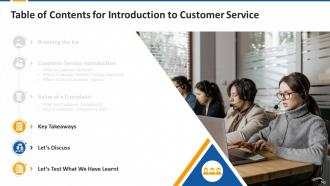
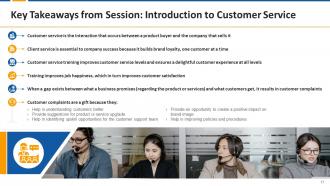
This slide depicts the summary of introduction to customer service training session.
Slide 38 to 52
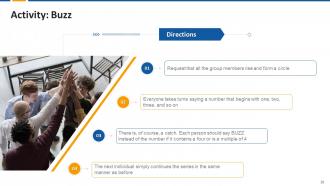
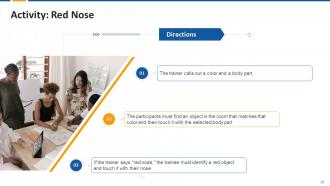
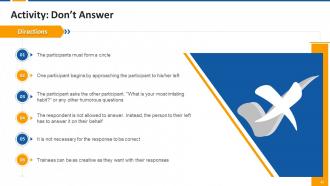
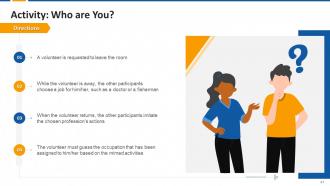
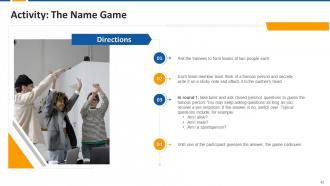
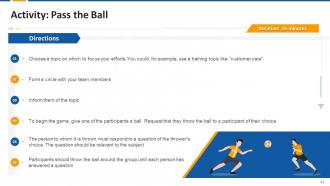
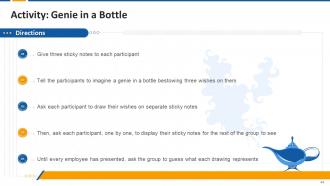
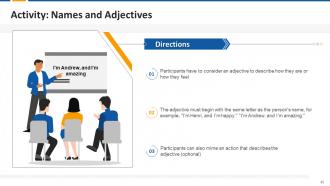
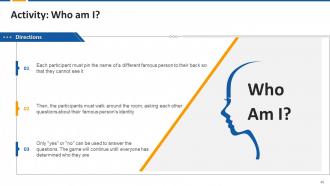
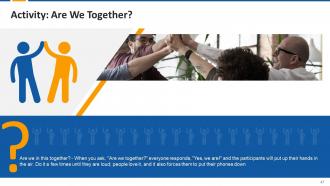
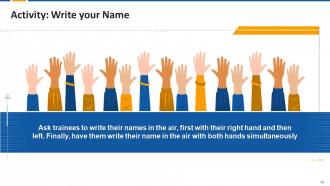
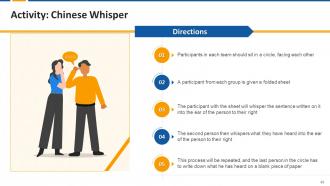
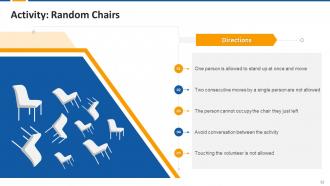
These slides depict energizer activities to engage the audience of the training session.
Slide 54
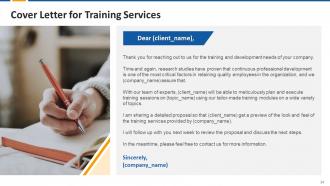
This slide highlights the cover letter for the training proposal. It includes details regarding what the company providing corporate training can accomplish for the client.
Slide 57
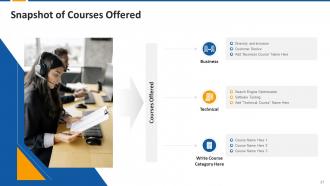
The purpose of this slide is to showcase the multiple types of courses offered by the training company.
Slide 59
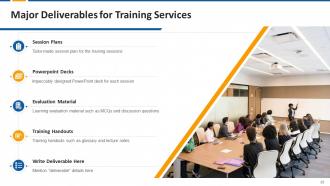
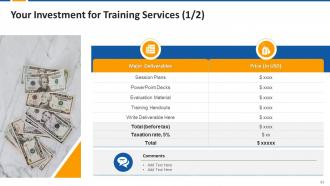
This slide indicates the major deliverables that the corporate training firm will provide to the client. The key deliverables highlighted are session plans, PowerPoint deck, evaluation material, and training handouts.
Slide 61
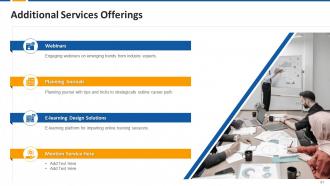
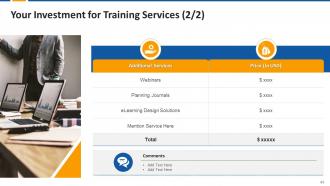
This slide represents the multiple additional services offered by the training firm to the client, such as webinars, planning journals, and e-learning design solutions.
Slide 63
This slide tabulates the major deliverables offered by the training company to the client along with their associated costs.
Slide 64
The purpose of this slide is to highlight the multiple additional services offered by the training firm along with their cost details.
Slide 66
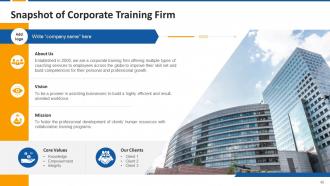
This slide provides an overview of the corporate training firm's vision and mission statements, core values, and key clients.
Slide 68
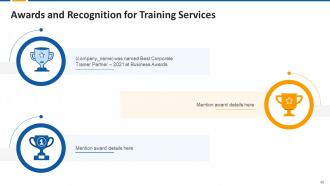
This slide highlights the major awards and recognition won by the training firm for their exceptional service to clients.
Slide 70
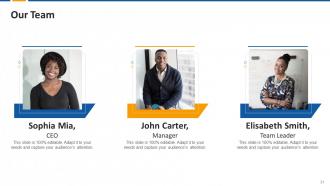
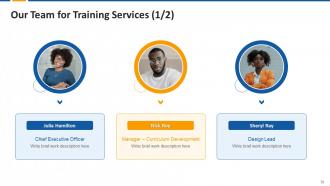
The slide provides information regarding the team members that would be providing the training services to the client. It includes details of the trainer and their respective designations.
Slide 71
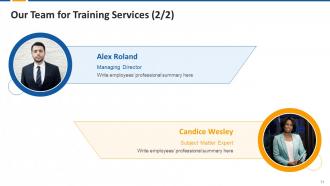
The slide provides information regarding the team members that would be providing the training services to the client. It includes details of the employees’ names and their respective designations.
Slide 73
This slide provides information pertaining to testimonials given by satisfied clients of the training firm.
Slide 74
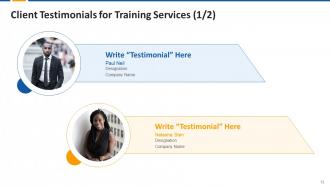
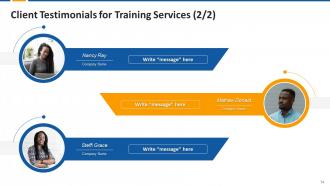
This slide highlights the testimonials from multiple satisfied clients of the training firm providing information regarding congratulatory messages, client name, and company details.
Slide 76
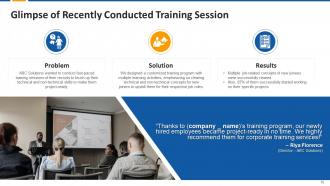
This slide showcases the case study for the training proposal. It includes information regarding the problem faced by the client and solutions offered by the training firm. It also covers details of the results and client testimonial.
Slide 78
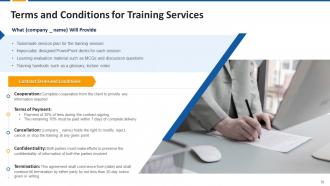
This slide provides information regarding the contract terms and conditions of the training proposal. It also includes details of deliverables that the training company will provide to the client.
Slide 80
The purpose of this slide is to provide the contact information of the corporate training firm. It includes the firm’s official address, contact number, and email address.
Slide 81
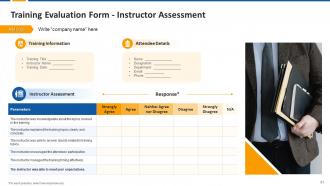
This slide highlights the training evaluation form for instructor assessment. It also includes sections to fill details of training information and attendee details.
Slide 82
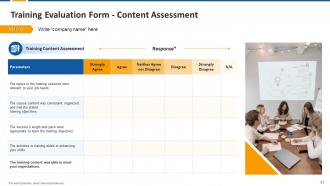
This slide showcases the questions for the assessment of the training content by the attendees.
Slide 83
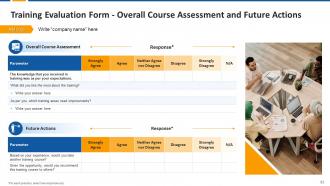
The slide indicates the evaluation form for course assessment. It also includes questions pertaining to the future actions of the attendees.
Introduction to Customer Service Training Module on Customer Service Edu Ppt with all 88 slides:
Use our Introduction to Customer Service Training Module on Customer Service Edu Ppt to effectively help you save your valuable time. They are readymade to fit into any presentation structure.











FAQs for Introduction to Customer Service Training Module on Customer
Hey! So I'd hit four main things: communication skills, knowing your products really well, problem-solving methods, and emotional intelligence stuff. The communication part is huge - most people suck at actually listening because they're already planning what to say next. Your team needs to know every product detail, then learn how to handle angry customers without losing their cool. Honestly, the emotional intelligence training might be the most important part? It keeps everyone calm when things get heated. Oh, and definitely do role-playing exercises - way better than just talking through scenarios.
Honestly, role-playing is a game changer for training your team. Let them practice dealing with angry customers and those bizarre situations that always come up - you know the ones I'm talking about. It's way better than just handing them a manual about de-escalation. They can screw up without any real damage, which is huge. I'd set up different scenarios each week and have people take turns being the difficult customer. You'll see what clicks and what doesn't right away. Plus your reps actually get to feel that pressure beforehand instead of being thrown to the wolves.
Track your CSAT scores, NPS, and first-call resolution rates first - those show immediate wins. Employee confidence surveys are honestly where you'll see the most telling changes. When your team feels equipped, everything else follows. Also monitor average handle time and escalation rates. Oh, and don't sleep on retention data for both customers and staff. Mix the hard numbers with actual feedback from real customer calls. Set your baselines before training starts, then check progress at 30, 60, and 90 days. That's when you'll really see what's working.
First thing - talk to each team about what actually drives them crazy with customers. Sales deals with pushback on pricing, support handles angry people whose stuff broke, finance gets yelled at about bills. Totally different problems. Build training around those real situations, not some boring generic "customer is always right" nonsense. Role-play the messy scenarios they face daily. Finance arguing with someone over a $50 charge? Practice that. Marketing fielding weird product questions? Work on it. Don't forget cross-department stuff either since customers bounce around between teams.
Oh man, the tech stuff has totally changed how we train customer service teams. AI simulations let your people practice tricky situations without pissing off real customers - which is honestly brilliant. Most companies are doing chatbot training now since everyone hits the bot first anyway. Video role-plays work great too. Real-time coaching during live calls is probably the biggest game-changer though. VR for complex scenarios is getting popular but might be overkill depending on your budget. I'd look at what training tech you're actually using right now - bet there's gaps you haven't thought of.
Honestly, start with helping your team understand their own emotional triggers - that's huge. Then teach them how to pick up on customer emotions through tone and word choices. Role-playing is where the magic happens though. I've watched teams completely flip after practicing de-escalation with angry customer scenarios. They learn to spot the real emotion behind complaints. Active listening and empathy responses are key skills to drill. Self-regulation too when you're dealing with someone who's completely losing it. Keep it hands-on, not just theory. Try having them practice mirroring techniques and emotional labeling in your next session.
Definitely do shadowing first - have them watch experienced reps for a few days, then switch to co-handling calls where the newbie leads but has backup. Cover your tools and escalation stuff early too. I know it's tempting to just throw them on calls when you're swamped, but trust me, that always bites you later. Role-play the tricky conversations before they go solo. Oh, and daily check-ins for their first two weeks are clutch - catches problems early and keeps their confidence up. Way better than dealing with a frustrated new hire who's been struggling alone for weeks.
Honestly, dig into what customers are actually saying - complaints AND compliments. When you keep seeing the same issues pop up (like "your rep seemed rushed"), boom, there's your training topic. I get way more excited about specific feedback than those useless generic surveys, tbh. Grab actual quotes from customer comments for role-play exercises. Super helpful. Track your metrics before and after you update training so you know if it's working or just... not. Oh, and maybe start small? Review last month's feedback and find your top three problem areas first.
So cross-cultural training basically teaches you how different people like to be treated as customers. Some cultures are super direct, others beat around the bush. Honestly, the relationship-building thing is huge - certain customers need to chat and connect before they'll buy anything. You'll pick up on communication styles that prevent awkward misunderstandings. Like when to be formal vs casual, or if small talk is actually required. Oh, and you'll know about holidays that might affect what they need. I'd start with whatever customer groups you see most often and just adapt from there.
Honestly? Every 6-12 months is the sweet spot, but it really depends on your setup. Tech companies should probably do it quarterly since everything changes so fast. More stable industries can get away with once a year. Here's the thing though - don't just set it and forget it. Base your updates on actual stuff that's happening. New tools, process changes, whatever complaints keep popping up. I always tell people to track their most common customer issues and use that data to figure out what needs tweaking in the next round. Way more effective than generic training modules.
Honestly, the trick is making it actually matter to them personally. Show how better customer service skills = way less stressful days and fewer nightmare interactions. Skip the generic role-play stuff - use real situations from your actual workplace instead. I'm a big fan of gamification too, like competitions or little achievement badges for different skills they master. What really works though? Connect it to what THEY want - easier shifts, promotions, or just feeling confident when Karen starts yelling about her expired coupon lol. Next time, ask them straight up what situations make them want to hide in the break room.
Honestly, role-playing scenarios work best - sounds cheesy but it's true. Train your team on de-escalation and active listening first. Most conflicts happen because of miscommunication anyway. Have them acknowledge the customer's feelings before jumping into solutions. That approach actually works. You should focus on your top three complaint types and build training around those specific situations. Don't forget empathy responses and when to escalate to managers. Oh, and practice with real scenarios your reps face - makes a huge difference when someone's actually screaming at them later.
Honestly, mix it up with interactive workshops, short videos, and role-playing. Videos are perfect for the basics - keep them under 10 minutes though or people zone out. But workshops? That's where the magic happens. Your team gets to practice those nightmare customer conversations and actually get feedback in real time. Role-playing builds confidence before they deal with the real jerks (we've all had those customers, right?). I'd kick off with a solid workshop, then sprinkle in videos throughout the year for refreshers. Nothing replaces hands-on practice with actual scenarios.
Dude, gamification is a total game-changer for training. Points and badges make everything way less soul-crushing than those PowerPoint marathons. Set up challenges where people earn points for completing modules or nailing those tricky customer scenarios. Team competitions work great too - pit groups against each other for best satisfaction scores. Build progression levels like "Support Rookie" to "Customer Hero" as they level up skills. Honestly, the trick is making it feel fun instead of mandatory. Start simple with just points and see how they react before going crazy with bells and whistles.
Honestly, the biggest pain is people just zone out behind their screens - way different energy than in-person role plays. Plus you miss those quick teaching moments when someone's struggling and you can't just walk over. What's worked for me is chopping everything into like 15-20 minute chunks with breakout rooms for practice. Screen sharing helps too - I'll pull up actual customer calls and we'll dissect them together. Oh, and definitely do follow-up calls one-on-one, that's where the real learning happens. It's all about making it feel less like a webinar and more like actual training, you know?
-
This visual representation is stunning and easy to understand. I like how organized it is and informative it is.
-
SlideTeam was so customer-centric and quick service-provider that I doubted the amount I was paying and literally re-checked the transaction.