


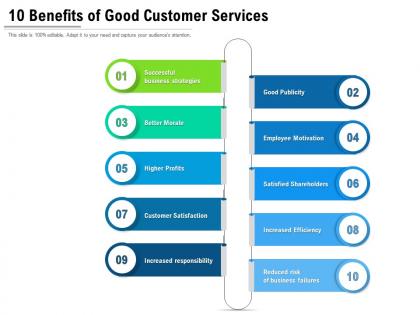
10 benefits of good customer services




Try Before you Buy Download Free Sample Product
 Impress Your
 Audience
 100%
100% Editable
 Save Hours
 of Time


Our 10 Benefits Of Good Customer Services are topically designed to provide an attractive backdrop to any subject. Use them to look like a presentation pro.
People who downloaded this PowerPoint presentation also viewed the following :
10 benefits of good customer services with all 2 slides:
Use our 10 Benefits Of Good Customer Services to effectively help you save your valuable time. They are readymade to fit into any presentation structure.

FAQs for 10 benefits of
Honestly, it comes down to three big things. Speed matters most - people lose their minds waiting for replies on social media or chat. Use their actual data for personalization, not just that fake "Hi Sarah!" stuff. Oh, and here's what drives me crazy as a customer: having to explain my problem all over again when I switch from email to phone. Your team needs one system where they can see everything about that person's issue. Otherwise you'll have angry customers repeating themselves constantly. Get a platform that shows the whole story in one place. Makes everyone's life easier.
Look, going above and beyond builds real trust with customers - they actually start caring about your brand instead of just buying stuff. People won't bail on you for competitors even when there's cheaper options out there. Happy customers basically become free advertising through referrals, which is honestly the best marketing you can get. Train your team to see every single interaction as relationship-building, not just problem-solving. It's kinda like friendship - treat people well and they'll have your back. Short interactions, long-term loyalty.
Dig into what customers are actually complaining about - not just star ratings but the real details about slow service, clueless staff, whatever. Most companies just dump feedback into spreadsheets and forget about it (such a missed opportunity). Set up weekly reviews where you assign fixes to actual people. Here's the kicker though - circle back and tell customers what you changed because of their input. They'll turn into your biggest fans. Oh, and focus on patterns, not one-off complaints. That's where the real problems hide.
So tech can really speed up your customer service game. Chatbots give instant answers, CRM systems keep track of everyone's history, and AI actually predicts what customers want before they ask - which is honestly pretty cool when it works right. The automation alone will save you tons of time on boring repetitive stuff. Live chat, screen sharing, mobile apps... there's so many ways to connect now. Don't just grab the flashiest tool though. Figure out what's actually broken in your service first, then find tech that fixes those specific problems.
Honestly, start with the basics - CSAT scores, Net Promoter Score, and first-call resolution rates. Response times are huge too, especially for chat support (email's a bit more forgiving). But here's the thing - numbers don't tell you everything. I always dig into the actual customer comments because that's where you find out what's really going wrong. Quick surveys help too. My advice? Pick 2-3 metrics that actually matter for your business goals first. You can always add more once you've got those dialed in. Don't overwhelm yourself right out the gate.
Oh man, the worst thing is when customers get bounced around to like three different people who all say something different. Kills trust instantly. Slow response times are brutal too - nobody wants to wait forever for help. Companies get obsessed with closing tickets fast instead of actually fixing the problem, which is backwards if you ask me. Undertrained staff who can't solve anything? Recipe for disaster. Train your people properly, give them clear escalation rules, and actually follow up to make sure the issue got resolved. That last part is huge.
Dude, training is everything - seriously can't stress this enough. Most companies think they're doing fine but they're really not. Your team needs way more than just boring policy stuff (though yeah, that matters). Focus on communication skills and problem-solving first. Give people confidence to actually make decisions when things get messy. I've watched businesses completely flip their customer satisfaction just from better training programs. Communication skills matter more than you'd think. Start by looking at what you're doing now - I bet there's huge gaps you haven't noticed.
Honestly, customer service can make or break your whole business. Happy customers become your best marketing team - they'll tell everyone how great you are. Screw up though? They'll blast you all over social media and review sites. I've seen companies lose months of good marketing because of one terrible customer interaction. People remember how you treated them way more than what you actually sold them, which is kinda crazy when you think about it. Train your team properly and jump on complaints fast. Your reputation literally depends on it.
Dude, personalized service is honestly a game changer. Customers feel like you actually give a shit about them instead of treating them like walking dollar signs. So instead of the boring "how can I help you today," try something like "hey, still having issues with that software update from last week?" Way better connection right there. I mean, you're already collecting all this data anyway - might as well use it. When people feel understood, they stick around longer and buy more stuff. It's basically showing them you remember who they are as individuals.
Stay calm and actually listen to what's making them mad - not just how they're saying it. First thing is acknowledging their frustration before you try fixing anything. "I get why that's frustrating" is magic, even when they're being completely nuts about it. Focus on what you CAN actually do instead of rattling off policies. Honestly, half the time they just need to rant for a sec before they'll work with you. Oh, and write everything down after so your coworkers aren't blindsided if they call again.
Honestly, you need both speed AND quality metrics or you're flying blind. Track response times and first-call resolution for efficiency stuff. But customer satisfaction and NPS scores? Way more important IMO - fast doesn't mean good if you're not actually fixing anything. Also keep an eye on agent happiness and turnover because miserable staff = miserable customers, always. Oh and don't go crazy with like 15 different metrics right away. Pick 3-4 that actually matter to your business and start there.
So basically you want customers contacting you however they like - phone, email, chat, whatever works for them. Way better than forcing everyone to call when half your customers probably hate talking on the phone anyway. You'll catch issues faster too since people can reach out their preferred way instead of just giving up. The trick is making sure all your channels actually sync up so customer info doesn't get lost between platforms. Honestly, I'd just start with whatever channels your customers already use most. No point setting up fancy stuff nobody wants.
Honestly, automation works best when it handles the boring stuff - password resets, basic questions, routing tickets to the right people. Chatbots can knock out FAQs no problem. Your team gets AI suggestions for faster responses too, which is pretty helpful. But here's the thing - don't go full robot mode because customers totally know when they're talking to a machine. It's kinda obvious. Save your actual humans for the tricky situations where someone's really frustrated or the issue is complicated. Let automation do the grunt work so your agents can have real conversations instead.
So basically, customer service recovery is your backup plan for when stuff inevitably goes sideways. Server dies, wrong pizza gets delivered, billing gets screwed up - whatever. Here's the thing though: how you fix it matters way more than the actual mistake. People literally remember great recovery better than flawless service, which honestly surprised me when I first learned that. You want to move fast, show you actually care, and do more than just patch the problem. Oh, and give your team power to comp things or offer solutions without having to call their manager every single time.
Honestly, stories work way better than just spitting out policy stuff. When someone's frustrated, I'll say something like "Oh man, I had another customer last week with this exact same mess, and here's how we sorted it out." People actually listen because they feel heard instead of like they're talking to a robot. Quick 30-second stories make everything click better - complex solutions suddenly make sense. It's weird how much it changes the vibe of the whole conversation. Try it next time you're explaining something tricky to a customer.
-
Excellent Designs.
-
Easily Editable.
-
Top Quality presentations that are easily editable.
-
Excellent work done on template design and graphics.