


Smart Grid Implementation IoT Based Electricity Energy Meter Reading Via Internet




Try Before you Buy Download Free Sample Product
 Impress Your
 Audience
 100%
100% Editable
 Save Hours
 of Time


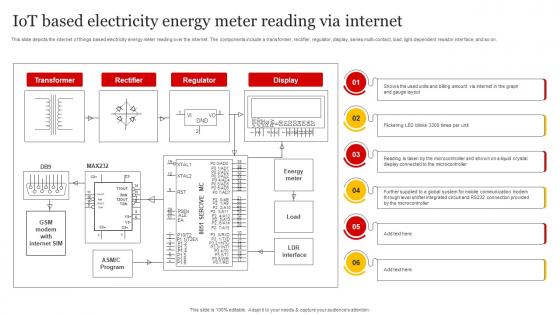
This slide depicts the internet of things based electricity energy meter reading over the internet. The components include a transformer, rectifier, regulator, display, series multi-contact, load, light-dependent resistor interface, and so on.
People who downloaded this PowerPoint presentation also viewed the following :
Smart Grid Implementation IoT Based Electricity Energy Meter Reading Via Internet with all 9 slides:
Use our Smart Grid Implementation IoT Based Electricity Energy Meter Reading Via Internet to effectively help you save your valuable time. They are readymade to fit into any presentation structure.








FAQs for Smart Grid Implementation IoT Based Electricity Energy Meter
Smart Grid IoT metering systems include smart meters, communication networks, data management platforms, analytics software, and grid management systems. These interconnected components streamline energy distribution by enabling real-time monitoring, automated billing, and predictive maintenance, with utilities across power, water, and gas sectors finding that this integration ultimately delivers enhanced operational efficiency and improved customer experiences.
IoT meters revolutionize energy consumption monitoring by delivering real-time data collection, automated meter readings, detailed usage analytics, and predictive maintenance capabilities for both consumers and utility providers. Through smart sensors and wireless connectivity, consumers gain granular insights into their energy patterns while utilities streamline operations, reduce manual inspections, and optimize grid management, ultimately delivering enhanced efficiency and cost savings.
Data analytics plays a crucial role in smart grid IoT metering by transforming raw consumption data into actionable insights through predictive modeling, pattern recognition, and real-time anomaly detection. These analytics enable utilities to optimize energy distribution, predict equipment failures, and enhance grid reliability, while consumers benefit from personalized energy recommendations and cost savings, ultimately delivering improved operational efficiency across the entire electrical infrastructure.
Smart Grid IoT metering enhances renewable energy integration by providing real-time monitoring of energy production and consumption, enabling dynamic load balancing, and facilitating two-way communication between utilities and consumers. These smart systems streamline grid management by predicting energy fluctuations, optimizing storage deployment, and automatically adjusting distribution patterns, ultimately delivering improved grid stability and reduced operational costs.
Smart Grid IoT metering faces cybersecurity threats including data breaches, device vulnerabilities, network intrusions, unauthorized access, and privacy concerns around energy consumption patterns. These challenges can be mitigated through end-to-end encryption, multi-factor authentication, regular security updates, and network segmentation, with many utilities finding that comprehensive cybersecurity frameworks ultimately deliver enhanced grid resilience and customer trust.
Smart Grid IoT metering impacts consumer energy tariffs by enabling dynamic pricing models, time-of-use rates, and personalized billing structures based on real-time consumption patterns. Through advanced metering infrastructure, utility companies can offer competitive pricing tiers, peak-hour adjustments, and demand-response incentives, while consumers gain transparency in usage costs, ultimately delivering lower bills and enhanced energy efficiency.
Smart Grid IoT metering facilitates real-time data communication through wireless connectivity, cloud-based platforms, automated meter reading systems, and advanced sensor networks that continuously transmit consumption data. These technologies streamline utility operations by enabling instant usage monitoring, dynamic pricing adjustments, and predictive maintenance scheduling, with many energy providers finding that real-time communication ultimately delivers enhanced grid efficiency and improved customer experiences.
Smart Grid IoT metering innovations include advanced analytics platforms, edge computing capabilities, blockchain-based security protocols, AI-powered demand forecasting, and real-time bidirectional communication systems. These technologies streamline energy distribution by enabling predictive maintenance, automated load balancing, and dynamic pricing models, with utilities increasingly finding that integrated smart metering delivers enhanced operational efficiency and improved customer experiences.
Regulatory policies significantly accelerate Smart Grid IoT metering adoption by establishing mandatory deployment timelines, data privacy standards, and interoperability requirements across utility networks. These frameworks enable utilities to justify infrastructure investments, ensure consumer protection, and streamline grid modernization efforts, with many energy providers finding that compliance-driven implementations ultimately deliver enhanced operational efficiency and improved customer services.
Advanced metering infrastructure (AMI) delivers real-time energy consumption data, two-way communication capabilities, remote meter reading, automated outage detection, and enhanced grid monitoring across utility networks. These technologies streamline operations by reducing manual meter reading costs, enabling dynamic pricing models, and facilitating faster service restoration, with many utilities finding that AMI ultimately enhances customer engagement while delivering significant operational efficiencies.
Smart Grid IoT metering accelerates disaster recovery by providing real-time network visibility, enabling automated fault isolation, and facilitating rapid service restoration through precise damage assessment. These systems streamline emergency response by identifying critical infrastructure needs, prioritizing restoration efforts, and delivering continuous monitoring capabilities, with utilities finding that IoT-enabled grids reduce outage duration and enhance community resilience significantly.
Smart Grid IoT metering systems deliver significant environmental benefits through reduced energy consumption, minimized carbon emissions, optimized resource allocation, enhanced renewable energy integration, and decreased infrastructure waste. These technologies enable utilities and organizations to streamline operations by providing real-time consumption data, facilitating demand response programs, and supporting sustainable energy practices, ultimately delivering lower environmental impact while enhancing operational efficiency.
Interoperability standards significantly streamline Smart Grid IoT metering deployment by ensuring seamless communication between devices, reducing integration costs, and accelerating system rollouts across utility networks. These standards enable utilities to mix vendors and technologies while maintaining operational efficiency, with many power companies finding that standardized protocols deliver faster implementation timelines and enhanced grid reliability.
Consumer engagement and education are critical for Smart Grid IoT metering success, driving adoption through awareness of energy usage patterns, cost-saving opportunities, real-time monitoring benefits, and environmental impact reduction. These initiatives enable utilities to achieve demand response goals, reduce peak load strain, and enhance grid stability, while empowered consumers make informed energy decisions that ultimately deliver system-wide efficiency and customer satisfaction.
Machine learning algorithms enhance Smart Grid IoT metering efficiency by predicting energy demand patterns, detecting anomalies in real-time, and optimizing grid load distribution automatically. These intelligent systems enable utilities to reduce operational costs, prevent outages before they occur, and deliver more reliable energy services, with many power companies finding that predictive analytics ultimately streamlines resource allocation while improving customer satisfaction.
-
The PPTs are extremely simple to modify. Thank you for providing the slides that are ready to be used. They assist me in saving a lot of time.
-
Unique design & color.