


Smart Manufacturing Dashboard For Inventory Management Enabling Smart Manufacturing




Try Before you Buy Download Free Sample Product
 Impress Your
 Audience
 100%
100% Editable
 Save Hours
 of Time


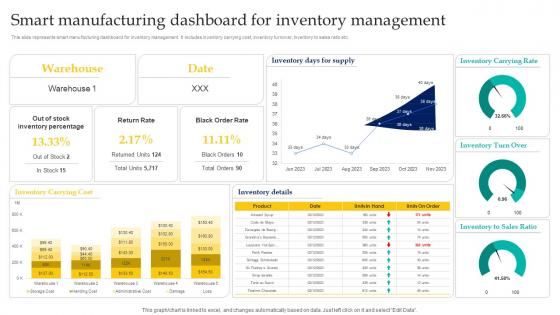
This slide represents smart manufacturing dashboard for inventory management. It includes inventory carrying cost, inventory turnover, inventory to sales ratio etc.
People who downloaded this PowerPoint presentation also viewed the following :
Smart Manufacturing Dashboard For Inventory Management Enabling Smart Manufacturing with all 7 slides:
Use our Smart Manufacturing Dashboard For Inventory Management Enabling Smart Manufacturing to effectively help you save your valuable time. They are readymade to fit into any presentation structure.






FAQs for Smart Manufacturing Dashboard For Inventory Management
Smart manufacturing dashboards should include Overall Equipment Effectiveness (OEE), production throughput, downtime tracking, quality metrics, and energy consumption indicators. These KPIs enable manufacturers to streamline operations by identifying bottlenecks, minimizing waste, and optimizing resource allocation, with many facilities finding that real-time visibility ultimately delivers improved productivity and competitive advantage.
Real-time data analytics enhances smart manufacturing decision-making by providing instant visibility into production metrics, equipment performance, and quality indicators, enabling immediate responses to operational changes. Through continuous monitoring dashboards, manufacturers can optimize resource allocation, predict maintenance needs, and adjust production schedules dynamically, ultimately delivering improved efficiency and reduced downtime across operations.
Technologies enabling IoT device integration in smart manufacturing dashboards include edge computing, industrial communication protocols like MQTT and OPC-UA, cloud platforms, APIs, and real-time data processing engines. These technologies streamline operations by enabling seamless device connectivity, automated data collection, and instant performance monitoring, with manufacturers finding that integrated dashboards deliver enhanced visibility and faster decision-making capabilities.
Smart manufacturing dashboards enhance predictive maintenance by analyzing real-time sensor data, identifying equipment performance patterns, and forecasting potential failures before they occur. Through advanced analytics and machine learning algorithms, manufacturers can schedule maintenance proactively, minimize unexpected downtime, and reduce repair costs, with many industrial facilities finding significantly improved operational efficiency and equipment longevity.
Data visualization improves manufacturing team communication by transforming complex operational data into clear, accessible formats that enable faster decision-making, reduce misunderstandings, and align cross-functional teams around shared metrics. Through interactive dashboards and real-time visual reports, production managers, quality control specialists, and maintenance teams can quickly identify bottlenecks, coordinate responses, and ultimately enhance operational efficiency while minimizing costly miscommunications.
Cloud computing enables smart manufacturing dashboards by providing scalable data storage, real-time processing capabilities, and seamless integration across multiple production facilities. Through cloud infrastructure, manufacturers can centralize operations data, enable remote monitoring and control, and facilitate predictive analytics, while reducing IT costs and enhancing system flexibility, ultimately delivering improved operational visibility and faster decision-making capabilities.
Manufacturers ensure dashboard data accuracy through real-time sensor validation, automated data cleansing protocols, standardized integration APIs, and regular system audits. These technologies streamline operations by eliminating manual errors, enhancing predictive maintenance capabilities, and delivering consistent reporting across production lines, with many manufacturing facilities finding that integrated validation systems ultimately reduce downtime while improving operational efficiency.
Mobile-friendly smart manufacturing dashboards enable real-time monitoring, remote troubleshooting, instant alert notifications, enhanced collaboration, and flexible accessibility across devices. These platforms streamline operations by allowing managers to track production metrics from anywhere, respond to equipment issues immediately, and coordinate with teams seamlessly, ultimately delivering faster decision-making and improved operational efficiency.
Machine learning algorithms enhance manufacturing dashboards by enabling predictive maintenance, real-time quality control, demand forecasting, and automated anomaly detection across production lines. These intelligent systems streamline operations by analyzing vast datasets, identifying patterns before issues occur, and optimizing resource allocation, with many manufacturers finding that ML-powered dashboards ultimately deliver reduced downtime and significantly improved operational efficiency.
Manufacturers face integration complexity with legacy systems, data quality issues from multiple sources, employee training requirements, and significant upfront investment costs. While these challenges present initial hurdles, many organizations find that strategic implementation ultimately delivers enhanced operational visibility, reduced downtime, and improved decision-making capabilities, providing substantial competitive advantages in increasingly automated manufacturing environments.
A smart manufacturing dashboard facilitates regulatory compliance by providing real-time monitoring of quality metrics, automated documentation of production processes, and instant alerts for deviations from standards. Through centralized data visualization, manufacturers can track FDA, ISO, or safety requirements continuously, generate audit-ready reports automatically, and respond to compliance issues immediately, ultimately reducing regulatory risks while streamlining inspection processes.
Traditional manufacturing dashboards display basic metrics like production volume and downtime, while smart dashboards integrate real-time IoT data, predictive analytics, machine learning insights, and automated alerts. Smart dashboards enable manufacturers to anticipate equipment failures, optimize resource allocation, and enhance operational efficiency through advanced visualization, with many facilities finding significantly improved decision-making capabilities.
User customization and interactivity enable operators to personalize their dashboard views, configure alerts based on their specific responsibilities, and access relevant data through intuitive drill-down capabilities. These features streamline workflow efficiency by reducing information overload, minimizing response times to critical issues, and enhancing operator engagement, ultimately delivering improved productivity and faster decision-making across manufacturing operations.
Historical data analysis in smart manufacturing dashboards reveals equipment performance patterns, production bottlenecks, quality trends, predictive maintenance needs, and resource utilization cycles. These insights enable manufacturers to optimize production schedules, reduce downtime, improve quality control, and streamline operations, with many facilities finding that data-driven decisions ultimately deliver significant cost reductions and enhanced competitive advantage.
Smart manufacturing dashboards contribute to sustainability by monitoring energy consumption, tracking waste generation, optimizing resource utilization, and measuring carbon footprints in real-time. Through advanced analytics and automated alerts, manufacturers can identify inefficiencies, reduce material waste, and minimize environmental impact, with many organizations finding that data-driven sustainability initiatives ultimately deliver cost savings and enhanced regulatory compliance.
-
Use of different colors is good. It's simple and attractive.
-
I never had to worry about creating a business presentation from scratch. SlideTeam offered me professional, ready-made, and editable presentations that would have taken ages to design.