


Social Media Candidate Awareness Journey Social Recruiting Strategy




Try Before you Buy Download Free Sample Product
 Impress Your
 Audience
 100%
100% Editable
 Save Hours
 of Time


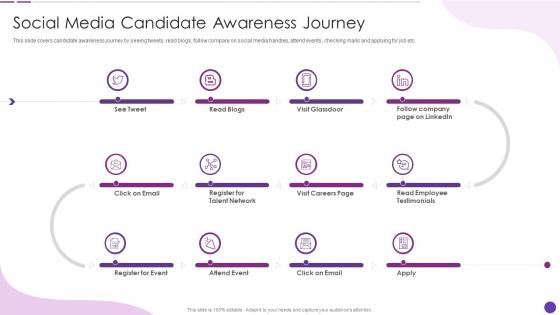
This slide covers candidate awareness journey by seeing tweets, read blogs, follow company on social media handles, attend events, checking mails and applying for job etc.
People who downloaded this PowerPoint presentation also viewed the following :
Social Media Candidate Awareness Journey Social Recruiting Strategy with all 6 slides:
Use our Social Media Candidate Awareness Journey Social Recruiting Strategy to effectively help you save your valuable time. They are readymade to fit into any presentation structure.
-
Social Media Candidate Awareness Journey Social Recruiting Strategy
-

Social Media Candidate Awareness Journey Social Recruiting Strategy
-

Social Media Candidate Awareness Journey Social Recruiting Strategy
-

Social Media Candidate Awareness Journey Social Recruiting Strategy
-

Social Media Candidate Awareness Journey Social Recruiting Strategy
-

Social Media Candidate Awareness Journey Social Recruiting Strategy
FAQs for Social Media Candidate Awareness Journey
Social recruiting offers enhanced candidate reach, cost-effectiveness, faster hiring cycles, better cultural fit assessment, and improved employer branding compared to traditional methods. Through platforms like LinkedIn and Twitter, organizations streamline talent acquisition by accessing passive candidates, reducing recruitment costs, and leveraging social insights for cultural alignment, ultimately delivering competitive advantage in increasingly tight talent markets.
Employers can effectively leverage social media by showcasing company culture through authentic content, engaging with industry professionals, posting targeted job opportunities, and utilizing platform-specific recruiting tools like LinkedIn Recruiter and Facebook Jobs. Through strategic social recruiting, organizations streamline talent acquisition, reach passive candidates more effectively, and build stronger employer brands, with many companies finding that social platforms significantly reduce hiring costs while attracting higher-quality candidates.
Companies should track engagement rates on job postings, application quality scores, time-to-hire reductions, cost-per-hire improvements, and candidate source attribution across platforms. These metrics enable organizations to optimize their social recruiting strategies by identifying high-performing channels, measuring ROI, and enhancing candidate experiences, with many finding that comprehensive tracking ultimately delivers faster hiring and stronger talent pipelines.
Social recruiting varies significantly across industries based on talent needs, candidate behavior, and regulatory requirements. Tech companies leverage GitHub and Stack Overflow for developers, healthcare organizations use LinkedIn for specialized roles, while retail brands utilize Instagram and TikTok for customer-facing positions, with financial services maintaining more conservative approaches due to compliance considerations, ultimately enabling targeted talent acquisition strategies.
Best practices for creating an engaging employer brand on social media include sharing authentic employee stories, showcasing company culture through behind-the-scenes content, highlighting career development opportunities, posting diverse team achievements, and actively engaging with candidates' comments and questions. These strategies enhance talent attraction by building trust, demonstrating workplace values, and creating meaningful connections, with many organizations finding that authentic storytelling and consistent engagement significantly improve candidate quality and application rates.
Companies ensure diversity and inclusion in social recruiting by posting on diverse platforms, using inclusive language in job descriptions, partnering with diversity-focused organizations, and actively engaging underrepresented communities online. These strategies help organizations reach broader talent pools, reduce unconscious bias, and build more representative teams, with many companies finding that diverse social networks ultimately deliver stronger candidates and enhanced workplace innovation.
Employee referrals serve as powerful amplifiers in social recruiting by leveraging employees' personal networks, increasing candidate quality through trusted recommendations, and expanding reach beyond traditional recruiting channels. When employees share job postings across their social platforms, organizations access passive candidates more effectively, reduce hiring costs significantly, and improve cultural fit, with many companies finding that referred candidates stay longer and perform better than traditional hires.
Organizations optimize their social media profiles by showcasing company culture through employee testimonials, highlighting career development opportunities, sharing behind-the-scenes content, posting job openings regularly, and maintaining consistent professional branding across platforms. These strategies enhance employer branding by demonstrating workplace values, growth potential, and authentic experiences, with many companies finding that transparent, engaging profiles attract higher-quality candidates and reduce recruitment costs significantly.
**INPUT**: What are the ethical considerations surrounding social recruiting practices? **OUTPUT**: Ethical considerations in social recruiting include privacy boundaries, discrimination prevention, consent transparency, data protection compliance, and maintaining professional standards throughout candidate evaluation. These practices require balancing thorough candidate assessment with respectful information gathering, with many organizations finding that clear social media policies, bias training, and structured evaluation criteria ultimately deliver fair hiring processes while protecting both candidate rights and company reputation. [Word count: 60 words]
Businesses can personalize social media outreach by researching candidates' professional backgrounds, engaging with their content meaningfully, and crafting tailored messages that reference specific skills or achievements. This strategic approach, increasingly used by tech companies and healthcare organizations, enhances candidate engagement, builds authentic relationships, and ultimately delivers higher response rates and quality hires.
Social recruiting significantly enhances candidate experience by providing transparent company insights, streamlined application processes, and direct communication channels with hiring teams and current employees. Through platforms like LinkedIn, Twitter, and Instagram, candidates gain authentic workplace perspectives, faster response times, and personalized interactions, ultimately creating more engaging, informative recruitment journeys that build stronger employer-candidate relationships.
Recruiters can utilize data analytics to refine social recruiting by tracking engagement metrics, analyzing candidate source effectiveness, measuring conversion rates across platforms, and identifying optimal posting times and content types. Through predictive analytics and performance dashboards, organizations streamline talent acquisition processes, enhance candidate targeting precision, and reduce time-to-hire, with many companies finding that data-driven approaches deliver significantly improved recruitment outcomes.
Common pitfalls include inconsistent employer branding across platforms, neglecting candidate privacy concerns, over-relying on algorithms without human oversight, failing to engage authentically with potential hires, and inadequate screening processes. These challenges can result in poor candidate experiences, compliance issues, and misaligned hiring outcomes, with many organizations finding that balanced automation and personal engagement delivers stronger recruitment results.
Remote work has transformed social recruiting by emphasizing digital-first engagement, virtual networking events, and enhanced online employer branding to attract distributed talent. Companies increasingly leverage LinkedIn Live sessions, virtual career fairs, and authentic remote culture content, with many organizations finding that showcasing flexible work policies and digital collaboration tools significantly expands their candidate reach.
Social recruiting tools include applicant tracking systems with social integration, LinkedIn Recruiter, social media management platforms, AI-powered candidate sourcing tools, and automated screening software. These technologies streamline recruitment by aggregating candidate profiles across platforms, automating initial outreach, and filtering applications through intelligent matching algorithms, with many organizations finding faster hiring cycles and improved candidate quality through strategic technology combinations.
-
Great combination of visuals and information. Glad I purchased your subscription.
-
Use of different colors is good. It's simple and attractive.