


Social media marketing mobile marketing ppt presentation




Try Before you Buy Download Free Sample Product
 Impress Your
 Audience
 100%
100% Editable
 Save Hours
 of Time


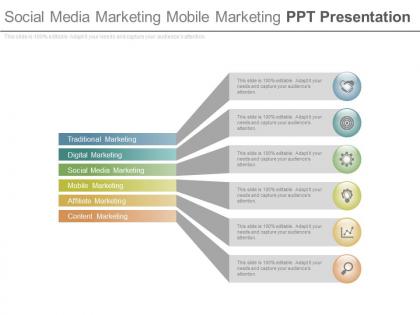
Believe it or not, online profiles and blogospheres are actually the first and foremost effort for increasing sales and winning new clientele. Hours of labor have gone into fabrication of PPT Presentation on Social Media Marketing Mobile Marketing. Establishing the objectives and setting goals is just a click away with our exceptionally peppy social marketing PPT info graphic. The six stages processes layout will streamline your thoughts and incorporation of key points regarding the same in the graphics will enable the audience to catch hold of the central idea of the whole PowerPoint presentation show at once. So once you engage your viewers in your talk regarding media marketing; extending the organizational efforts and ensuring social goals solving challenges will not be any more difficult for you. Whether an aspiring business owner or an entrepreneur wants to provide an overview of organizational social media marketing strategy, or focus individually on six stages process, this media marketing PPT presentation info graphic is a complete beginner’s guide to generating social media marketing plan. Decide to go with our Social Media Marketing Mobile Marketing Ppt Presentation. You will be happy with your choice.
People who downloaded this PowerPoint presentation also viewed the following :
Social media marketing mobile marketing ppt presentation with all 5 slides:
Call upon our Social Media Marketing Mobile Marketing Ppt Presentation whenever you feel. They will gladly come to your aid.


FAQs for Social media marketing mobile
Key elements of a successful social media marketing strategy include clearly defined target audiences, compelling content creation, consistent posting schedules, strategic platform selection, and comprehensive performance analytics. These components work together by building brand awareness, fostering customer engagement, and driving conversions, with many businesses finding that strategic social media presence ultimately delivers increased brand loyalty, enhanced customer relationships, and measurable competitive advantage in increasingly digital marketplaces.
Brands can effectively measure social media ROI by tracking conversion rates, customer acquisition costs, engagement metrics, brand awareness lift, and lifetime customer value across platforms. Through advanced analytics tools, companies in retail, hospitality, and financial services quantify direct sales attribution, lead generation, and cost-per-acquisition, ultimately delivering measurable revenue growth and optimized marketing spend allocation.
Audience segmentation enables social media marketers to deliver personalized content, optimize ad targeting, and maximize engagement by categorizing users based on demographics, behaviors, interests, and purchasing patterns. Through strategic segmentation, brands streamline campaign efficiency, reduce acquisition costs, and enhance customer experiences, with companies like Nike and Starbucks finding that targeted approaches ultimately deliver higher conversion rates and stronger brand loyalty.
Businesses leverage influencer partnerships by identifying niche-relevant creators, developing authentic content collaborations, establishing clear performance metrics, and creating long-term relationship strategies rather than one-off campaigns. Through strategic partnerships, companies enhance brand credibility, reach targeted demographics more effectively, and generate higher engagement rates, with many retail and lifestyle brands finding that micro-influencers often deliver superior ROI.
Best practices for creating visually appealing social media content include maintaining consistent brand colors and fonts, using high-quality images and videos, incorporating strategic white space, creating eye-catching graphics with clear focal points, and optimizing content dimensions for each platform. These approaches enhance audience engagement by improving readability, increasing shareability, and building brand recognition, with many organizations finding that cohesive visual strategies significantly boost conversion rates and follower growth.
Brands maintain consistent voice and tone across platforms by developing comprehensive style guides, training content teams on messaging principles, and using centralized content calendars that align with brand values. Through strategic templates and approval workflows, organizations like Nike and Starbucks ensure cohesive communication while adapting format-specific nuances, ultimately strengthening brand recognition and customer trust.
Algorithm changes on Facebook and Instagram significantly impact marketing strategy by affecting organic reach, content visibility, and audience engagement patterns. These updates require marketers to continuously adapt their approach through diversified content formats, increased focus on authentic engagement, and strategic paid advertising investments, with many brands finding that algorithm-friendly content ultimately delivers better long-term audience relationships and conversion rates.
Social media analytics enable businesses to refine their marketing approach by tracking engagement rates, audience demographics, content performance, and conversion metrics across platforms. These insights help organizations identify which content resonates most with their target audience, optimize posting schedules for maximum reach, and allocate resources more effectively, ultimately delivering improved ROI and stronger customer connections.
Effective platforms include LinkedIn for B2B services, Instagram and TikTok for lifestyle brands, Facebook for local businesses, YouTube for educational content, and Pinterest for retail and design companies. These platforms streamline audience targeting through demographic alignment, industry-specific features, and content formats, with many organizations finding that strategic platform selection significantly enhances engagement rates and ultimately delivers higher conversion rates.
Storytelling enhances brand awareness by creating emotional connections, humanizing brands, building memorable narratives, and encouraging authentic engagement across platforms. Through compelling stories, brands can differentiate themselves in crowded markets, foster community loyalty, and drive meaningful conversations, with many companies finding that narrative-driven content generates significantly higher shares, comments, and ultimately stronger customer relationships.
Paid social media advertising delivers precise audience targeting, immediate visibility, measurable ROI tracking, and guaranteed content placement, while organic reach builds authentic community engagement and long-term brand credibility cost-effectively. Many retail and financial services companies find that combining both approaches maximizes customer acquisition and retention, with paid campaigns driving immediate conversions and organic content fostering sustained brand loyalty.
Brands can effectively handle negative feedback by responding quickly and professionally, acknowledging concerns publicly, moving detailed discussions to private channels, and demonstrating genuine commitment to resolution. Through transparent communication and proactive engagement, companies in retail, hospitality, and financial services often transform negative experiences into positive outcomes, ultimately building stronger customer relationships and enhanced brand credibility.
Marketers should monitor video-first content, authentic influencer partnerships, social commerce integration, AI-powered personalization, and community-driven engagement strategies. These trends are revolutionizing customer interactions across platforms, with retail brands finding that authentic storytelling combined with seamless shopping experiences delivers higher conversion rates and stronger brand loyalty in an increasingly competitive digital landscape.
User-generated content integrates into social media marketing through strategic hashtag campaigns, customer testimonials, product reviews, contest submissions, and branded community challenges. These approaches enhance authenticity and engagement by showcasing real customer experiences, with many retail and hospitality brands finding that UGC delivers higher conversion rates, builds community trust, and reduces content creation costs while amplifying organic reach.
Brands should consider transparency in sponsored content, data privacy protection, authentic audience engagement, responsible targeting practices, and truthful advertising claims. These ethical practices enhance consumer trust, reduce regulatory risks, and build sustainable brand reputation, with companies like Patagonia and Ben & Jerry's finding that authentic, values-driven social media strategies ultimately deliver stronger customer loyalty and competitive advantage.
-
Very well designed and informative templates.
-
Easy to edit slides with easy to understand instructions.