


Social media roll out plan ppt slide




Try Before you Buy Download Free Sample Product
 Impress Your
 Audience
 100%
100% Editable
 Save Hours
 of Time


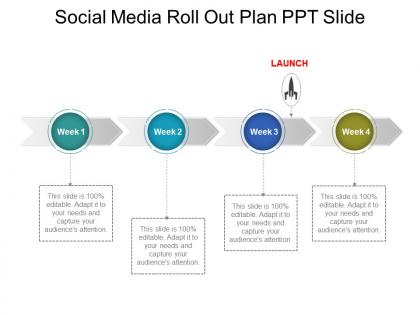
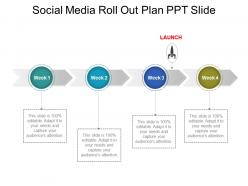
Feel like a celebrity with our social media roll out plan ppt slide and bask in the attention showered by the audience. This is a four stage process which comprises of the following components, namely: plan, product launch, launch plan and action plan. Use this PowerPoint slide to explain the significance of the social media roll out plan and this can be incorporated in any business. As concentration is key when it comes to running a business or even in daily life, this PPT deck has been carefully designed and integrated to incorporate the attention of a professional and a varied audience during business meetings. Use this PPT to smartly process and convey the concept of the social media roll out plan in a business meeting within an organisation. This icon is smartly designed so that you can now captivate your audience with this process chart PowerPoint layout at the simple click of a button! Simply download, add your data and present it to your audience! Feel like a celebrity with our Social Media Roll Out Plan Ppt Slide. Bask in the attention showered by the audience.
People who downloaded this PowerPoint presentation also viewed the following :
Social media roll out plan ppt slide with all 5 slides:
Be frank and forthright with our Social Media Roll Out Plan Ppt Slide. They don't entertain any bias.
FAQs for Social media roll out
Key objectives when creating a social media rollout plan include brand awareness building, audience engagement enhancement, lead generation acceleration, customer retention improvement, and competitive positioning strengthening. These strategic goals work together by establishing clear metrics for success, aligning content with business outcomes, and creating measurable touchpoints across platforms, ultimately delivering increased market visibility and sustainable customer relationships.
Target audience demographics influence rollout strategy by determining platform selection, content timing, messaging tone, and engagement approaches tailored to specific age groups, interests, and behaviors. For instance, younger demographics drive TikTok-first strategies while professional audiences require LinkedIn focus, with successful campaigns leveraging demographic insights to optimize reach, maximize engagement rates, and ultimately deliver higher conversion rates across targeted market segments.
Platform prioritization should align with your target demographics, content format strengths, and business objectives, considering factors like audience age, engagement patterns, industry relevance, and conversion potential. While B2B brands often find success with LinkedIn and Twitter for thought leadership, consumer brands typically prioritize Instagram and TikTok for visual storytelling, ultimately delivering enhanced reach and meaningful customer connections.
Analyzing competitors' social media strategies reveals content types, posting frequencies, audience engagement patterns, platform preferences, and campaign timing that can inform your rollout approach. By identifying their successful tactics and content gaps, you can strategically differentiate your brand while adopting proven engagement methods, ultimately accelerating your market entry and competitive positioning.
A social media rollout should include diverse content types such as behind-the-scenes content, user-generated content, interactive polls, educational tutorials, and live Q&A sessions. These formats work together by building authentic connections, encouraging community participation, and demonstrating expertise, with many brands finding that varied content strategies deliver higher engagement rates and stronger audience loyalty.
User-generated content amplifies rollout impact by encouraging customer testimonials, social media contests, branded hashtag campaigns, and product demonstrations from early adopters. These authentic endorsements build trust and credibility while reducing marketing costs, with many brands finding that customer-created content generates higher engagement rates and accelerates organic reach across target audiences.
**INPUT**: What metrics should be established to measure the success of the rollout? **OUTPUT**: Essential rollout metrics include engagement rates, follower growth, reach expansion, conversion tracking, and brand sentiment analysis across all platforms. These measurements enable organizations to assess content performance, audience development, and strategic ROI, with many companies finding that comprehensive analytics ultimately deliver deeper customer insights and competitive advantage in increasingly crowded social landscapes. **Word count: 54 words**
Social media rollout plans should be assessed weekly during initial launch phases, then monthly for ongoing optimization, with quarterly comprehensive reviews for strategic adjustments. Through real-time analytics and engagement metrics, organizations can identify content performance patterns, audience response trends, and platform-specific opportunities, ultimately enabling agile campaign refinements that maximize reach and ROI.
Influencers amplify brand reach, build credibility through authentic endorsements, create engaging content, and provide access to targeted audience segments during rollout campaigns. Their established trust with followers enhances message authenticity and drives higher engagement rates, with many brands finding that strategic influencer partnerships significantly accelerate product adoption and deliver measurable ROI.
Consistent branding across social media channels requires standardized visual elements, unified messaging guidelines, coordinated content calendars, and regular brand audits. Through centralized brand management systems, organizations streamline logo usage, color schemes, and voice consistency, while social media teams leverage template libraries and approval workflows, ultimately delivering cohesive brand experiences that enhance recognition and customer trust.
Social media rollout challenges include brand consistency issues, negative feedback amplification, resource allocation difficulties, platform algorithm changes, and content quality control across channels. These risks can be mitigated through comprehensive planning, dedicated monitoring teams, and crisis management protocols, with many organizations finding that proactive preparation ultimately delivers smoother launches and stronger audience engagement.
Effective integration combines strategic timing, complementary messaging, and unified audience targeting across both paid and organic channels. Paid advertisements can amplify high-performing organic posts, while organic content builds authentic engagement that paid campaigns leverage for broader reach, with many brands finding that synchronized messaging across both channels delivers enhanced brand visibility, improved conversion rates, and ultimately maximized return on advertising investment.
Social media rollout management tools include Hootsuite, Buffer, Sprout Social, Later, and CoSchedule for scheduling and analytics. These platforms streamline content planning, automate posting across multiple channels, and provide comprehensive performance tracking, with many marketing teams finding that centralized management significantly reduces operational complexity while enhancing campaign consistency and measurable engagement outcomes.
Planning for crisis management within social media rollout strategy involves developing comprehensive response protocols, establishing monitoring systems for real-time feedback tracking, creating pre-approved messaging templates, and designating crisis response teams with clear escalation procedures. These proactive measures enable organizations to address negative feedback, technical issues, or brand reputation threats swiftly, while maintaining customer trust and minimizing potential damage to rollout momentum.
Social media rollout best practices include creating a content calendar with consistent posting schedules, batching content creation for efficiency, timing posts for optimal audience engagement, maintaining brand voice consistency, and strategically spacing major announcements. These approaches streamline campaign management by reducing daily decision-making, maximizing reach through data-driven timing, and sustaining audience interest, with many organizations finding that systematic scheduling delivers higher engagement rates and measurable momentum throughout their rollout phases.
-
Unique research projects to present in meeting.
-
Qualitative and comprehensive slides.
-
Illustrative design with editable content. Exceptional value for money. Highly pleased with the product.
-
The Designed Graphic are very professional and classic.