

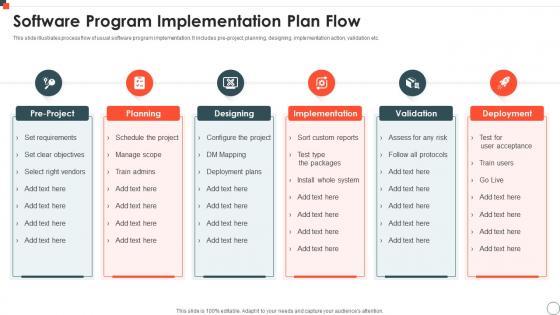
Software Program Implementation Plan Flow




Try Before you Buy Download Free Sample Product
 Impress Your
 Audience
 100%
100% Editable
 Save Hours
 of Time


This slide illustrates process flow of usual software program implementation. It includes pre-project, planning, designing, implementation action, validation etc.
People who downloaded this PowerPoint presentation also viewed the following :
Software Program Implementation Plan Flow with all 6 slides:
Use our Software Program Implementation Plan Flow to effectively help you save your valuable time. They are readymade to fit into any presentation structure.





FAQs for Software Program
Key components of an effective software implementation plan include project scope definition, timeline establishment, resource allocation, risk assessment, training protocols, and stakeholder communication frameworks. These elements work together by ensuring systematic deployment, minimizing operational disruptions, and maximizing user adoption, with many organizations finding that comprehensive planning reduces implementation costs by 30% while accelerating time-to-value.
Assessing organizational readiness involves evaluating technical infrastructure, user skill levels, change management capabilities, budget allocation, and timeline constraints. Through comprehensive audits, many organizations identify gaps in training needs, system compatibility, and stakeholder buy-in, while strategic planning ultimately ensures smoother deployment, reduced resistance, and faster adoption rates across departments.
Stakeholder engagement ensures alignment, secures buy-in, and identifies potential roadblocks throughout the software implementation process, ultimately reducing resistance and accelerating adoption timelines. Through regular communication, feedback sessions, and collaborative planning, organizations streamline change management, enhance user acceptance, and deliver more successful implementations, with many finding that early stakeholder involvement significantly improves long-term project outcomes.
Project timelines and milestones are determined through comprehensive project scope analysis, stakeholder requirement assessment, resource availability evaluation, and technical complexity review. These factors enable project managers to establish realistic phases, from initial system configuration and data migration to user training and deployment, with many organizations finding that phased rollouts ultimately deliver better adoption rates and minimize operational disruption.
Managing change resistance during software implementation requires comprehensive communication strategies, stakeholder engagement programs, training initiatives, phased rollout approaches, and feedback collection systems. These strategies streamline adoption by addressing user concerns early, providing adequate support resources, and demonstrating tangible benefits, with many organizations finding that involving employees in the planning process ultimately delivers smoother transitions and higher acceptance rates.
Software selection criteria include functionality alignment, scalability potential, integration capabilities, user experience design, security standards, and total cost of ownership. Organizations should evaluate vendor support quality, implementation timelines, and customization flexibility, with many enterprises finding that prioritizing long-term strategic fit over initial cost delivers superior operational efficiency and competitive advantage.
A pilot program enhances software implementation by identifying potential issues early, gathering user feedback, and refining processes before full deployment, while minimizing organization-wide disruption and costs. Through controlled testing with select departments, companies can optimize training protocols, adjust system configurations, and build user confidence, ultimately delivering smoother rollouts and higher adoption rates across the enterprise.
Software implementation risks include system integration failures, user resistance, budget overruns, data migration errors, and timeline delays. These challenges can be mitigated through comprehensive planning, stakeholder training, phased rollouts, and robust testing protocols, with many organizations finding that proactive risk assessment and change management ultimately deliver smoother transitions and higher adoption rates.
User training is critical for successful software implementation, directly impacting adoption rates, productivity levels, and overall return on investment. Comprehensive training programs minimize resistance to change, reduce support tickets, and accelerate time-to-value, with many organizations finding that well-trained users become internal advocates who drive further adoption and maximize the software's strategic benefits.
Software implementation success metrics include user adoption rates, system performance benchmarks, project timeline adherence, budget variance analysis, and user satisfaction scores. These measurements enable organizations to assess operational efficiency gains, cost reduction achievements, and productivity improvements, with many enterprises finding that combining quantitative performance data with qualitative user feedback delivers comprehensive insights into implementation effectiveness and long-term strategic value.
Communication plans can be structured through regular status updates, role-specific information channels, milestone-based reporting, escalation protocols, and feedback mechanisms. These frameworks enable project managers to deliver timely updates to executives, technical teams, and end-users, while maintaining transparency and addressing concerns proactively, ultimately ensuring smoother implementation and stronger stakeholder buy-in.
Project management tools for software implementation include Gantt charts, task tracking systems, resource allocation dashboards, risk management frameworks, and stakeholder communication platforms. These technologies streamline coordination by automating progress monitoring, facilitating team collaboration, and providing real-time visibility into project milestones, with many organizations finding that integrated project management solutions ultimately deliver faster deployment timelines and reduced implementation costs.
Data migration serves as a critical foundation within software implementation plans by ensuring accurate data transfer, maintaining system integrity, and preserving business continuity throughout the transition process. Organizations typically allocate 30-40% of their implementation timeline to migration activities, with sectors like banking and healthcare finding that thorough data validation and testing phases ultimately deliver seamless operations and minimize costly post-launch disruptions.
Common software implementation pitfalls include inadequate user training, insufficient stakeholder buy-in, unrealistic timelines, poor data migration planning, and lack of change management processes. These challenges can be avoided through comprehensive training programs, early stakeholder engagement, phased rollout approaches, and thorough testing protocols, with many organizations finding that dedicated project management and clear communication ultimately deliver smoother transitions and higher adoption rates.
Continuous improvement post-implementation involves establishing feedback loops, monitoring key performance metrics, conducting regular user surveys, and implementing iterative updates based on data insights. Organizations typically schedule quarterly reviews to assess system performance, user adoption rates, and operational efficiency gains, while maintaining dedicated support channels that enable ongoing optimization and feature enhancements for sustained competitive advantage.
-
Very well designed and informative templates.
-
Thank you for showering me with discounts every time I was reluctant to make the purchase.