


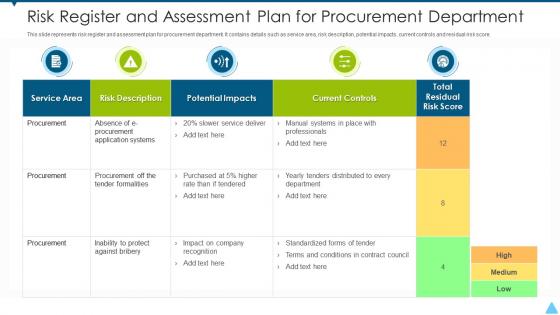
Risk register and assessment plan for procurement department




Try Before you Buy Download Free Sample Product
 Impress Your
 Audience
 100%
100% Editable
 Save Hours
 of Time


Our Risk Register And Assessment Plan For Procurement Department are topically designed to provide an attractive backdrop to any subject. Use them to look like a presentation pro.
People who downloaded this PowerPoint presentation also viewed the following :
Risk register and assessment plan for procurement department with all 6 slides:
Use our Risk Register And Assessment Plan For Procurement Department to effectively help you save your valuable time. They are readymade to fit into any presentation structure.





FAQs for Risk register and assessment plan
You'll want to cover four main things: spotting risks, sizing them up, planning how to handle them, and keeping tabs on everything. Map out what could actually blow up in your specific situation - seriously, don't just steal someone else's template because it won't fit. Rank your risks by how likely they are and how much damage they'd do. Build real action plans for the scary ones and make sure someone owns each piece. Here's the thing though - you can't just write this once and call it done. Check in regularly to see if you're still on track or if new problems have popped up.
Honestly, just start by mapping out everything your business does, then think through what could totally screw up each part. Pull in people from different teams - finance folks are weirdly good at spotting disasters nobody else sees. Cover the obvious internal stuff like systems crashing or key people quitting, plus external chaos like new regulations or market shifts. Then rate everything by how likely it is vs how badly it'd hurt. That gives you a clear picture of what to tackle first instead of just panicking about everything at once.
Tech makes risk management way less stressful, honestly. AI can catch patterns you'd totally miss and predict problems before they get ugly. Real-time monitoring shows you exactly what's happening with markets or operations - no more guessing games. The automated responses are clutch too since they kick in immediately instead of waiting for someone to actually notice something's off (and we both know how that usually goes). I'd start with whatever keeps you up at night worrying and find tools that give you better eyes on those areas.
Start with your industry's biggest headaches - that's where customization begins. Tech companies obsess over cyber threats and data breaches. Manufacturing? They're all about operational safety and supply chain mess-ups. Healthcare is a whole different beast with patient safety and HIPAA stuff. The basic framework skeleton doesn't change, but you swap out the risk pieces that actually matter to you. Think of it like changing out Lego blocks - same foundation, different builds. Honestly, I'd just list your top 5 scariest risks first and work backwards from there. Way easier than trying to force-fit some generic template.
Dude, the worst thing people do is treat risk management like some one-and-done task. Check the box, move on - terrible idea. Most companies obsess over financial risks but completely ignore operational stuff, cyber threats, reputation issues. Those "minor" risks? They'll absolutely wreck you when you least expect it. Oh, and don't be that person who creates this perfect risk assessment then lets it collect dust somewhere. Actually use the damn thing in your planning meetings. Keep updating your risk register regularly - I've seen too many businesses get blindsided because they never revisited their original assumptions.
Honestly, you've gotta bake compliance monitoring into your risk framework right from day one. First things first - figure out which regulations actually hit your business, then build controls around those. I'd start with your biggest regulatory headaches and work down from there. Regular audits are your friend here. Make sure someone owns each compliance area (trust me, nothing falls through cracks faster than when nobody's responsible). Document the hell out of everything too - when auditors show up, you'll want proof you weren't just winging it. Way better than scrambling later.
For quantifying risk, start with expected value - just multiply probability times potential loss. Pretty straightforward math. Monte Carlo simulations are awesome for complex stuff with tons of variables, but honestly they can get way too complicated if you're just starting out. VaR shows your worst-case scenarios at different confidence levels. Sensitivity analysis is clutch for seeing how tweaking key factors hits your numbers. Historical loss data is incredibly valuable when you actually have it (which isn't always). My advice? Begin with the basic methods and work your way up to the fancy stuff once you've got those down solid.
Oh man, this is such a huge thing people don't think about enough. Your German teams will want every detail documented perfectly while the Silicon Valley crew just wants to ship fast and figure it out later. What one culture sees as "smart caution" another thinks is totally reckless - I've watched this torpedo so many projects. Plus some cultures are super direct about flagging problems while others just drop hints and expect you to read between the lines. You've gotta map out these different risk styles upfront and build processes that actually work for everyone, not just whatever HQ prefers.
You've gotta speak their language, you know? Executives care about the bottom line, so hit them with impact numbers. Operations folks want the nitty-gritty details they can actually use. I learned this the hard way - nobody knows what "risk appetite" means! Just give them real examples they get. Visual stuff works great too. Traffic lights, simple dashboards, whatever clicks. Don't just blast out reports and hope for the best. Actually talk to people, ask what they're worried about. Oh, and ditch the jargon completely. Regular check-ins beat formal presentations every time.
Think of scenario analysis as practice rounds for your business decisions - you're basically asking "what if this goes wrong?" before it actually does. Pick maybe 3-4 realistic situations that could mess with your project. Market tanks, supplier bails, whatever keeps you up at night. Then work backwards from there to see if your plan survives or completely falls apart. Honestly, it's saved my butt more times than I can count because you'll catch blind spots you totally missed. Way better than just crossing your fingers and hoping for the best case scenario.
Track your incident rates and how well your controls are actually working. Heat maps are honestly a game-changer for exec presentations - way easier than boring spreadsheets. Mean time to detect issues matters too, plus what percentage of your risks have solid mitigation plans. Don't forget the money stuff - losses avoided or actual damages. Here's the thing though: focus more on leading indicators like control gaps instead of just counting incidents after they happen. Keep it simple with maybe 5-7 key metrics and review monthly so you can catch patterns before they bite you.
So risk appetite is basically how much risk your company's willing to stomach - think of it as your comfort zone. Low appetite? You'll play it super safe with conservative controls, maybe missing out on profitable opportunities. High appetite means rolling the dice for bigger rewards. Here's the thing though - whatever leadership claims they're comfortable with needs to actually match your day-to-day practices. Otherwise you're either being way too cautious or completely blind to real threats. It's honestly pretty common to see this mismatch in companies.
Honestly, you'll want to focus on AI-powered risk analytics and climate risk integration - those are game changers. Cyber resilience planning is huge too. Companies are finally ditching those old risk silos for more holistic approaches, which makes way more sense since risks don't stay in neat categories anyway. Real-time monitoring is pretty much expected now. ESG risks have moved from "nice idea" to must-have status. Oh, and everyone's going predictive instead of just reacting to stuff after it happens. I'd audit your current setup against these trends - especially the tech and climate pieces since that's where most companies are behind.
Honestly, you've got to get everyone thinking it's their responsibility, not just some compliance team's headache. Train people to actually speak up when they spot weird stuff - and don't punish them for it! Reward those moments instead. Your leadership needs to walk the walk too, because if execs ignore concerns, you're basically screwed. Build risk conversations into regular meetings rather than saving everything for annual reviews. Oh, and create easy reporting channels that people will actually use. Follow up when someone raises something. Show your team that catching problems early makes life easier for everyone, not more complicated.
Honestly, I'd grab ServiceNow or MetricStream first - they're solid GRC platforms that'll do the boring risk tracking stuff for you. Tableau's great for visualizing patterns, or Power BI if you're cheap like me. Python scripts help tons if anyone on your team codes (seriously worth learning). Splunk's clutch for real-time monitoring and connecting APIs from different systems. Oh, and don't go crazy trying to automate everything day one. Pick one process, get it working, then expand. Trust me on that one.
-
Excellent work done on template design and graphics.
-
Great quality product.