


Solar Rooftop Project Proposal Powerpoint Presentation Slides




Try Before you Buy Download Free Sample Product
 Impress Your
 Audience
 100%
100% Editable
 Save Hours
 of Time


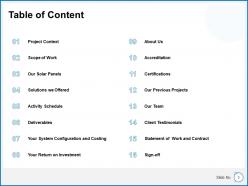
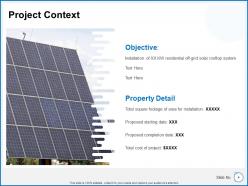
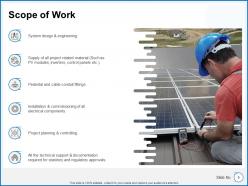
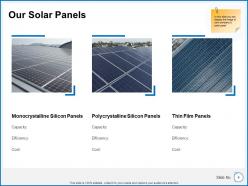
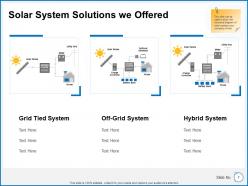
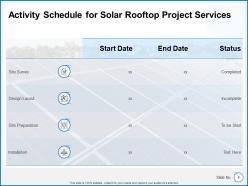
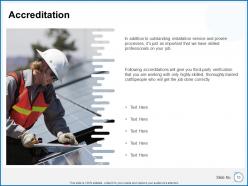
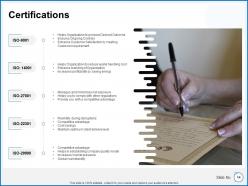
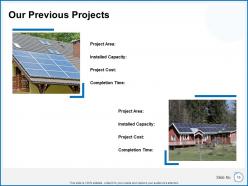
Showcase your scope of work in a precise manner and land new clients by using our content-ready Solar Rooftop Project Proposal PowerPoint Presentation Slides. Take advantage of this engaging solar rooftop assignment proposal PPT layout to mention your professional, skilled, and technical personnel that create a positive impact on your customers. Talk about the acknowledgment and recognition you have received from different clients over the past years. With the help of our eye-catching solar rooftop proposal presentation template, you can describe how your services can benefit your customers and save their power consumption. To give a clear understanding to your consumers, specify the overall time frame taken by your professionals to complete the project. You can describe the proposed terms & conditions of your company for the solar rooftop installation project. Employ this professionally designed solar rooftop installation project PPT theme to highlight your well-executed previous projects that hold the interest of your clients. Included here are tables of contents that consist of the project context, scope of work, solar panels, solutions offered, activity schedules, system configuration and costing, return on investment, certifications, accreditations, client testimonials, statement of work and contract, etc. With the aid of this solar rooftop proposal PPT slides, you can show the supplies of project-related material that your company provides like PV modules, inverters, control panels, etc. Portray the types of solar panel your company provides like monocrystalline silicon panels, polycrystalline silicon panels, and thin-film panels and illustrate the capacity, efficiency, and cost of these panels your company provides. By using the practical solar rooftop assignment proposal PowerPoint presentation layout. Display your accreditations and certifications like ISO 9001, ISO 14001, ISO 27001, ISO 22301, ISO 29990 to impress your customers. Download our ready-to-use project proposal ppt now.
People who downloaded this PowerPoint presentation also viewed the following :
Solar Rooftop Project Proposal Powerpoint Presentation Slides with all 29 slides:
Create a good group with our Solar Rooftop Project Proposal Powerpoint Presentation Slides. They are great at generating cohesion.




FAQs for Solar Rooftop Project Proposal
So you'll need the basics first - good solar panels, an inverter for converting DC to AC, and a solid mounting system for your specific roof. Cables, monitoring stuff, all that. The permit paperwork is honestly the worst part but you can't skip it. If your roof's over 15 years old, definitely get someone to check if it can handle the weight. Oh, and shading can kill your efficiency so that's huge. Start with a site assessment to see what you're working with, then figure out sizing from there. Way easier than guessing.
So there's basically three types to pick from. Monocrystalline is the most efficient at around 20-22% but costs the most - honestly though, it's worth it if you can swing it since you get way more power from the same roof space. Polycrystalline is like the middle child, decent efficiency at 15-17% and easier on the wallet. Thin-film is super cheap but the efficiency kinda sucks (10-12%), so you'd need a massive roof. I'd probably go mono if I were doing my house again. But definitely crunch the numbers first - sometimes saving upfront makes more sense depending on your situation.
Yeah so commercial definitely wins on ROI - usually pays back in 6-8 years vs 8-12 for residential. Makes sense when you think about it. Businesses use tons of power during the day when solar's cranking, plus they get better financing terms and can write off depreciation faster. Honestly the scale just makes everything cheaper per watt. Your residential folks will still do well, especially with today's rebates, but it's more of a long game. I'd probably emphasize the property value bump and decades of free power when you're pitching homeowners.
Check your roof first - can't be falling apart since you don't want to rip panels off in 5 years for repairs. Look around for shade issues too. Trees, chimneys, that weird neighbor's antenna thing, whatever might block sun during the day. South-facing is perfect but east/west works fine honestly. The angle stuff? Way less critical than solar companies make it sound. You need roughly 100 square feet per kilowatt. But seriously, just get someone out there with the fancy measuring tools - I tried eyeballing mine and was way off.
Honestly, you've got tons of options for financing solar panels. Bank loans are the obvious route, but there's also equipment financing made just for solar stuff. Leasing is pretty straightforward - you're basically renting the panels. PPAs are interesting though - someone else owns the system and you just pay for the power at a set rate. My neighbor did that and loves it. Don't sleep on government incentives either, they can knock off a huge chunk of your costs. I'd definitely start there since some of these programs fill up fast, then shop around for the best loan terms.
Permits are your first step - call the building department before you do anything else. You'll also need electrical permits since you're tying into the grid. The utility company has to sign off on interconnection too, which honestly takes forever (so frustrating). If you've got an HOA, they'll want their say. Fire department rules mean you can't just slap panels everywhere - they need setbacks from roof edges. Oh, and some places are way pickier than others about this stuff. I'd hit up the permitting office early to get their whole checklist. Trust me, it'll save you major headaches down the road.
Dude, panel placement is honestly huge for your energy output. True south-facing at an angle matching your latitude is the sweet spot. But even if you're off by 20-30 degrees, you're looking at 10-15% less power - that really hurts your payback time. East or west roofs? They'll work but expect around 15-20% less juice. I'd definitely get someone out with a solar pathfinder to check for shade issues first. My neighbor learned that lesson the hard way when his big oak tree basically killed half his production.
Honestly, it's way easier than I thought. Clean them every 3-6 months - dirt cuts efficiency by like 15-20% which is crazy. Check your inverter app monthly to spot any weird drops in performance. Get a pro inspection once a year for the electrical stuff and mounting hardware. Oh, and trim back any tree branches that might shade them. I learned the hard way that even partial shade tanks your output. Set phone reminders for this stuff or you'll totally forget like I did my first year!
So basically batteries let you save all that solar power from the day and actually use it at night when you need it. Right now you're probably just selling excess back to the grid during the day, then buying power back later - which is kinda dumb when you think about it. With storage you get way better value from your panels since you're using more of your own power instead of the utility's. Plus backup power during outages is clutch. The upfront cost definitely adds up when you're doing the math, but honestly the independence factor makes it worth considering. My neighbor just got Tesla batteries and loves them.
Yeah so government incentives are pretty much carrying solar adoption right now. Federal tax credits cover 30% of install costs, which is huge. Most states add their own rebates and net metering deals on top of that. Without all this help the payback time would honestly suck for regular homeowners. We're talking thousands saved on a typical home system just from the federal credit alone. But here's the catch - this stuff won't stick around forever. If you're doing that project proposal, definitely spotlight these current savings and maybe throw in when they might disappear.
Yeah, environmental stuff is huge for solar. Shading's your worst enemy - one shaded panel can mess up your whole system since they're all connected. Here's the weird part though: panels actually love cool, sunny days more than blazing hot ones. Crazy hot weather drops efficiency like 10-15%. Rain and snow obviously block sunlight temporarily, but honestly they're doing you a favor by washing the panels clean. You'll want to check what might cast shadows on your roof throughout different seasons. Trees grow taller over time too, so factor that in.
Oh man, so many myths about solar! People think cloudy days = zero power, but panels still work - just not as efficiently. You don't need perfect south-facing roof either. Honestly the cost thing bugs me most because prices have dropped like crazy and financing is actually decent now. Everyone's convinced panels will wreck their roof but good installation protects it. And maintenance? Just spray them down sometimes, that's basically it. Definitely get 3 quotes though so you can see real numbers instead of whatever your neighbor's brother-in-law told you.
Dude, solar panels are seriously worth it for hitting your sustainability targets. Your carbon footprint drops immediately, plus customers can actually see you're not just talking green - you're doing it. The money you save on electricity bills? That's budget freed up for other eco stuff. Companies I know showcase their solar data in real-time, which is pretty cool honestly. Some even do tours (maybe overkill but whatever works). Definitely crunch the numbers on your carbon offset first - those stats look impressive in meetings and your marketing will basically write itself.
Hey! So bifacial panels are huge right now - they grab light from both sides and can bump efficiency up 30%. Battery costs have crashed too, which is insane when you think about where prices were just a few years ago. Smart inverters with AI are getting pretty cool, they actually predict weather and adjust automatically. Oh, and BIPV tech is making solar way less obvious if aesthetics matter. Honestly, I'd play up all this stuff in your proposal since it shows you're not just slapping outdated tech on their roof.
So basically, you'll want to set up monitoring dashboards first - they track your daily and monthly output so you can spot when something's off. The data these systems pump out is actually insane (in a good way though). You can catch underperforming panels early and figure out if it's dirt, shading, or actual equipment issues. Real-time metrics show energy output, weather patterns, all that stuff. Predictive maintenance is clutch too - schedules cleanings and repairs when it makes the most sense financially. Compare your actual performance against what you should be getting. Trust me, catching problems early saves serious money down the road.
No Reviews