


Solar Panel Installation And Maintenance Powerpoint Presentation Slides




Try Before you Buy Download Free Sample Product
 Impress Your
 Audience
 100%
100% Editable
 Save Hours
 of Time


World is moving towards a sustainable future and renewable energy is playing a vital role in achieving that goal. There are various sources of renewable energy but solar energy is dominant when it comes to meet both industrial and residential energy demand at low cost. Our presentation will benefit the manufacturing organization that wants to optimize their energy consumption and electricity bill cost by shifting to solar energy. The solar energy presentation includes sections namely energy consumption analysis that will help the firm in defining its current electricity composition by resource, its daily, monthly and annual energy utilization rate, share of electricity demand in current year, energy star rating of current appliances and machineries and monthly electricity bill of the plant. Issues we are currently facing section will highlight the current challenges faced by the manufacturer in terms of machine downtime, energy consumption and Co2 emission. Firm can illustrate various solution along with their cost overview to counter their current challenges with help of Available solutions to counter energy issues section. Solar system overview section will help the firm in providing overview about solar system types and its applications along with system workflow. Permission and regulatory key considerations section will help the manufacturer to describe the essential permission and regulatory key consideration required for solar system installation. Manufacturer can provide detailed specification about the project, it objective and expected outcomes with the help of Project description and specifications section. Manufacturer can ensure the best quality of solar panels, mounting structure and inverter with decision making checklist for solar project section. Estimated cost of solar project section will shed a light on total cost required to install solar system. Implementation schedule will help the firm in illustrating the different stages to install solar system. Maintenance plan and schedule section will help the organization in maintaining the solar panel and inverter health. Manufacturer can portrays the stats of plant capacity per annum and electricity bill saving with impact on performance section. Risk and mitigation strategies section will help the manufacturer in illustrating possible risk that may occur during solar system installation and right measures to overcome them. Company can portray possible challenges that may arise while opting for solar energy and solution to overcome them with the help of barriers and solutions for solar energy application section. Finally, performance tracking dashboard will help the manufacturer in tracking plant electricity consumption, solar production and export to grid.
People who downloaded this PowerPoint presentation also viewed the following :
Content of this Powerpoint Presentation
Slide 1: This slide introduces Solar Panel Installation & Maintenance.
Slide 2: This slide displays Agenda for Solar Panel Installation & Maintenance
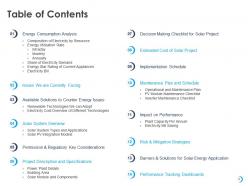
Slide 3: This slide displays Table of Contents.
Slide 4: This slide displays Table of Contents.
Slide 5: This slide covers statistics about plant composition of electricity by resource. Manufacturing Plant depends 77% on the electricity supply provided by government.
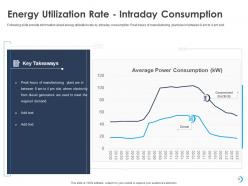
Slide 6: This slide provide information about energy utilization rate by intraday consumption. Peak hours of manufacturing plant are in between 8 am to 4 pm slot.
Slide 7: This slide provide information about energy utilization rate by monthly consumption. It covers details such as building, monthly electricity consumption, annual cost, baseload, average peak and electric consumption.
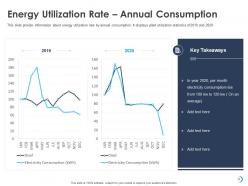
Slide 8: This slide provide information about energy utilization rate by annual consumption. It displays plant utilization statistics of 2019 and 2020.
Slide 9: This slide displays Table of Contents.
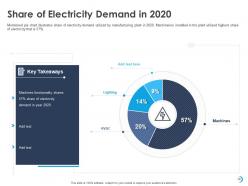
Slide 10: The pie chart chart in the slide illustrates share of electricity demand utilized by manufacturing plant in 2020. Machineries installed in the plant utilised highest share of electricity that is 57%.
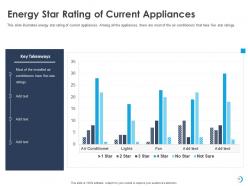
Slide 11: This slide illustrates energy star rating of current appliances. Among all the appliances, there are most of the air conditioners that have five star ratings.
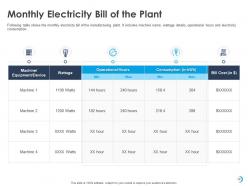
Slide 12: The table shows the monthly electricity bill of the manufacturing plant. It includes machine name, wattage details, operational hours and electricity consumption.
Slide 13: This slide displays Table of Contents.
Slide 14: This slide covers various energy issues faced by the plant. It includes issues such as machine downtime, energy consumption and Co2 emission.
Slide 15: This slide depicts Table of Contents.
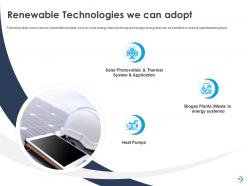
Slide 16: This slide covers various renewable energies such as solar energy, thermal energy and biogas energy that can be installed or used at manufacturing plant.
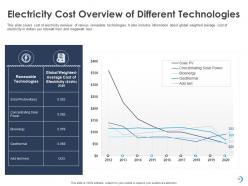
Slide 17: This slide covers cost of electricity overview of various renewable technologies. It also includes information about global weighted average cost of electricity in dollars per kilowatt hour and megawatt hour.
Slide 18: This slide displays Table of Contents.
Slide 19: This slide shows information about solar technology type, System and Application. Technology type covered are solar electric and solar thermal.
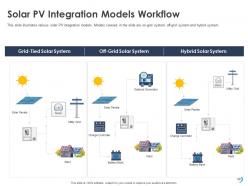
Slide 20: This slide illustrates various solar PV integration models. Models covered in the slide are on-grid system, off-grid system and hybrid system.
Slide 21: This slide explains key considerations about permission and regulatory required before project implementation. It includes details about permit, authority, checklist and status of confirmation.
Slide 22: This slide shows Table of Contents.
Slide 23: This slide provides description and specifications about power plant. It includes
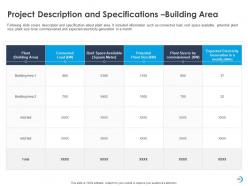
Slide 24: Following slide covers description and specification about plant area. It included information such as connected load, roof space available, potential plant size, plant size to be commissioned and expected electricity generation in a month.
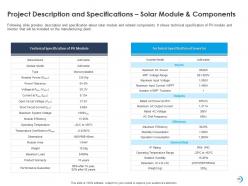
Slide 25: This slide provides description and specification about solar module and related components. It shows technical specification of PV module and inverter that will be installed on the manufacturing plant.
Slide 26: This slide depicts Table of Contents.
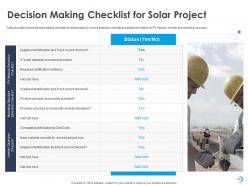
Slide 27: This slide covers decision making checklist for solar project. It covers selection checklist and status information of PV module, inverter and mounting structure.
Slide 28: This table displays information about estimated cost of project. It covers information such as particulars, unit cost, quantity required and total cost.
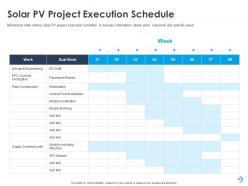
Slide 29: Mentioned slide shows solar PV project execution schedule. It includes information about work, sub-work and specific week.
Slide 30: This slide displays Table of Contents.
Slide 31: This slide provides photo voltaic operational and maintenance plan. It includes information of task, weekly, monthly and semi annually requirement.
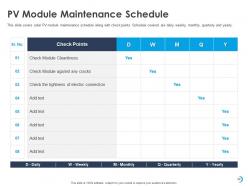
Slide 32: This slide covers solar PV module maintenance schedule along with check points. Schedule covered are daily, weekly, monthly, quarterly and yearly.
Slide 33: This slide shows maintenance schedule for inverter. Schedule covered are daily, weekly, monthly, quarterly and yearly.
Slide 34: This slide displays Table of Contents.
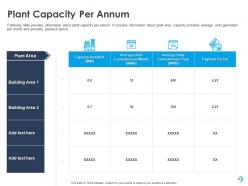
Slide 35: This table provides information about plant capacity per annum. It includes information about plant area, capacity installed, average units generated per month and annually, payback period.
Slide 36: This slide shows forecasting information about monthly electricity bill. It provides details about billable units saved after installing solar power plant.
Slide 37: This slide displays Table of Contents
Slide 38: Mentioned slide explains possible risk and mitigation strategies. It covers risk classification, likelihood, impact, risk rating and ,mitigation strategies.
Slide 39: This slide shows possible barrier that may occur while installing solar project and right solutions to overcome them. Risk covered are high installation cost, government policies.
Slide 40: This slide shows performance tracking dashboard for solar power plant. It includes details such as consumption rate, daily production rate, electricity export & import from grid.
Slide 41: This slide is titled as Additional Slides.
Slide 42: This Solar Panel Installation and Maintenance Icons Slide.
Slide 43: This is About Us slide to showcase Company specifications.
Slide 44: This is Our Team slide with Names and Designations.
Slide 45: This slide displays Roadmap Process.
Slide 46: This slide displays Our Mission, Vision and Goal.
Slide 47: This slide is titled as Post it Notes. Post your important notes.
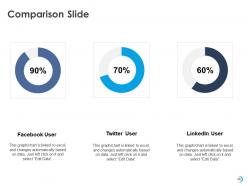
Slide 48: This slide shows Comparison between different social media users.
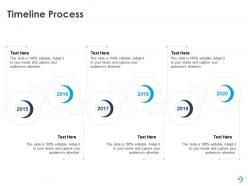
Slide 49: This slide displays Timeline Process.
Slide 50: This is Idea Generation slide.
Slide 51: This is Thank You slide with Contact details.
Solar Panel Installation And Maintenance Powerpoint Presentation Slides with all 51 slides:
Use our Solar Panel Installation And Maintenance Powerpoint Presentation Slides to effectively help you save your valuable time. They are readymade to fit into any presentation structure.



















FAQs for Solar Panel Installation And Maintenance
First thing - make sure your roof isn't falling apart and faces south if possible. Trees or buildings casting shadows will kill your efficiency, so watch for that. Check your electric bills to figure out what size system makes sense (why pay for more than you need, right?). HOA approval can take forever so start that paperwork early. Also see if your utility does net metering - totally worth it. Oh, and don't just go with the first quote you get. Have a couple companies actually come look at your place instead of doing some generic online estimate.
First thing - dig up your last 12 months of electric bills and find your average monthly usage. That's your starting point. Your roof size and which direction it faces matters a ton too, plus how much actual sunlight hits it during the day. There's this rough guideline about needing 100 square feet per kilowatt of solar, but honestly panels are way more efficient now than they used to be. Figure out if you want to cover all your usage or just cut your bill down some. Then get 2-3 local installers out there for quotes - they'll do the real assessment and give you proper numbers.
So there's basically three types - monocrystalline, polycrystalline, and thin-film. Mono panels are the expensive ones but they're super efficient and last forever. Worth it if you can swing the cost. Polycrystalline is the middle ground - cheaper but you'll need more roof space since they're not quite as efficient. Then there's thin-film which is kinda neat because it's flexible and works on weird shaped roofs, but honestly the efficiency sucks and they don't last as long. My neighbor went with poly and he's happy with it. I'd probably go mono if your budget allows though.
So you'll need a building permit from your city first. Then electrical permits for all the wiring stuff. Most places also want structural engineering approval - panels are heavier than you'd think! Your utility company has to sign off on connecting to the grid too. Oh, and if you have an HOA, they might have their own annoying process. The good news? Your installer should handle most of this paperwork mess. Just ask them upfront what they're covering vs what's on you. Definitely check with your local building department though since every area's different.
Dude, placement makes or breaks your solar setup. Face them south if you're up north, angled around 30-45 degrees. I was shocked when I found out that even a tiny bit of shade on one panel can mess up your whole system - like, way more than you'd think. Trees are the worst culprits. You could lose a quarter of your power with bad positioning, which is just money down the drain. Before you install anything, definitely get someone to check for shade patterns throughout the day. Trust me, it's worth the extra step upfront.
Clean those panels every few months - dirt kills efficiency big time, like 20% or more. Just hose them down, maybe use a soft brush if stuff's really stuck on there. My neighbor's were crushing mine until I figured this out lol. Watch out for trees growing over them too. Check your app or inverter regularly to see if output drops weirdly. Oh and inspect for damage or loose stuff quarterly. Honestly the annual professional checkup is probably the most crucial thing since it keeps your warranty intact. Don't skip that one.
Grab some soft brushes, squeegees, and mild soap for cleaning - pretty basic stuff. You'll definitely need a multimeter to check electrical connections. Oh, and get a decent ladder or harness setup because falling off your roof is not the kind of story you want to tell at parties. Some screwdrivers and wrenches are handy for tightening loose bolts. Most of it's just cleaning and looking around for obvious problems. Don't go crazy buying everything upfront - start simple and grab more tools when weird issues pop up.
Honestly, rain takes care of most of it for you. I'd say clean them maybe 2-4 times a year, but it really depends on how dusty your area gets or if birds are constantly making a mess. Just use water and maybe some mild soap - don't get fancy with chemicals that'll scratch everything up. A soft brush works great. Quick tip though - check your energy output first to see if they're actually dirty enough to matter. And dude, if your roof is steep, just pay someone. Trust me, it's not worth the potential hospital visit. My neighbor learned that the hard way last summer.
Biggest thing to watch is your energy production suddenly dropping - that's usually the first sign something's wrong. Check for cracks or weird discoloration on the panels themselves. Bird poop is honestly such a pain, but it'll kill your efficiency way more than you'd expect. Your inverter might show error codes too, so peek at that display occasionally. I do a quick visual check every couple months, nothing crazy. Oh and obviously keep tabs on your energy bills - if they spike for no reason, that's your cue. Don't mess around if something feels off though, just call someone who knows what they're doing.
Yeah, weather hits them but honestly they're pretty tough. Cold weather actually helps efficiency a bit - heat's what kills it, dropping performance like 10-20%. Rain's your friend since it cleans off all the dust and crap. Snow, hail, and crazy winds are what you gotta worry about for actual damage. Most panels can take golf ball-sized hail which is wild when you think about it. Just make sure whoever installs yours uses mounting that can handle your area's weather. I'd check them after big storms too - better safe than sorry.
Oh nice timing on this question! Federal tax credit is huge - 30% off installation costs until 2032. Your state probably has rebates too, plus utility companies sometimes throw money at this stuff. Net metering's where it gets interesting though - you literally sell power back to the grid when your panels are going crazy in summer. Amounts are all over the place depending where you are. Definitely hit up the DSIRE website first before getting quotes. That site's like the holy grail for figuring out what cash you can actually get in your zip code.
So batteries don't actually make your panels work better, but they make the whole setup way smarter. Think about it - right now you're probably sending all that extra daytime power back to the grid for like pennies, then buying it back at night for way more. Pretty annoying, right? With batteries you just store what you made during the day and use it later when rates are highest. Way better than depending on grid power all the time. My neighbor got batteries last year and his electric bill is basically nothing now. If you're doing solar anyway, I'd definitely throw batteries into the mix.
Dude, so many people think solar panels are useless when it's cloudy - total BS. They still work, just not at full power. The cost thing is overblown too, especially with all the rebates now. Maintenance? Pretty much just hosing them off occasionally. My neighbor was convinced they'd wreck his roof, but actually they protect it from weather. And honestly, the new ones look way better than those chunky panels from like 2010. I'd definitely get some quotes if I were you - installers can show you real numbers instead of random internet horror stories.
Smart inverters are your gateway - most have WiFi built in. Connect those to apps like Tesla's or Enphase and boom, you're monitoring everything. I'm weirdly obsessed with checking my solar stats tbh. Set your dishwasher and stuff to run when the sun's cranking, get alerts if something's wonky. You can even auto-sell extra power back to the grid. Some systems let you choose which devices get solar power first before pulling from regular electricity. Oh and the energy management platforms usually play nice with whatever smart home setup you've already got going.
Definitely start with sun exposure - you want south-facing spots without trees or buildings blocking light all day. Wind's another thing to think about since it can mess with the panels. Here's what's weird though - panels actually perform better when it's cooler, so skip anywhere that gets crazy hot. Check your area's weather too, like how much snow you get or if hail's common. Hurricane zones obviously have their own issues. Honestly? Get a pro to assess it. They've got fancy equipment to measure sunlight and they'll catch stuff you'd totally miss.
-
Awesome presentation, really professional and easy to edit.
-
Easy to edit slides with easy to understand instructions.
-
Perfect template with attractive color combination.
-
Excellent Designs.