


Solid Waste Handling And Vehicle Tracking System IoT Driven Waste Management Reducing IoT SS V




Try Before you Buy Download Free Sample Product
 Impress Your
 Audience
 100%
100% Editable
 Save Hours
 of Time


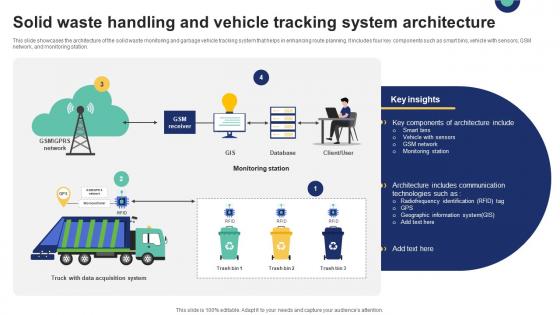
This slide showcases the architecture of the solid waste monitoring and garbage vehicle tracking system that helps in enhancing route planning. It includes four key components such as smart bins, vehicle with sensors, GSM network, and monitoring station.
People who downloaded this PowerPoint presentation also viewed the following :
Solid Waste Handling And Vehicle Tracking System IoT Driven Waste Management Reducing IoT SS V with all 9 slides:
Use our Solid Waste Handling And Vehicle Tracking System IoT Driven Waste Management Reducing IoT SS V to effectively help you save your valuable time. They are readymade to fit into any presentation structure.








FAQs for Solid Waste Handling And Vehicle Tracking System IoT Driven Waste Management Reducing
Key components of an effective solid waste management system include waste generation reduction, systematic collection and transportation, material recovery and recycling, treatment and processing, and safe disposal methods. These integrated approaches streamline operations by minimizing environmental impact, optimizing resource recovery, and reducing operational costs, with many municipalities and private organizations finding that comprehensive systems deliver significant efficiency gains and regulatory compliance.
Different waste types require specialized handling protocols, with organic waste needing composting or anaerobic digestion, recyclables requiring sorting and reprocessing facilities, and hazardous materials demanding secure containment and specialized disposal methods. These tailored approaches enable municipalities and corporations to maximize resource recovery, minimize environmental impact, and ensure regulatory compliance, while organizations increasingly find that integrated waste stream management delivers significant cost reductions and operational efficiency.
Technology revolutionizes solid waste management through smart bins, IoT sensors, GPS tracking, automated sorting systems, and data analytics platforms. These innovations streamline collection routes, enhance recycling efficiency, and minimize operational costs, with many municipalities finding that automated waste sorting and predictive analytics ultimately deliver faster services and improved environmental outcomes.
Communities can encourage better waste segregation through comprehensive education campaigns, providing clearly labeled multi-bin systems, implementing incentive programs with reduced fees for proper sorting, and establishing convenient collection schedules. These approaches work by making segregation accessible and rewarding, with many municipalities finding that combining awareness programs with economic incentives significantly improves participation rates while reducing overall waste management costs.
Poor solid waste management creates significant environmental impacts including soil contamination, groundwater pollution, air quality degradation, greenhouse gas emissions, and ecosystem disruption. These challenges present both immediate health risks and long-term sustainability concerns, with many municipalities finding that strategic waste management systems ultimately deliver cost savings, regulatory compliance, and enhanced community health outcomes.
Policies and regulations influence solid waste management by establishing mandatory recycling programs, waste reduction targets, and disposal standards that cities must implement. Through regulatory frameworks, urban areas streamline collection systems, enhance recycling infrastructure, and minimize landfill dependency, with many municipalities finding that compliance ultimately delivers cost savings and environmental benefits while maintaining operational efficiency.
Innovative waste reduction methods include AI-powered sorting systems, chemical recycling technologies, waste-to-energy conversion, smart bin sensors, and circular economy platforms. These technologies streamline operations by automating material separation, converting non-recyclable plastics into new products, and optimizing collection routes, with many municipalities and manufacturing facilities finding that strategic implementation delivers significant cost reductions and enhanced environmental compliance.
Businesses can integrate sustainable practices through waste auditing, circular economy principles, employee training programs, technology adoption, and strategic partnerships with eco-friendly vendors. These approaches streamline operations by reducing disposal costs, enhancing brand reputation, and ensuring regulatory compliance, with many organizations finding that comprehensive sustainability initiatives ultimately deliver competitive advantage while meeting increasingly demanding environmental expectations.
Educational initiatives to promote solid waste awareness include community workshops, school-based environmental programs, public awareness campaigns, digital educational platforms, and neighborhood recycling demonstrations. These programs enhance citizen engagement by providing practical waste sorting training, highlighting environmental impacts, and showcasing successful local examples, with many municipalities finding that hands-on education ultimately delivers higher recycling rates and stronger community participation in sustainable practices.
Developing countries face unique challenges including limited infrastructure, insufficient funding, rapid urbanization, lack of technical expertise, and inadequate policy frameworks for solid waste management. These nations often struggle with overwhelming waste volumes from growing populations, while lacking proper collection systems, treatment facilities, and recycling programs, ultimately requiring strategic international partnerships and innovative, cost-effective solutions.
Effective solid waste management systems deliver significant cost savings through reduced landfill fees, resource recovery revenues, and operational efficiency gains. These systems create economic opportunities by generating jobs in recycling industries, enabling circular economy models, and reducing environmental cleanup costs, with many municipalities finding that strategic waste management ultimately enhances property values and attracts sustainable business investments.
Public participation significantly enhances waste management program success by increasing compliance rates, improving source separation practices, and fostering community ownership of environmental initiatives. When residents actively engage through education campaigns and feedback mechanisms, municipalities achieve higher recycling rates, reduced contamination levels, and lower operational costs, with many cities finding that community-driven programs deliver more sustainable long-term outcomes.
Waste-to-energy technologies include incineration with energy recovery, anaerobic digestion for biogas production, gasification, pyrolysis, and plasma arc processing. These systems streamline waste reduction while generating electricity, heat, and biofuels, with many municipalities and industrial facilities finding that strategic implementation delivers cost savings, reduced landfill dependency, and sustainable energy sources.
Circular economy principles transform solid waste management by emphasizing waste prevention, reuse, recycling, and recovery through systematic resource loops. Manufacturing companies, municipalities, and retail organizations increasingly adopt these approaches by redesigning products for durability, implementing comprehensive recycling programs, and converting waste into energy or raw materials, ultimately reducing disposal costs while creating new revenue streams and competitive advantages.
Municipalities can adopt route optimization software, automated collection vehicles, waste segregation programs, public education campaigns, and strategic partnerships with recycling facilities. These practices streamline operations by reducing collection costs, improving recycling rates, and enhancing community participation, with many cities finding that integrated approaches ultimately deliver cleaner environments and significant operational savings.
-
Thank you for showering me with discounts every time I was reluctant to make the purchase.
-
SlideTeam is my one-stop solution for all the presentation needs. Their templates have beautiful designs that are worth every penny!