


Sprint Retrospective Agile Scrum Methodology




Try Before you Buy Download Free Sample Product
 Impress Your
 Audience
 100%
100% Editable
 Save Hours
 of Time


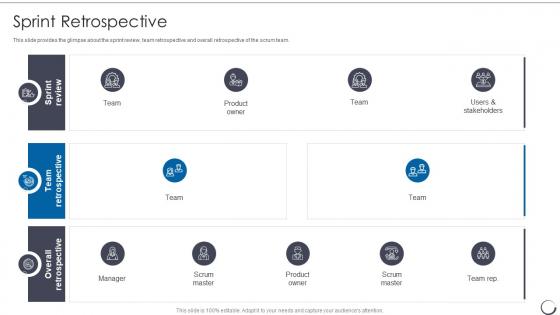
This slide provides the glimpse about the sprint review, team retrospective and overall retrospective of the scrum team.
People who downloaded this PowerPoint presentation also viewed the following :
Sprint Retrospective Agile Scrum Methodology with all 6 slides:
Use our Sprint Retrospective Agile Scrum Methodology to effectively help you save your valuable time. They are readymade to fit into any presentation structure.





FAQs for Sprint Retrospective
The primary objective of a Sprint Retrospective is to enable teams to reflect on their processes, identify what worked well and what didn't, and implement actionable improvements for future sprints. This structured reflection helps organizations enhance team collaboration, streamline workflows, and increase delivery efficiency, with many development teams finding that regular retrospectives significantly boost productivity and reduce project bottlenecks.
Teams effectively prepare for Sprint Retrospectives by gathering relevant data, reviewing Sprint goals and outcomes, collecting feedback from stakeholders, and identifying specific challenges encountered during development. Through structured preparation frameworks, teams streamline discussion focus, enhance problem-solving efficiency, and accelerate improvement implementation, with many organizations finding that prepared retrospectives deliver actionable insights and stronger team alignment.
Techniques include creating psychological safety through ground rules, using anonymous feedback tools, implementing structured formats like Start-Stop-Continue, and rotating facilitation among team members. These approaches streamline dialogue by removing hierarchy barriers, encouraging diverse perspectives, and enabling honest assessment of sprint challenges, with many agile teams finding that varied communication methods ultimately deliver more actionable insights and stronger team cohesion.
Effective Sprint Retrospectives typically allocate 30-40% of time to celebrating successes and 60-70% to identifying improvement areas, though this balance should flex based on team dynamics and sprint outcomes. Many agile teams find that acknowledging wins first creates psychological safety for deeper problem-solving discussions, ultimately delivering more actionable insights and stronger team cohesion for future sprints.
The Scrum Master facilitates retrospectives by creating a safe environment for open dialogue, guiding structured discussions, and ensuring all team members participate equally in identifying improvements. They employ various facilitation techniques, remove organizational impediments, and help teams focus on actionable solutions rather than blame, ultimately enabling continuous improvement and stronger team collaboration in subsequent sprints.
Teams can measure retrospective effectiveness by tracking sprint velocity improvements, team satisfaction scores, action item completion rates, and cycle time reductions over multiple iterations. Through consistent metrics collection, teams identify patterns in productivity gains, communication improvements, and problem-solving speed, with many agile organizations finding that systematic measurement ultimately delivers enhanced team performance and sustainable process optimization.
Common Sprint Retrospective pitfalls include blaming individuals instead of examining processes, focusing solely on problems without identifying solutions, allowing dominant voices to overshadow quieter team members, and rushing through discussions without deep analysis. These issues undermine team psychological safety and continuous improvement, with many agile organizations finding that structured facilitation and balanced participation ultimately deliver more actionable insights and stronger team cohesion.
Visual aids and templates enhance retrospective discussions by providing structured frameworks, improving clarity of communication, and ensuring comprehensive coverage of key topics. These tools streamline the process by guiding participants through systematic reflection, facilitating better identification of issues and solutions, and ultimately delivering more productive outcomes and actionable insights for sprint improvement.
Retrospective feedback translates into actionable sprint items through prioritized improvement identification, specific task creation, and integration into the product backlog alongside user stories. Teams convert insights into concrete actions like process adjustments, tool implementations, or workflow changes, with many organizations finding that assigning owners and deadlines to retrospective outcomes significantly enhances team performance and delivery consistency.
Creating psychological safety through structured facilitation, anonymous input methods, rotating speaking opportunities, and establishing ground rules ensures comfortable retrospective participation. Many agile teams find that using techniques like silent brainstorming, dot voting, and "no blame" agreements encourages honest feedback, ultimately delivering more productive discussions and stronger team collaboration across sprint cycles.
Team dynamics significantly influence Sprint Retrospective outcomes by affecting psychological safety, communication openness, and collaborative problem-solving capabilities within development teams. When teams demonstrate strong trust and mutual respect, retrospectives generate more honest feedback, actionable improvement strategies, and sustainable process changes, while poor dynamics can limit transparency and hinder meaningful progress, ultimately impacting delivery velocity and product quality.
Remote teams should adapt retrospectives by leveraging digital collaboration tools like Miro or Retrospective.ly, implementing structured time-boxing for discussions, and establishing clear virtual facilitation protocols. These approaches enhance participation through anonymous feedback options, breakout room discussions, and shared digital boards, ultimately delivering improved team transparency and engagement while maintaining the collaborative spirit essential for continuous improvement in distributed work environments.
**INPUT**: What retrospective formats (e.g., Start-Stop-Continue, Sailboat) work best for different team cultures? **OUTPUT**: Start-Stop-Continue works well for direct, results-focused cultures, while creative teams often prefer visual formats like Sailboat or Mad-Sad-Glad for deeper emotional engagement. The strategic combination depends on team maturity, communication style, and psychological safety, with many organizations finding that rotating formats maintains engagement while delivering consistent process improvements and enhanced collaboration.
Address conflicts during retrospective discussions by establishing clear ground rules, encouraging active listening, and focusing conversations on processes rather than individuals. Use facilitation techniques like timeboxing discussions, acknowledging different perspectives, and guiding teams toward data-driven solutions, with many organizations finding that structured conflict resolution ultimately strengthens team collaboration and sprint outcomes.
**INPUT**: What strategies can be implemented to keep retrospectives engaging and productive over time? **OUTPUT**: Effective retrospective strategies include rotating facilitation among team members, implementing varied formats like timeline reviews and satisfaction surveys, incorporating anonymous feedback tools, and setting concrete action items with clear ownership. These approaches enhance team participation by maintaining fresh perspectives, encouraging honest communication, and ensuring continuous improvement momentum, with many agile organizations finding that structured variety ultimately delivers stronger team cohesion and measurable process improvements. [Word count: 60 words]
-
Informative and engaging! I really like the design and quality of the slides.
-
Thrilled to see several customizable templates catering various verticals and industries.