


Stages Of Product Lifecycle Management Powerpoint Presentation Slides




Try Before you Buy Download Free Sample Product
 Impress Your
 Audience
 100%
100% Editable
 Save Hours
 of Time


The product lifecycle refers to the stages a product goes through from its inception to its eventual decline and discontinuation and is a crucial concept in marketing. Check out our professionally curated Stages of Product Lifecycle Management PowerPoint presentation. It exhibits detailed information about the product lifecycle. The life cycle has four stages introduction, growth, maturity, and decline. Additionally, our Product lifecycle deck contains slides providing gap analysis based on the challenges an inefficient product management system faces. Furthermore, it includes five stages of the product lifecycle, showcasing an introduction to the development stage, key influencing factors, and concept testing determinants to develop a new product. Moreover, the product growth strategies incorporate techniques to improve product sales and social media campaign ads to boost sales. Lastly, the Maturity and Decline stages cover strategies to prolong product life and dashboards to track performance. Download this 100 percentage editable Pitch Deck and get access to our highly researched and skilfully designed product.
People who downloaded this PowerPoint presentation also viewed the following :
Content of this Powerpoint Presentation
Slide 1: This slide introduces Stages of Product Lifecycle Management. Commence by stating Your Company Name.
Slide 2: This slide depicts the Agenda of the presentation.
Slide 3: This slide incorporates the Table of contents.
Slide 4: This slide highlights the Title for the Topics to be covered further.
Slide 5: This slide covers brief introduction of a product along with availability of several commodities in the market.
Slide 6: This slide shows a brief summary of characteristics of different stages in a product lifecycle.
Slide 7: This slide displays the Sales and revenue curve in product lifecycle.
Slide 8: This slide states the Product lifecycle effective influencing factors.
Slide 9: This slide highlights the Checklist for various stages in product lifecycle.
Slide 10: This slide continues the Checklist for various stages in product lifecycle.
Slide 11: This slide presents the Importance of product lifecycle journey to estimate market performance.
Slide 12: This slide elucidates the Heading for the Contents to be discussed next.
Slide 13: This slide covers activities that are must for improving the management system of a product.
Slide 14: This slide exhibits the Title for the Ideas to be covered in the following template.
Slide 15: This slide reveals the Five stage model of product lifecycle.
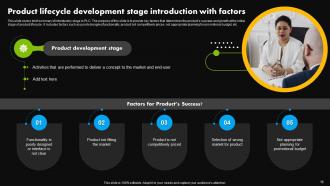
Slide 16: This slide showcases the Product lifecycle development stage introduction with factors.
Slide 17: This slide covers different steps in developing a new product from the concept approved by customers.
Slide 18: This slide portrays the Concept testing determinants to develop new product.
Slide 19: This slide exhibits the Benefits of testing product concept through customer survey.
Slide 20: This slide indicates the Product concept testing survey form.
Slide 21: This slide continues the Product concept testing survey form.
Slide 22: This slide covers analysis of results generated through customer survey.
Slide 23: This slide talks about the Concept testing survey outcomes to evaluate product perception.
Slide 24: This slide reveals the Outcomes based on customer purchasing behavior analysis.
Slide 25: This slide indicates the Heading for the Ideas to be discussed in the upcoming template.
Slide 26: This slide shows a brief summary of launching a new product in the market after getting customer’s approval via survey.
Slide 27: This slide covers approaches to define new target markets through idea filtering process.
Slide 28: This slide highlights new market ranking system to select ideal sector for introducing the product.
Slide 29: This slide provides information for product launch planning roadmap to determine key tasks involved.
Slide 30: This slide reveals the Checklist for effective management to introduce new product.
Slide 31: This slide states the Different marketing campaigns to accelerate sales.
Slide 32: This slide includes the Title for the Contents to be covered further.
Slide 33: This slide talks about the Growth stage in product lifecycle with tracking KPIs.
Slide 34: This slide focuses on the Growth Strategies to emerge as stronger beverage brand.
Slide 35: This slide deals with the Marketing strategies to grow beverage product revenue and sales.
Slide 36: This slide displays the Product performance returns with ad spends in growth stage.
Slide 37: This slide represents the Social media campaign ads to boosts sales at growth stage.
Slide 38: This slide contains the Heading for the Topics to be discussed next.
Slide 39: This slide covers brief summary of maturity stage in PLC.
Slide 40: This slide exhibits the Strategies to win market competition with product lifecycle management.
Slide 41: This slide depicts the Marketing strategies to shift from maturity to growth stage.
Slide 42: This slide indicates the Title for the Topics to be covered in the following template.
Slide 43: This slide reveals the Overview of decline stage in product lifecycle.
Slide 44: This slide mentions the Ways to detect decline in product sales from market.
Slide 45: This slide portrays the Strategies to revitalize failed product in declined stage.
Slide 46: This slide displays the Heading for the Contents to be discussed further.
Slide 47: This slide illustrates the Dashboard to track beverage brand revenue and sales.
Slide 48: This slide covers dashboard to track brand with lowest sales.
Slide 49: This slide presents the Title for the Ideas to be covered in the forth-coming template.
Slide 50: This slide states the Four Stages of product with special reference to Nokia.
Slide 51: This is the Icons slide containing all the Icons used in the plan.
Slide 52: This slide is used for depicting some Additional information.
Slide 53: This is the Idea generation slide for encouraging fresh ideas.
Slide 54: This is Our goal slide. State your company-goals here.
Slide 55: This slide is used for the purpose of Comparison.
Slide 56: This is Our team slide. State your team-related information here.
Slide 57: This slide elucidates the Bar graph.
Slide 58: This slide contains the Post it notes for reminders and deadlines.
Slide 59: This slide represents the organization's Timeline.
Slide 60: This is the 30 60 90 days plan slide for effective planning.
Slide 61: This is the Thank You slide for acknowledgement.
Stages Of Product Lifecycle Management Powerpoint Presentation Slides with all 64 slides:
Use our Stages Of Product Lifecycle Management Powerpoint Presentation Slides to effectively help you save your valuable time. They are readymade to fit into any presentation structure.











FAQs for Stages Of Product Lifecycle Management
So PLM basically breaks down into five main chunks: concept, design, manufacturing, service, and retirement. You kick off with ideation and requirements gathering. Then comes detailed design and prototyping - this part's actually pretty fun if you're into that stuff. Manufacturing is where things get messy though, dealing with production planning and quality control nightmares. Once you launch, it's all about service docs, maintenance, and handling customer complaints. End-of-life planning wraps it up with recycling decisions. The cool thing? Data flows backward between stages, so your design team can learn from manufacturing screwups and service issues. Having everything in one system really helps teams work together instead of operating in silos.
Think of PLM as the one place where everyone finally stops working off different info. Right now your engineering team probably uses one thing, manufacturing has their own system, and don't even get me started on those random spreadsheets floating around marketing. With PLM, everyone sees the same real-time data. Changes get tracked automatically. Marketing actually gets correct specs, manufacturing sees updated designs, and quality can catch problems before they blow up. Honestly, just look at where info gets lost between teams - that's your biggest win right there.
Look, data analytics is honestly a game-changer for product decisions. When you're developing stuff, market research and user feedback help validate if your idea actually makes sense. Launch phase gets interesting - you can watch sales and customer behavior in real-time and pivot fast if things go sideways. But maintenance is where it gets really cool. You'll spot patterns about component failures before they happen, predict demand spikes. Even helps you decide when to kill a product instead of beating a dead horse. My advice? Figure out which metrics actually matter for whatever stage you're in right now and build some simple dashboards around those.
Build feedback loops straight into development - don't save it for the end. Regular customer touchpoints are huge: surveys, beta programs, user interviews at every stage. Honestly, waiting until launch to ask for input is such a rookie move. Your support team already hears all the complaints anyway, so tap into that goldmine. Google Forms works fine if you don't want fancy tools like UserVoice. The real magic happens when you actually act on feedback and circle back to tell customers how they influenced the final product. That's what builds loyalty.
Oh man, data migration is gonna be your biggest nightmare - trust me on this one. Your team will fight you tooth and nail because everyone's obsessed with their Excel sheets and whatever ancient system they're used to. Integration with your ERP and CAD stuff? Total pain since nothing talks to each other properly at first. Training takes forever too since PLM systems are weirdly complicated. Here's what actually works: find a few people who don't hate technology and start there. Clean up your data mess before you do anything else, and seriously budget like 3x more training time than seems reasonable.
So digital transformation completely changed how PLM works - everything's moved to the cloud now and teams can actually collaborate in real time. Before, engineering and manufacturing were basically in separate worlds, but now they share live data and can use AI analytics to spot issues early. Digital twins are probably the coolest part though - you can test products virtually before building anything physical. The whole process is way faster since everyone's looking at current data instead of some random Excel file from last month. I'd start with whatever handoff between your teams takes forever and digitize that first.
PLM tracks your product's environmental impact from start to finish - sourcing, manufacturing, disposal, the whole thing. You can analyze carbon footprints and swap out materials for greener options right in the design phase. Honestly, the sustainability reporting features alone make it worth it. Your suppliers can collaborate on eco-friendly alternatives too. Different scenarios? Easy to simulate and compare. Plus it keeps you compliant with all those environmental regs (which seem to multiply every year, ugh). Just start by mapping where your current products hit the environment hardest. You'll probably find some surprises.
Honestly, map out your data flows first before you write a single line of code. I know it's boring but saves you SO much pain later. Bill of materials, change orders, item master - those are your big integration points. Everyone thinks real-time sync is the way to go, but batch processing overnight usually works way better and doesn't break things constantly. Set up clear rules about who owns what data or your teams will keep overwriting each other's work. Oh, and don't try integrating everything at once - that's where projects go to die. Pick one product line, get it working perfectly, then move on.
Dude, cloud PLM is a game changer. Your teams can jump into product data from literally anywhere and make updates in real-time. No more of that version control hell we've all been through. New projects? They start instantly - no waiting around for IT to set up servers (seriously, that used to take forever). Engineers across different offices can actually work together without stepping on each other's toes. Oh, and everything just moves faster when people aren't dealing with file sync issues. Honestly, just try a small pilot project first. You'll see how much quicker your dev cycles get.
Oh man, PLM is a game-changer for compliance stuff in pharma, aerospace, medical devices - basically anywhere regulators breathe down your neck. It tracks every single design change and component spec throughout your product's life. When inspectors show up, you'll have that complete audit trail ready to go (regulators actually get excited about good documentation, weird but true). The system forces proper approval workflows and keeps all your regulated docs under version control. Honestly, it cuts compliance risk while getting products to market faster. I'd start by figuring out how your current processes fit into PLM workflows first.
So PLM basically gives you eyes on your entire product lifecycle, which is huge for catching problems early. Think compliance issues, supply chain mess, design problems - you'll see them coming instead of getting blindsided. Everyone works from the same data too, so no more "wait, why didn't anyone tell me about this?" moments. Honestly, the audit trails alone make it worth it when regulators come knocking. I'd start by figuring out where you're flying blind right now with risks. Those gaps are probably where PLM could help most.
Honestly, start simple with like 3-4 metrics that actually matter to your goals. Time-to-market is huge - track how much faster you're getting products out there. Also watch your development cycle times and how many revisions you need before launch (fewer is obviously better). Quality stuff matters too: defect rates, compliance headaches, those annoying post-launch changes that eat your budget. Oh, and don't skip the collaboration piece - are teams actually sharing data better or still drowning in email threads? I'd focus on efficiency first since that's where you'll see quick wins, then add quality metrics once you've got your baseline down.
Honestly, go with a cloud solution first - way cheaper and you won't need IT people babysitting it constantly. Pick your worst problem (usually it's docs scattered everywhere) and fix that before moving on. I've watched so many companies try to do everything at once and it's a disaster every time. Find something that plays nice with whatever software you're already stuck with. Most vendors let you add pieces gradually anyway. Oh, and make sure whatever you pick can actually grow with you - sounds obvious but you'd be surprised how many don't scale well.
Dude, PLM is getting crazy right now with all the AI stuff. You've got smart automation handling design optimization, plus predictive analytics that actually tell you how your products will perform. Cloud platforms are taking over too - honestly way better than those old clunky systems we dealt with before. Digital twins are everywhere now for monitoring products in real-time. Oh, and sustainability tracking is huge because everyone needs ESG compliance these days. You should probably check if your current PLM setup can handle the AI features. That's where companies are getting their biggest advantages right now.
Oh man, cultural stuff will totally mess with your PLM rollout if you're not careful. Some places need tons of approvals from the top before anything moves. Others hate being told exactly how to do things. You've got language barriers, different attitudes about deadlines - honestly, I've watched projects completely tank because nobody thought about Ramadan or Chinese New Year. The tech adoption thing varies wildly too. Map out what each region actually cares about first. Then adapt your training instead of using the same cookie-cutter approach everywhere.
-
SlideTeam is very efficient when it comes to saving time. I am happy that I chose them for my presentation.
-
Unique design & color.