


Statistics Of Artificial Intelligence Application In Finance Training Ppt




Try Before you Buy Download Free Sample Product
 Impress Your
 Audience
 100%
100% Editable
 Save Hours
 of Time


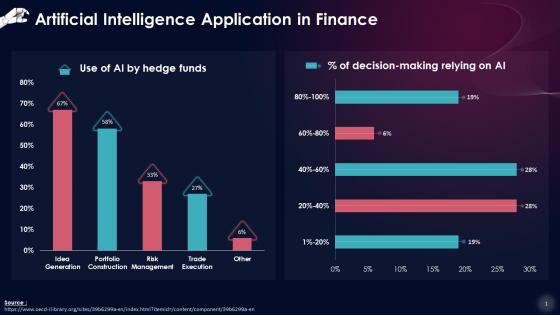
This slide depicts the usage of Artificial Intelligence in Hedge Funds which include idea generation, portfolio construction, risk management, and trade execution. It also shows the percentage of decision-making that relies on Artificial Intelligence.
People who downloaded this PowerPoint presentation also viewed the following :
Statistics Of Artificial Intelligence Application In Finance Training Ppt with all 17 slides:
Use our Statistics Of Artificial Intelligence Application In Finance Training Ppt to effectively help you save your valuable time. They are readymade to fit into any presentation structure.














FAQs for Statistics Of Artificial Intelligence Application In
Approximately 75-80% of financial institutions currently integrate AI technologies into their operations, with implementation varying from basic automation to advanced machine learning systems. These technologies enhance fraud detection, algorithmic trading, credit scoring, and customer service operations, with many banks and investment firms finding that AI-driven solutions significantly reduce operational costs while delivering faster, more accurate financial services.
AI adoption has significantly enhanced risk assessment accuracy in finance by leveraging machine learning algorithms, real-time data processing, and predictive analytics to identify patterns traditional models miss. Financial institutions increasingly report 20-40% improvements in fraud detection rates and loan default predictions, with banks like JPMorgan and Goldman Sachs finding that AI-driven models reduce assessment errors while accelerating decision-making processes.
Common AI applications in investment banking include algorithmic trading, risk management, fraud detection, credit scoring, and regulatory compliance automation. These technologies streamline operations by accelerating transaction processing, enhancing portfolio optimization, and improving client advisory services, with many major banks finding that AI-driven analytics ultimately deliver faster decision-making and significant competitive advantages.
AI solutions in financial audits typically save 40-60% of time compared to traditional methods by automating data collection, anomaly detection, and compliance checking. Through machine learning algorithms, audit teams streamline risk assessment, accelerate transaction analysis, and enhance documentation processes, with many accounting firms finding that AI-powered audits deliver faster completion times while maintaining accuracy and regulatory compliance.
AI-driven algorithmic trading volumes have grown dramatically over the last five years, with automated systems now handling approximately 60-80% of equity trades globally, high-frequency trading reaching $1.8 trillion annually, and machine learning algorithms increasingly dominating forex and derivatives markets. This exponential growth reflects institutions' pursuit of faster execution speeds, reduced transaction costs, and enhanced market analysis capabilities, with major investment banks and hedge funds finding that AI-powered trading delivers significant competitive advantages in today's data-driven financial landscape.
Regulatory bodies are implementing comprehensive frameworks through updated compliance standards, AI governance requirements, and enhanced transparency mandates to address algorithmic decision-making in financial services. Major regulators like the Federal Reserve and European Banking Authority are establishing guidelines for model validation, bias testing, and explainable AI systems, with many institutions finding that proactive compliance delivers competitive advantage while ensuring consumer protection.
Key metrics include return on investment (ROI), operational efficiency gains, cost reduction percentages, customer satisfaction scores, risk mitigation effectiveness, processing time improvements, and accuracy rates in fraud detection or credit decisions. These measurements enable financial institutions to quantify AI's impact across customer service, compliance, and risk management, with many banks finding that combining multiple metrics delivers clearer insights into strategic value and competitive positioning.
AI enhances customer experience in banking through personalized recommendations, 24/7 chatbot support, faster loan processing, and real-time fraud detection. These technologies streamline customer interactions by reducing wait times, automating routine inquiries, and delivering tailored financial advice, with many banks finding that AI-powered services significantly improve customer satisfaction while reducing operational costs.
AI has significantly enhanced fraud detection rates in finance by reducing false positives by up to 50%, accelerating transaction processing speeds, and improving accuracy through machine learning pattern recognition. Financial institutions using AI-powered systems detect fraudulent activities 3-5 times faster than traditional methods, while simultaneously reducing operational costs and enhancing customer experiences through fewer legitimate transaction blocks.
Studies indicate that approximately 35-40% of financial professionals expect AI to replace their jobs within the next decade, though this varies significantly by role and specialization. However, many institutions find that AI more often augments human capabilities rather than completely replacing positions, with professionals in areas like relationship management, strategic analysis, and compliance oversight experiencing enhanced productivity and decision-making capabilities.
AI tools assist in portfolio management and asset allocation by analyzing vast datasets, predicting market trends, optimizing risk-return ratios, and automating rebalancing strategies. Through machine learning algorithms, financial institutions can process real-time market data, identify emerging opportunities, and minimize human bias in investment decisions, ultimately delivering enhanced returns and reduced portfolio volatility for clients.
The most significant ethical concerns include algorithmic bias in lending decisions, lack of transparency in AI decision-making processes, data privacy violations, job displacement, and potential market manipulation through automated trading. These challenges present both risks and opportunities, with many financial institutions finding that proactive ethical frameworks, diverse training data, and human oversight mechanisms ultimately deliver fairer outcomes while maintaining competitive advantage.
AI has significantly reduced operational costs in financial institutions by automating routine processes, minimizing manual errors, and streamlining compliance workflows. Banks and credit unions leveraging AI for transaction processing, customer service automation, and risk assessment report cost reductions of 20-40%, while enhancing service speed and accuracy, ultimately delivering competitive advantages in an increasingly efficiency-driven market.
AI contributes to personalized financial services by analyzing consumer spending patterns, credit histories, and financial behaviors to deliver customized recommendations, tailored investment portfolios, and individualized banking experiences. Through machine learning algorithms, financial institutions streamline loan approvals, enhance customer interactions, and minimize operational costs, with many banks finding that these technologies ultimately deliver faster services and significantly improved customer satisfaction.
Healthcare, retail, manufacturing, and logistics are rapidly following finance's lead in AI adoption, implementing similar technologies for diagnostics, personalized recommendations, predictive maintenance, and supply chain optimization. These industries leverage AI for fraud detection, automated decision-making, and customer service enhancements, with many organizations finding that finance's proven AI frameworks significantly accelerate their own digital transformation initiatives.
-
A beautiful, professional design paired with high-quality images and content that is sure to impress. It is a must-use PPT template in my opinion.
-
SlideTeam was so customer-centric and quick service-provider that I doubted the amount I was paying and literally re-checked the transaction.