


Statutory audit ppt layout ppt model




Try Before you Buy Download Free Sample Product
 Impress Your
 Audience
 100%
100% Editable
 Save Hours
 of Time


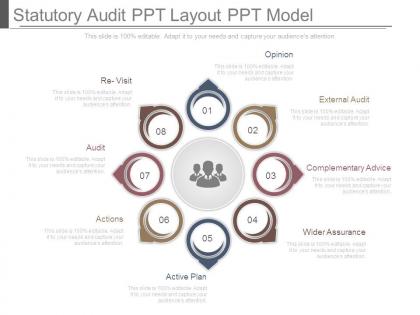
Break down the formula with our Statutory Audit Ppt Layout Ppt Model. Clearly explain each important component.
People who downloaded this PowerPoint presentation also viewed the following :
Statutory audit ppt layout ppt model with all 7 slides:
Inspire ambitions with our Statutory Audit Ppt Layout Ppt Model. Create dreams for folks to fulfill.


FAQs for Statutory audit ppt
Key components include audit scope and methodology, financial statement opinions, internal control assessments, compliance findings, risk evaluations, and management recommendations. These elements work together by providing comprehensive oversight of financial accuracy, regulatory adherence, and operational effectiveness, with many organizations finding that well-structured presentations enhance stakeholder confidence and support strategic decision-making processes.
Visuals enhance statutory audit understanding by transforming complex financial data into clear charts, graphs, infographics, and comparative tables that highlight key findings, risk areas, and compliance status. Through strategic visual elements, auditors can effectively communicate material weaknesses, regulatory gaps, and recommendations to board members and stakeholders, ultimately delivering faster comprehension and more informed decision-making across organizations.
Common pitfalls include overwhelming stakeholders with excessive technical detail, failing to contextualize findings within business operations, presenting conclusions without clear remediation pathways, and neglecting to prioritize issues by materiality and risk impact. These presentation challenges can undermine audit effectiveness by creating confusion rather than clarity, with many organizations finding that streamlined, business-focused communications enhance stakeholder engagement and accelerate corrective action implementation.
Statutory audit presentations require stakeholder-specific customization, with management needing operational details and compliance insights, boards focusing on governance and risk oversight, and investors emphasizing financial performance and strategic implications. Effective tailoring involves adjusting technical depth, emphasizing relevant metrics, and highlighting outcomes that matter most to each audience, with many organizations finding that targeted presentations enhance stakeholder engagement and decision-making while ensuring regulatory transparency.
Storytelling transforms statutory audit presentations by creating compelling narratives around compliance findings, risk assessments, and financial health indicators, making complex regulatory data more accessible to stakeholders. Through structured storytelling approaches, organizations can present audit outcomes that engage board members and regulators more effectively, while clearly communicating remediation strategies and demonstrating transparency, ultimately building stakeholder confidence and trust.
Data analytics enhances statutory audit presentations by enabling deeper pattern recognition, trend analysis, and risk assessment across larger datasets, while providing interactive visualizations and real-time dashboards. Through advanced analytical tools, auditors can identify anomalies, benchmark performance metrics, and present compelling visual narratives that transform complex financial data into actionable insights, ultimately delivering more comprehensive and strategic audit findings.
PowerPoint remains the most effective format for statutory audit presentations because it offers structured templates, comprehensive charting capabilities, collaborative editing features, and universal compatibility across organizations. Its familiar interface enables auditors to create professional presentations with financial data visualization, risk assessment matrices, and compliance summaries, while stakeholders can easily navigate findings, ultimately delivering clear communication and regulatory transparency that boards and management teams expect.
Auditors ensure clarity and accuracy by implementing comprehensive verification procedures, standardized reporting frameworks, detailed documentation protocols, and systematic review processes throughout their presentations. These methodologies streamline financial reporting by minimizing errors, enhancing transparency, and ensuring regulatory compliance, with many financial institutions finding that structured audit presentations ultimately deliver improved stakeholder confidence and operational efficiency.
Ethical considerations include maintaining independence and objectivity, ensuring accurate financial reporting, protecting client confidentiality, avoiding conflicts of interest, and adhering to professional standards. These principles enhance audit credibility by establishing transparent reporting practices, building stakeholder trust, and ensuring regulatory compliance, with many organizations finding that ethical auditing ultimately delivers stronger investor confidence and competitive market positioning.
Feedback can be effectively gathered through structured questionnaires, one-on-one discussions with key stakeholders, anonymous digital surveys, and follow-up meetings with audit committees and management teams. Many organizations find that combining immediate verbal feedback sessions with detailed written assessments enables comprehensive evaluation of presentation clarity, ultimately enhancing future audit communications and stakeholder engagement.
Emerging trends in statutory audits include increased regulatory scrutiny, enhanced data analytics integration, ESG reporting requirements, cybersecurity risk assessments, and real-time continuous auditing technologies. These developments streamline compliance processes by automating documentation, improving risk detection accuracy, and enhancing stakeholder transparency, with many financial institutions finding that proactive trend adoption delivers competitive advantage and operational efficiency.
Risk assessment findings should be communicated through clear executive summaries, visual risk matrices, and prioritized action plans with specific timelines and ownership assignments. Effective presentations include real-world scenarios from similar organizations, quantified impact assessments, and strategic recommendations that enable management teams to allocate resources efficiently, ultimately delivering enhanced compliance outcomes and strengthened organizational resilience.
Techniques include interactive Q&A sessions, visual data representations, real-time polling, case study breakdowns, and structured discussion segments. These approaches enhance engagement by transforming complex compliance information into digestible formats, encouraging participant involvement, and facilitating clearer understanding of audit findings, ultimately delivering more productive meetings and stronger stakeholder buy-in across organizations.
The regulatory environment directly shapes statutory audit presentations by mandating specific disclosure requirements, standardized reporting formats, and compliance documentation across financial statements, internal controls, and risk assessments. These frameworks ensure presentations address regulatory expectations through comprehensive audit trails, materiality thresholds, and standardized methodologies, with many auditing firms finding that structured compliance approaches ultimately streamline client communications while maintaining regulatory integrity.
Technology enhances statutory audit presentations through automated data visualization, real-time analytics, interactive dashboards, cloud-based collaboration tools, and AI-powered risk assessment platforms. These technologies streamline audit processes by improving data accuracy, enabling seamless stakeholder communication, and delivering comprehensive compliance reporting, with many financial institutions finding that digital transformation ultimately reduces audit timelines while enhancing transparency.
-
Awesome use of colors and designs in product templates.
-
Enough space for editing and adding your own content.