


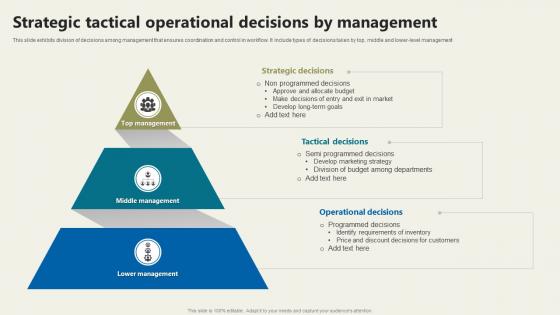
Strategic Tactical Operational Decisions By Management




Try Before you Buy Download Free Sample Product
 Impress Your
 Audience
 100%
100% Editable
 Save Hours
 of Time


This slide exhibits division of decisions among management that ensures coordination and control in workflow. It include types of decisions taken by top, middle and lower level management.
People who downloaded this PowerPoint presentation also viewed the following :
Strategic Tactical Operational Decisions By Management with all 6 slides:
Use our Strategic Tactical Operational Decisions By Management to effectively help you save your valuable time. They are readymade to fit into any presentation structure.





FAQs for Strategic Tactical Operational
Honestly? Just force yourself to pause for like 30 seconds when everything's going crazy - it actually resets your brain. Break big decisions into smaller pieces and focus on what you can control right this second. This might sound dumb, but write down your top 2-3 options. When your mind's racing, seeing it on paper makes everything way clearer. I always use this "10-10-10" thing - how will I feel about this choice in 10 minutes, 10 months, 10 years? Trust me, you know more than you think you do in those stressful moments. Your experience kicks in when you let it.
Your brain basically tricks you with these sneaky shortcuts. Like, you'll throw good money after bad because of sunk cost fallacy - I do this with Netflix shows I hate but can't stop watching lol. Then there's confirmation bias where you only look for stuff that backs up what you think. Anchoring is the worst though - whatever number someone throws out first just sticks in your head during negotiations. Plus your brain thinks recent dramatic events are way more common than they are. Honestly, just catching yourself helps. Take a sec on big decisions and think "what am I not seeing?"
So basically, data analytics turns those random hunches you have into actual proof. You know how you're always wondering if customers really want that new feature or which marketing actually works? The numbers will tell you. Honestly, I used to think it was overrated until I tried it - now making decisions without data feels sketchy. You can catch trends super early and spot problems coming. Plus you'll finally know what's genuinely working vs what just looks good on paper. Pick one thing you're curious about and dive in. The patterns are wild once you see them.
Dude, you'll actually SEE what's going on in your data instead of staring at endless spreadsheet rows. Charts make complicated stuff click instantly - wish someone told me this years ago! Comparing different scenarios becomes so much easier when they're side-by-side visually. Time-based decisions? Way clearer with graphs showing how things unfold. Plus your boss will actually pay attention to colorful dashboards instead of falling asleep over bullet points (been there). Start basic - bar charts, simple decision trees. You can get fancy later but honestly the simple stuff works great.
Think about fairness, transparency, and who gets impacted. Honestly, the biggest thing is just mapping out everyone who might be affected - you'd be surprised how many people you miss at first. Are you being straight about the info you're working with? Does this align with calls you've made before? Also ask yourself if you could defend this decision publicly without cringing. I mean, some of this stuff feels obvious but it's easy to get tunnel vision when you're in the thick of it. Once you start doing this regularly though, it becomes pretty automatic.
Give everyone space to think individually first - the quiet people always have the best ideas but get steamrolled. Try round-robin where everyone talks without interruptions, or anonymous surveys if it's a touchy subject. Oh, and assign someone to play devil's advocate on purpose. I watched a team completely flip their decision because one person finally spoke up about something obvious that everyone else somehow missed. Before you lock anything in, just ask "what aren't we seeing here?" Trust me, there's always something.
Honestly, I used to be the worst at making decisions - like, I'd spend 20 minutes picking a Netflix show. What helped me was setting deadlines for myself and not allowing endless deliberation. Try the 10-10-10 thing: how will you feel about each choice in 10 minutes, 10 months, and 10 years? Game changer. Also, ditch the hunt for perfection. "Good enough" is actually good enough most of the time. Write pros and cons if you need to, but don't spiral into overthinking hell. Start practicing with smaller stuff first - what to order for lunch, which route to take home. Builds confidence for bigger choices later.
Honestly, emotional intelligence is a game-changer for decisions. You know that weird gut feeling when a deal seems sketchy? That's your emotions giving you intel, not just being dramatic. Being able to read your own mood plus other people's vibes means you're not just running on pure logic and spreadsheets. Plus you don't spiral into self-hate when you mess up - which, let's be real, happens to everyone. I've learned to actually pause before big choices and ask myself: are my feelings pointing to something real here, or am I just being anxious? It's surprisingly helpful.
Start with SWOT analysis - it's dead simple and covers your strengths, weaknesses, opportunities, threats. For bigger picture stuff, McKinsey 7S is solid for checking if all your org pieces actually fit together. Scenario planning helps when your market's all over the place (which, let's be honest, most are these days). PEST analysis covers external factors like politics and economic shifts. Most companies just go with their gut anyway, but these frameworks make you think things through properly. Pick whatever matches your timeline and how complex things are getting. I'd go SWOT first, then add scenario planning if there's tons of uncertainty.
Honestly, AI is pretty great for cutting through all the mental noise when you're trying to make decisions. It won't get caught up in confirmation bias or let last week's drama influence everything like we do. The thing processes way more data than I could ever handle - which is slightly terrifying but also useful. You can throw your options at it and get pure metric-based feedback. It'll spot patterns you'd completely miss and run through different scenarios. Just make sure you're feeding it decent info to work with. At the end of the day though, you're still the one making the actual choice.
So basically, everything you've been through becomes like this mental filing system that kicks in whenever you're making decisions. Good experiences? You'll probably go that route again. Bad ones make you way more cautious - sometimes too cautious, which honestly can be just as problematic. Over time you get better at reading situations though, like spotting warning signs or good opportunities way faster than someone who hasn't dealt with similar stuff. The downside is your past can also create these weird blind spots or make you stuck in old patterns. I'd say just check in with yourself occasionally - are your usual choices actually working for you anymore?
Oh man, this is so real! Your German teammates will want three spreadsheets before making any decision, while others just go with their gut. Some cultures need everyone to agree first - which honestly can take forever. Then you've got the opposite where leadership just makes the call and everyone follows. I've noticed timing expectations are all over the place too. Quick decisions vs. taking time to think it through properly. Best thing? Figure out each person's style early and work around it. You'll still hit your deadlines but won't drive anyone crazy in the process.
Yeah, procrastination totally screws with your decision-making. You end up rushing and picking whatever's easiest or still available - which is usually not great. I've done this so many times with travel booking, ugh. When you're stressed and pressed for time, you can't think clearly about consequences or weigh your options properly. Your brain just goes into panic mode. Try giving yourself fake deadlines before the real ones hit. That way if you mess up (which honestly, you probably will at first), there's still time to fix it.
So basically, scenario planning is just thinking through different "what if" situations ahead of time. You map out maybe 3-4 possibilities - best case, worst case, and some realistic middle options. Honestly, it's like doing a practice round in your head before stuff actually happens. When things inevitably go sideways (because they always do), you won't be totally caught off guard since you've already gamed it out. I actually started doing this for work decisions and it's weirdly helpful. Just pick three scenarios for whatever you're dealing with and see how it changes your perspective.
Look, when your decisions actually match what your company stands for, everything just clicks better. You're not fighting upstream anymore. Leadership trusts you more because they know you get it. The whole team stays on the same page instead of pulling in different directions - which honestly saves everyone a headache. Going against those core values? That's when things get messy. Morale tanks, people get confused, and you end up wasting time on stuff that doesn't matter. I always tell people to just ask themselves: "Does this actually support what we're trying to do here?" Makes the tough calls way clearer.
-
“Superb. What a great finding. Thankful for SlideTeam. We were paying people to make slides which went all in vain. We are so happy to have found you.”
-
Crisp and neat slides. Makes it fun and easier to curate presentations.