

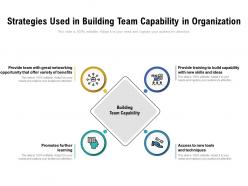
Strategies used in building team capability in organization





Try Before you Buy Download Free Sample Product
 Impress Your
 Audience
 100%
100% Editable
 Save Hours
 of Time


Our Strategies Used In Building Team Capability In Organization are topically designed to provide an attractive backdrop to any subject. Use them to look like a presentation pro.
People who downloaded this PowerPoint presentation also viewed the following :
Strategies used in building team capability in organization with all 2 slides:
Use our Strategies Used In Building Team Capability In Organization to effectively help you save your valuable time. They are readymade to fit into any presentation structure.
FAQs for Strategies used in building team
Effective team capability building strategies include skills assessment and gap analysis, targeted training programs, mentorship initiatives, cross-functional collaboration opportunities, and performance measurement systems. These components work together by identifying development needs, delivering relevant learning experiences, and fostering knowledge transfer, with many organizations finding that strategic capability building enhances productivity, employee engagement, and competitive advantage.
Organizations assess current team capabilities through skills audits, performance analytics, competency mapping, 360-degree feedback, and gap analysis tools. These comprehensive evaluations help identify strengths and development areas across technical, leadership, and soft skills, with many companies finding that systematic capability assessments enable targeted training investments, ultimately delivering improved performance and strategic alignment.
Continuous learning serves as the foundation for team capability enhancement by fostering skill development, promoting adaptability to emerging technologies, encouraging knowledge sharing, and building resilience against market changes. Through structured learning programs and cross-functional training, organizations streamline performance improvements while delivering competitive advantages, with many companies finding that learning-focused teams consistently outperform static counterparts in innovation and efficiency.
Team leaders can identify skill gaps by conducting performance assessments, analyzing project outcomes, gathering feedback through one-on-one meetings, reviewing team productivity metrics, and comparing current capabilities against strategic objectives. Through regular skills audits and competency mapping, organizations streamline talent development initiatives, enhance resource allocation, and ultimately deliver improved project success rates, with many finding that systematic gap analysis enables more targeted training investments.
Innovative methods include cross-functional project rotations, peer mentoring circles, collaborative digital workspaces, knowledge-sharing lunch sessions, and reverse mentoring programs. These approaches enhance team dynamics by breaking down silos, accelerating skill transfer, and creating continuous learning environments, with many organizations finding that structured knowledge exchange ultimately delivers improved innovation, faster problem-solving, and stronger team cohesion.
Technology enhances team capability building through learning management systems, virtual reality training, AI-powered skill assessments, collaborative platforms, and data analytics tools. These solutions streamline development by personalizing learning paths, providing immersive simulations, and tracking progress in real-time, with organizations increasingly finding that technology-enabled training delivers faster skill acquisition and measurable performance improvements.
Metrics for team development success include productivity improvements, employee engagement scores, skill assessment results, retention rates, and project completion times. These measurements enable organizations to track progress through enhanced collaboration, reduced turnover, and improved performance outcomes, with many companies finding that comprehensive tracking ultimately delivers stronger team cohesion and competitive advantage.
Organizations ensure alignment by establishing clear connections between skill development initiatives and strategic objectives, conducting regular capability assessments against business priorities, and creating development roadmaps that directly support company goals. This strategic approach enables teams to focus their learning efforts on competencies that drive revenue growth, operational efficiency, and competitive advantage, with many companies finding that aligned capability building delivers measurable improvements in performance metrics and business outcomes.
Team diversity significantly enhances capability building by bringing varied perspectives, experiences, problem-solving approaches, and skill sets that accelerate learning and innovation within organizations. This strategic combination enables teams to develop more comprehensive solutions, adapt faster to market changes, and ultimately deliver superior performance outcomes, with many companies finding that diverse teams consistently outperform homogeneous groups across multiple business metrics.
Feedback mechanisms integrate into capability building through regular performance assessments, peer reviews, mentor consultations, skill gap analyses, and real-time project evaluations. These systems enable organizations to continuously refine training programs, identify emerging development needs, and measure competency growth, with many companies finding that structured feedback loops accelerate skill acquisition and improve overall team performance significantly.
Creating a culture that supports team development requires establishing psychological safety, providing regular feedback and coaching opportunities, encouraging cross-functional collaboration, and celebrating both successes and learning from failures. These practices enable teams to innovate more effectively, enhance communication skills, and build trust, with many organizations finding that this strategic approach ultimately delivers higher employee engagement, improved retention rates, and sustained competitive advantage.
Remote teams effectively build capabilities through virtual training programs, online mentorship platforms, collaborative project-based learning, digital skill-sharing sessions, and cloud-based knowledge repositories. These approaches enable organizations to deliver targeted development while maintaining team cohesion, with many companies finding that virtual environments actually accelerate capability building through increased accessibility and flexible scheduling.
Mentorship and coaching enhance team capabilities by accelerating skill development, knowledge transfer, and professional growth through personalized guidance and structured feedback. These approaches enable organizations to build internal expertise more effectively, reduce talent gaps, and improve retention rates, with many companies finding that strategic mentorship programs deliver faster employee development and stronger succession planning outcomes.
Organizations can address resistance to change by involving employees in planning processes, communicating clear benefits and timelines, providing adequate training and support resources, and recognizing early adopters who embrace new initiatives. Through transparent communication and phased implementation approaches, companies in sectors like manufacturing and healthcare find that resistance diminishes significantly when teams understand how capability building enhances their professional growth, streamlines workflows, and ultimately delivers competitive advantages in an increasingly dynamic business environment.
Strategies include self-assessment tools, personalized learning paths, mentorship programs, cross-functional projects, and skill-based challenges that align with career goals. These approaches enhance engagement by empowering employees to take ownership of their growth, while organizations benefit from increased retention, improved performance, and stronger internal talent pipelines that deliver competitive advantage.
No Reviews