


Structure Of It Governance Enterprise Governance Of Information Technology EGIT





Try Before you Buy Download Free Sample Product
 Impress Your
 Audience
 100%
100% Editable
 Save Hours
 of Time


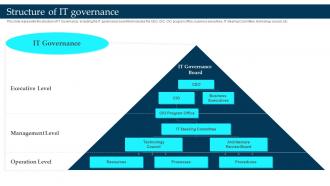
This slide represents the structure of IT Governance, including the IT governance board that includes the CEO, CIO, CIO program office, business executives, IT steering Committee, technology council, etc.
People who downloaded this PowerPoint presentation also viewed the following :
Structure Of It Governance Enterprise Governance Of Information Technology EGIT with all 6 slides:
Use our Structure Of It Governance Enterprise Governance Of Information Technology EGIT to effectively help you save your valuable time. They are readymade to fit into any presentation structure.





FAQs for Structure Of It Governance Enterprise Governance Of
Key components of a robust IT governance framework include strategic alignment, risk management, resource optimization, performance measurement, and stakeholder engagement. These elements work together by ensuring IT investments support business objectives, managing cybersecurity and operational risks, and optimizing technology resources, with many organizations finding that integrated governance ultimately delivers enhanced operational efficiency and competitive advantage.
IT governance aligns with corporate governance by establishing strategic oversight, risk management frameworks, and accountability structures that mirror board-level governance principles. Through integrated policy development, compliance monitoring, and performance measurement systems, organizations ensure technology decisions support business objectives, regulatory requirements, and stakeholder expectations, ultimately delivering transparent resource allocation and enhanced operational control across enterprise functions.
Risk management serves as a foundational pillar of IT governance, encompassing threat assessment, compliance monitoring, security protocols, and business continuity planning. Through systematic risk frameworks, organizations proactively identify vulnerabilities, implement protective measures, and ensure regulatory adherence, ultimately delivering operational resilience and competitive advantage in an increasingly complex digital landscape.
Organizations can measure IT governance effectiveness through key performance indicators like project delivery rates, budget adherence, security incident frequency, system uptime, and regulatory compliance scores. Through regular assessments and stakeholder feedback, companies in sectors like banking and healthcare track improved operational efficiency, reduced IT costs, and enhanced risk management, ultimately delivering measurable business value and competitive advantage.
Common implementation challenges include inadequate executive support, lack of clear policies and procedures, insufficient staff training, resistance to organizational change, and poor alignment between IT and business objectives. These obstacles often result in fragmented governance frameworks, with many organizations finding that addressing cultural resistance and establishing cross-departmental communication ultimately delivers more cohesive IT strategies and improved operational efficiency.
IT governance influences organizational decision-making by establishing clear frameworks for technology investments, risk management, and strategic alignment with business objectives. Through structured committees, defined approval processes, and performance metrics, organizations streamline technology choices, enhance resource allocation, and ensure compliance requirements, ultimately delivering faster decision cycles and greater operational efficiency across departments.
Common IT governance frameworks include COBIT, ITIL, ISO/IEC 38500, TOGAF, and NIST, each addressing different aspects of technology management and strategic alignment. These frameworks streamline organizational oversight by establishing clear accountability structures, risk management protocols, and performance metrics, with many enterprises finding that combining multiple frameworks delivers enhanced operational efficiency and regulatory compliance in increasingly complex digital environments.
Organizations ensure regulatory compliance through IT governance by establishing comprehensive frameworks that include risk assessment protocols, audit trails, data protection measures, and continuous monitoring systems. These governance structures enable businesses to maintain transparency, streamline compliance reporting, and minimize regulatory violations, with many financial services and healthcare institutions finding that robust IT governance ultimately delivers reduced compliance costs and enhanced operational efficiency.
IT governance and IT service management work synergistically, with governance providing strategic oversight, policies, and decision-making frameworks while service management handles operational delivery, process implementation, and day-to-day IT services. This strategic combination enables organizations to align technology investments with business objectives, streamline service delivery, and ensure compliance, ultimately delivering enhanced operational efficiency and measurable business value.
Technology trends significantly reshape IT governance strategies by requiring updated risk frameworks, new compliance protocols, and revised security measures to address emerging threats and opportunities. Organizations must continuously adapt their governance structures to accommodate cloud migrations, AI implementations, and digital transformation initiatives, with many finding that agile governance models enable faster innovation while maintaining strategic oversight and competitive advantage.
An IT governance committee oversees strategic IT alignment, risk management, resource allocation, policy development, and performance monitoring across the organization. Through regular assessments and stakeholder collaboration, these committees ensure technology investments deliver measurable business value, regulatory compliance, and operational efficiency, with many organizations finding that structured governance ultimately enhances decision-making and competitive advantage.
Stakeholders can be engaged through structured governance committees, regular strategic planning sessions, transparent reporting mechanisms, cross-functional working groups, and executive dashboards that provide real-time insights. These approaches enable organizations to align IT initiatives with business objectives, facilitate two-way communication, and ensure accountability, ultimately delivering enhanced decision-making and stronger stakeholder buy-in across departments.
IT governance success metrics include IT cost optimization ratios, project delivery timelines, system uptime percentages, compliance audit scores, and risk mitigation effectiveness rates. These measurements enable organizations to track operational efficiency, regulatory adherence, and strategic alignment, with many enterprises finding that comprehensive metrics ultimately deliver enhanced decision-making transparency and competitive advantage.
Organizations leverage IT governance to drive digital transformation by establishing clear strategic frameworks, aligning technology investments with business objectives, and implementing robust oversight mechanisms that ensure accountability and risk management. Through structured governance processes, companies streamline decision-making, accelerate project delivery, and optimize resource allocation, with many enterprises finding that effective IT governance ultimately delivers faster innovation cycles and sustainable competitive advantage in increasingly digital markets.
Poor IT governance creates significant business risks including security vulnerabilities, compliance failures, budget overruns, and operational inefficiencies that directly impact performance. Organizations with weak IT oversight often experience data breaches, regulatory penalties, and system downtime, while struggling with misaligned technology investments, ultimately delivering slower services, higher costs, and diminished competitive advantage in increasingly digital markets.
-
What a stunning collection of customizable templates! Really a time-saver..
-
I really liked their customized design services. I got my desired template made by their expert team. Thank You!