

Subject matter expert sme icon




Try Before you Buy Download Free Sample Product
 Impress Your
 Audience
 100%
100% Editable
 Save Hours
 of Time


Get folks to echo your feelings with our Subject Matter Expert Sme Icon. Your arguments will be genuinely convincing.
People who downloaded this PowerPoint presentation also viewed the following :
Content of this Powerpoint Presentation
Description:
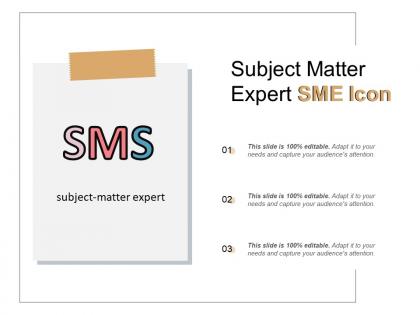
This image portrays a PowerPoint slide with a focus on subject matter expertise, highlighted by the acronym "SME" and an image of a document icon with "SMS" on it, standing for "subject-matter expert." The slide has the title "Subject Matter Expert SME Icon" which is in bold, indicating the importance of the role in various scenarios. It is directly followed by the phrase "This slide is 100% editable. Adapt it to your needs and capture your audience's attention." listed as points 01, 02, and 03. This repetition emphasizes the customizable nature of the slide, encouraging the presenter to tailor the content according to the specific needs and interests of the audience.
The slide could be effectively used in several industries to emphasize the importance of specialized knowledge and to introduce the concept or role of a Subject Matter Expert (SME) in different contexts. Here are seven specific industries where this slide could be applicable:
Use Cases:
Here are seven specific industries where this slide could be applicable:
1. Education:
Use: Introducing guest lecturers or specialized educators.
Presenter: Academic coordinator.
Audience: Students and faculty.
2. Healthcare:
Use: Discussing specialized medical fields or research.
Presenter: Medical director or department head.
Audience: Healthcare professionals.
3. Technology:
Use: Highlighting expertise in specific software or hardware.
Presenter: Lead developer or product manager.
Audience: Technical team members.
4. Finance:
Use: Explaining complex financial concepts or regulations.
Presenter: Senior financial analyst.
Audience: Investors and company stakeholders.
5. Legal Services:
Use: Outlining areas of legal specialization.
Presenter: Senior attorney or law firm partner.
Audience: Legal practitioners or law students.
6. Manufacturing:
Use: Detailing expert-led quality assurance processes.
Presenter: Quality assurance manager.
Audience: Operational staff and management.
7. Marketing:
Use: Showcasing niche market research and strategies.
Presenter: Marketing strategist or consultant.
Audience: Marketing team and management."
Subject matter expert sme icon with all 5 slides:
Your arguments appear genuinely convincing due to our Subject Matter Expert Sme Icon. Folks begin to echo your feelings.
FAQs for Subject matter
Subject Matter Experts possess deep specialized knowledge, extensive practical experience, recognized credentials, strong analytical skills, and effective communication abilities. These professionals demonstrate their expertise through years of hands-on application, continuous learning, and the ability to translate complex concepts into actionable insights, with many organizations finding that SMEs drive innovation and strategic decision-making across industries.
Organizations effectively identify SMEs through internal talent mapping, cross-functional assessments, performance reviews, and peer nominations to locate individuals with specialized knowledge and proven track records. Engaging these experts requires clear project scopes, flexible scheduling arrangements, recognition programs, and collaborative platforms that enable knowledge sharing, with many companies finding that offering professional development opportunities and visibility ultimately enhances SME participation and project outcomes.
SMEs provide essential expertise for developing accurate, relevant educational content by contributing specialized knowledge, validating technical accuracy, and ensuring materials align with industry standards and real-world applications. Through collaboration with instructional designers, SMEs help create comprehensive training programs that bridge theoretical concepts with practical implementation, ultimately delivering more effective learning experiences and better-prepared professionals across industries.
SMEs contribute to quality assurance by conducting technical reviews, validating requirements against industry standards, performing specialized testing, and ensuring deliverables meet regulatory compliance and best practices. Through their deep domain expertise, SMEs can identify potential issues early, recommend improvements, and verify that solutions align with business objectives, ultimately reducing rework costs and enhancing project success rates.
Businesses can leverage SMEs to enhance innovation by incorporating their specialized knowledge into cross-functional teams, strategic planning sessions, and product development processes. Through dedicated innovation workshops, advisory roles, and knowledge-sharing platforms, organizations streamline decision-making, minimize risks, and accelerate time-to-market, with many companies finding that SME insights ultimately deliver competitive advantages and foster breakthrough solutions.
SMEs can leverage webinar platforms, content management systems, social media channels, podcast hosting services, and video conferencing tools to amplify their knowledge reach. These technologies streamline content creation, audience engagement, and knowledge distribution across multiple formats, with many experts finding that strategic combinations deliver enhanced visibility, broader professional networks, and increased business opportunities.
SMEs can balance expertise with openness by actively seeking input from cross-functional teams, regularly questioning their own assumptions, and creating structured feedback mechanisms that encourage diverse viewpoints. This approach enhances decision-making quality and innovation potential, with many organizations finding that SMEs who embrace collaborative perspectives ultimately deliver more comprehensive solutions and stronger strategic outcomes.
Knowledge transfer from SMEs can be facilitated through structured mentoring programs, comprehensive documentation systems, cross-training initiatives, collaborative workshops, and peer-to-peer learning sessions. These strategies streamline organizational knowledge sharing by creating multiple touchpoints for expertise exchange, reducing dependency on individual contributors, and building institutional memory, with many companies finding that systematic knowledge transfer ultimately enhances team capabilities and operational resilience.
SMEs stay current through continuous learning methodologies including industry conferences, professional certifications, peer networks, research publications, and specialized training programs. These approaches enable knowledge professionals to maintain expertise by engaging with emerging technologies, participating in thought leadership forums, and collaborating with industry colleagues, ultimately delivering enhanced strategic value and competitive insights to their organizations.
SMEs should consider confidentiality obligations, intellectual property rights, conflict of interest disclosure, accurate representation of expertise limits, and unbiased advice provision. These ethical frameworks enhance professional credibility by ensuring transparent client relationships, protecting proprietary information, and maintaining objective recommendations, with many consulting professionals finding that strong ethical practices ultimately deliver sustained client trust and competitive advantage.
SMEs can effectively communicate complex concepts by simplifying technical language, using analogies and visual aids, breaking information into digestible segments, and focusing on practical applications rather than theoretical details. Through storytelling, real-world examples, and interactive presentations, many professionals find that audiences retain information better while building trust and engagement, ultimately delivering clearer understanding and stronger stakeholder buy-in.
SMEs face challenges including information overload requiring constant learning, increased competition from emerging experts, rapidly evolving industry standards, difficulty scaling personal expertise across organizations, and maintaining visibility in saturated markets. These professionals navigate credibility concerns by consistently delivering measurable results, building strategic partnerships, and leveraging thought leadership platforms, with many finding that combining deep expertise with strong communication skills ultimately delivers sustained authority and competitive advantage.
SMEs can enhance their professional visibility through LinkedIn thought leadership articles, Twitter industry insights, YouTube educational content, Instagram behind-the-scenes expertise, and Facebook community engagement. These platforms enable strategic personal branding by showcasing specialized knowledge, building industry networks, and establishing credibility, with many professionals finding that consistent, value-driven content ultimately delivers enhanced reputation and expanded business opportunities.
SMEs can engage audiences through interactive storytelling, real-world case studies, strategic questioning, visual demonstrations, and audience participation techniques. These approaches enhance presentations by connecting complex expertise to practical applications, encouraging active dialogue, and creating memorable learning experiences, with many professionals finding that combining technical knowledge with engaging delivery methods significantly improves audience retention and outcomes.
SME roles vary significantly across industries, with technology SMEs focusing on system architecture and development cycles, healthcare SMEs specializing in clinical protocols and regulatory compliance, and finance SMEs concentrating on risk management and regulatory frameworks. While each requires deep domain expertise, technology emphasizes innovation speed, healthcare prioritizes patient safety, and finance demands precision in compliance, with organizations increasingly leveraging cross-industry SME insights for competitive advantage.
No Reviews