


Summary financials revenue ebitda pat ppt pictures design inspiration




Try Before you Buy Download Free Sample Product
 Impress Your
 Audience
 100%
100% Editable
 Save Hours
 of Time


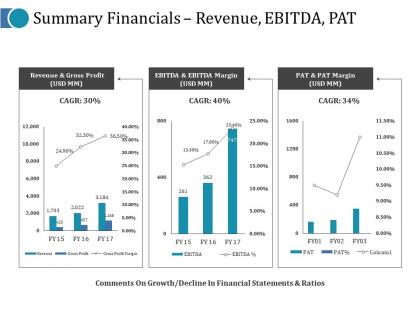
Improve existing conditions with our Summary Financials Revenue Ebitda Pat Ppt Pictures Design Inspiration. Act as a growth facilitator.
People who downloaded this PowerPoint presentation also viewed the following :
Summary financials revenue ebitda pat ppt pictures design inspiration with all 5 slides:
Create big buyers with our Summary Financials Revenue Ebitda Pat Ppt Pictures Design Inspiration. Enable them to check and compare.



FAQs for Summary financials revenue ebitda pat ppt
Key financial performance metrics include revenue growth, profit margins, return on equity, debt-to-equity ratio, and cash flow indicators. These metrics enable organizations to assess operational efficiency, profitability, and financial stability across different business cycles, with many companies finding that consistent monitoring ultimately delivers better strategic decision-making and competitive positioning.
Revenue growth and profit margins work together to determine financial sustainability, with strong growth meaningless if margins decline significantly, while healthy margins without growth can signal stagnation. Through strategic pricing, operational efficiency, and cost management, organizations balance expansion with profitability, ultimately delivering sustainable value creation and competitive positioning in increasingly dynamic markets.
Financial ratios like ROI and ROE reveal operational efficiency by measuring how effectively organizations convert investments and equity into profits, indicating management's ability to optimize resources, control costs, and generate returns. These metrics enable companies to benchmark performance against competitors, identify operational bottlenecks, and make strategic decisions that streamline processes, ultimately delivering enhanced profitability and competitive advantage.
Cash flow management directly impacts long-term financial stability by ensuring adequate liquidity for operations, debt obligations, and growth investments while minimizing financial stress during economic downturns. Through strategic cash flow planning, organizations enhance their ability to weather market volatility, seize expansion opportunities, and maintain operational continuity, ultimately delivering sustained profitability and competitive resilience.
Budgeting serves as a financial roadmap that enables organizations to set spending targets, allocate resources strategically, and track actual performance against planned objectives. Through regular budget variance analysis, companies can identify inefficiencies, adjust operational strategies, and optimize resource allocation, with many businesses finding that systematic budgeting ultimately delivers improved cash flow management and enhanced profitability.
Benchmarking against industry standards enhances financial strategies by identifying performance gaps, revealing optimization opportunities, and establishing realistic targets based on peer success metrics. Through comparative analysis, companies streamline resource allocation, improve operational efficiency, and accelerate strategic decision-making, with many organizations finding that systematic benchmarking ultimately delivers competitive advantage and measurable financial improvements.
External economic factors significantly impact financial performance through interest rate fluctuations, inflation levels, currency exchange rates, consumer demand shifts, and regulatory changes. These macroeconomic variables affect revenue generation, operational costs, and investment returns, with many organizations finding that proactive economic monitoring and adaptive financial strategies enable better resilience and competitive positioning.
Businesses can assess financial performance effectiveness by comparing key metrics across quarters and years, including revenue growth, profit margins, ROI, cash flow trends, and debt-to-equity ratios. Through period-over-period analysis, companies identify patterns, seasonal variations, and strategic impacts, with many organizations finding that consistent monitoring enables proactive adjustments and sustained competitive advantage.
Strategies to enhance financial performance during downturns include cost optimization, cash flow management, strategic partnerships, operational efficiency improvements, and diversified revenue streams. These approaches enable organizations to streamline expenses while maintaining service quality, with many companies in retail, manufacturing, and financial services finding that combining automation with targeted cost reduction ultimately delivers competitive advantage and improved resilience.
Capital structure decisions significantly influence financial health by affecting debt-to-equity ratios, interest obligations, tax benefits, and overall financial flexibility. Strategic combinations of debt and equity financing enable companies to optimize capital costs, enhance operational efficiency, and maintain adequate liquidity for growth opportunities, with many organizations finding that balanced approaches ultimately deliver sustainable competitive advantage.
Financial performance directly influences investor confidence, stock valuations, market perception, and access to capital markets. Strong financial results typically enhance share prices, attract institutional investors, and reduce borrowing costs, while weaker performance can trigger selloffs, analyst downgrades, and increased scrutiny from stakeholders, ultimately determining a company's market position and growth opportunities.
Mergers and acquisitions significantly impact financial performance through enhanced market share, operational synergies, cost reduction, and expanded revenue streams, though integration costs can initially strain profitability. While technology companies often achieve faster growth and healthcare organizations streamline operations, successful M&As ultimately deliver competitive advantages and improved long-term financial metrics.
Financial performance and corporate social responsibility initiatives demonstrate a strategic symbiotic relationship, where CSR investments enhance brand reputation, employee engagement, operational efficiency, and long-term profitability. Companies integrating sustainability practices often experience improved stakeholder trust, reduced regulatory risks, and enhanced market positioning, with many organizations finding that responsible business practices ultimately deliver competitive advantage and sustained financial growth.
Financial forecasting enables companies to anticipate performance challenges by analyzing historical data, market trends, economic indicators, and operational metrics to identify potential risks and opportunities. Through predictive modeling and scenario planning, organizations can proactively adjust strategies, optimize resource allocation, and implement contingency measures, ultimately delivering improved financial resilience and competitive advantage in volatile markets.
Financial performance technologies include business intelligence platforms, predictive analytics tools, automated reporting systems, real-time dashboards, and AI-powered forecasting solutions. These technologies streamline data collection, enhance decision-making accuracy, and automate complex calculations, with many organizations finding that integrated financial analytics ultimately deliver faster insights, reduced operational costs, and significantly improved strategic planning capabilities.
-
Great quality slides in rapid time.
-
Appreciate the research and its presentable format.