


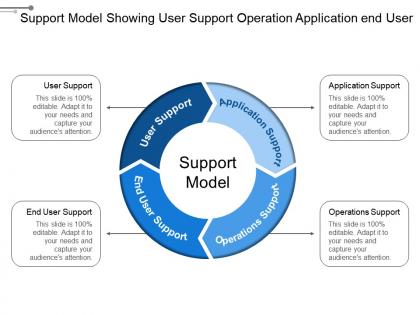
Support model showing user support operation application end user




Try Before you Buy Download Free Sample Product
 Impress Your
 Audience
 100%
100% Editable
 Save Hours
 of Time


The impact of our Support Model Showing User Support Operation Application End User can be highly captivating. It will get hearts to glow.
People who downloaded this PowerPoint presentation also viewed the following :
Support model showing user support operation application end user with all 5 slides:
Become better aware with our Support Model Showing User Support Operation Application End User. Benefit from their domain experience.



FAQs for Support model showing user support operation
Honestly, you'll want chat, email, and phone support as your foundation. Build different tiers - Level 1 handles the easy stuff, Level 2 tackles technical problems. A good knowledge base saves everyone time. Track response times and satisfaction scores because your boss will definitely ask for those numbers later. Training programs matter, but here's what really counts: give your team actual power to fix things, not just take notes about problems. Clear escalation paths help too. Oh, and set up regular feedback loops - sounds boring but it actually helps catch issues early. The whole thing falls apart if people can't solve what customers need.
Honestly, it depends SO much on your industry. Healthcare and finance? You're stuck with 24/7 support and all that compliance stuff. Retail can get away with focusing on chat during busy shopping times. SaaS needs those technical support tiers, but hospitality is all about training people to actually care - like, the emotional intelligence thing matters way more than knowing code. I'd start by looking at what customers bug you about most. Then figure out if your team actually knows how to handle those specific problems. Oh, and don't forget to set up escalation paths that make sense for your situation.
So tech basically speeds everything up and lets you handle way more people. Chatbots can knock out the basic questions instantly. Ticketing systems automatically send issues to whoever needs to deal with them. Knowledge bases are great because people can just find answers themselves - honestly, most users prefer that anyway. AI's getting crazy good at predicting what someone needs before they even ask. You can use analytics to spot patterns in all the complaints and actually fix the root problems. Just don't go overboard with flashy stuff that doesn't actually help your users.
So here's the thing - data analytics will completely change how you handle user support. You'll spot patterns you never noticed before. Common issues? You can catch them early instead of scrambling later. Plus you get to see which solutions actually work (spoiler: some don't). The coolest part is predicting when you'll get slammed with tickets so you can staff up ahead of time. Oh, and personalizing responses based on what users did before. Honestly just start tracking your top 5 ticket types and how long they take to fix.
Honestly, getting leadership to actually care about support is the worst part - they never see it as making money. Resource allocation becomes this constant battle. Then you've got staff burning out left and right because support work is just draining. Your escalation paths will probably be messy at first, and don't even get me started on trying to make SLAs that actually work with a small team. The tech integration stuff can get really frustrating too. But here's the thing - users want that human connection, not just chatbots. Start with one channel, get it right, then grow from there. Trust me on this one.
Honestly, user feedback is like gold - it shows you what's actually broken instead of what you *think* might be broken. People will straight up tell you "your chatbot is useless for returns" or "I waited 20 minutes on hold at noon." Way better than guessing, right? Set up simple ways to collect it - quick surveys, follow-up emails, or just ask "how'd we do?" The tricky part isn't getting feedback though. It's actually doing something with it instead of just letting it pile up in some spreadsheet nobody checks.
Good support makes customers stick around because they feel heard when stuff goes wrong. Quick responses help, but honestly? It's more about actually fixing their problem the first time instead of bouncing them between departments. I've watched people ditch amazing products just because the support sucked. Train your team to care about solving things, not just reading scripts. Oh, and reach out before problems explode - that's huge. Each support chat is basically a chance to build trust. Sounds cheesy but it works.
Track both speed and happiness metrics - that's the key. Response time, resolution time, and first-contact resolution rates show if your team's crushing it operationally. But those numbers are useless if customers hate the experience, so definitely grab satisfaction scores and NPS too. Also watch ticket volume trends and escalation rates since they'll tell you if you're actually preventing problems or just putting out fires. Honestly, escalation rates are super telling about team training gaps. Start with these basics, then layer on more metrics as you spot patterns.
Look at your most common support tickets first - that's your goldmine for self-service content. Build a solid FAQ section and knowledge base around those repeated questions. Video tutorials work great too, honestly people love those more than reading sometimes. Chatbots can route users to the right answers before they hit "contact us." The key thing? Make it stupidly easy to find on your site. Nobody wants to hunt around for help. Track which articles get clicked most so you know what's actually working. If it's buried or confusing, people will just email you anyway.
Honestly, role-playing saved my butt when I was training new reps. Get them practicing with real scenarios first - builds confidence fast. Product knowledge is obviously crucial, but don't skip the communication stuff and de-escalation tactics. Having them shadow your best people is clutch (way better than any manual). I'd set up feedback sessions weekly at first, maybe biweekly later. Oh, and build them a solid knowledge base they can actually find stuff in quickly. Active listening and empathy training helps too. Just don't make it a one-and-done thing - monthly refreshers keep everyone from getting rusty.
Honestly, just let people contact you however they want - email, chat, phone, social. I'm one of those weirdos who'd rather chat than call, but my mom will only pick up the phone. Makes sense, right? The trick is connecting everything on your end so customers don't have to restart their whole sob story when switching from email to chat. Nothing's more annoying than that. Get your support tools talking to each other so the conversation history follows them around. Trust me, it'll save everyone's sanity.
Write like you're talking to someone who just joined yesterday. Simple words, step-by-step stuff, screenshots everywhere. Honestly, nothing's worse than those lazy bullet-point docs with zero context. Explain WHY you do something, not just what to do. Put everything in one searchable spot - I use Notion but whatever works. Assign owners so people know who to bug when they're lost. Oh, and actually update your docs! Seriously, old instructions will just confuse everyone more than having nothing at all.
Build layers - start with self-service stuff like FAQs for basic questions. Then do tier 1 for simple issues, tier 2 for technical headaches, you get the idea. The tricky part? Figuring out when you need more people vs better tools (learned that one the hard way). Track your ticket volumes monthly so you can hire before things get crazy. As you grow, have people specialize by product or customer type instead of everyone doing everything. Oh, and automate whatever you can - saves so much time.
Oh man, this is such a pain point! Different cultures have totally opposite expectations for support. Like, some want super formal interactions while others prefer chatty, casual vibes. Direct cultures? They want quick answers. But try that with indirect cultures and they'll think you're being rude - they need more context and relationship-building first. I learned this the hard way when we had users complaining that our team seemed "cold" even though we were just being efficient. You've gotta train your support team on this stuff and maybe offer different channels. Some people love live chat, others want detailed email exchanges. It's annoying but worth it.
Honestly, collaboration tools are a game changer for support chaos. Your team gets real-time ticket visibility through shared dashboards, plus internal chat for those "wtf is this customer even asking?" moments. Knowledge bases actually stay current too, which is wild. Email chains disappear completely - thank god. When agents can grab subject matter experts instantly or escalate without losing context, resolution times plummet. Oh, and start by connecting your ticketing system to team chat first. That one change saves hours every week, no joke.
-
Illustrative design with editable content. Exceptional value for money. Highly pleased with the product.
-
The content is very helpful from business point of view.