

Support model of a company ppt slide template




Try Before you Buy Download Free Sample Product
 Impress Your
 Audience
 100%
100% Editable
 Save Hours
 of Time


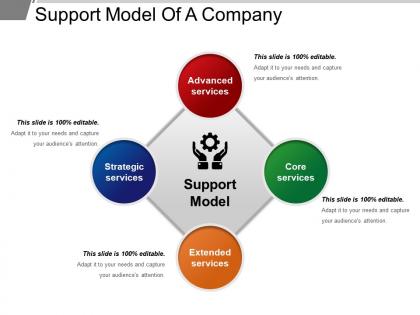
Get the fully professional, business oriented support model of a company PPT slide template designed by our professional PPT designers. Process support is one of the most important parts of any organizational success. This generalized application support and maintenance PPT diagram cater to an array of concerns related to business process and support. You can highlight various support services such as core services, extended services, strategic services and advanced services with this pre designed support model diagram. PPT can be used as an effective production support process document to specify your company’s requirement and process to handle customer’s escalations. As providing the best customer service is the key to any organization to be successful. Most of the customer service provider firms, professionals, business managers use this support case escalation PowerPoint template to display customer services being provided by the company to their audience. Download this awesome slideshow now and deliver your ideas in the most comprehensive manner. Our Support Model Of A Company Ppt Slide Template are designed to delight any connoisseur. They have been elegantly crafted.
People who downloaded this PowerPoint presentation also viewed the following :
Support model of a company ppt slide template with all 5 slides:
When you role the importance that presentations play in any successful business, then youd understand why having a powerful presentation is important. Our Support Model Of A Company Ppt Slide Template are there to help you produce powerful presentations.



FAQs for Support model of a company
You need four main things for a solid support setup. First, clear escalation paths - nobody wants tickets sitting in some weird limbo forever. Define realistic SLAs too (don't promise 2-hour response times if you're swamped). Knowledge management is huge because your team shouldn't have to solve the same problem twenty times. Good tooling for tracking everything matters just as much. Training is where most places screw up honestly - even perfect processes fail if people don't know how to actually use them. Everything has to work together smoothly. Start by figuring out what's currently driving you crazy, then fix those specific problems first.
Honestly, it's all about speed vs. regulations. Tech moves fast - people want instant chat or they'll find answers in forums themselves. But healthcare? Totally different game. Everything's documented to death, phone calls are still king because the stakes are literally life and death, and your support team needs to actually understand medical stuff. The regulatory side will eat you alive if you're not careful. I'd start there - figure out what hoops you have to jump through first, then build your support structure around that. Don't just copy what some startup is doing because it probably won't fly in healthcare.
Honestly, start with customer satisfaction scores - CSAT or NPS will tell you if people are actually happy or just being polite. First-contact resolution is clutch too; nobody wants to explain their problem three times to different agents. Response times are pretty obvious but still worth tracking. Oh, and don't sleep on agent utilization rates - helps you figure out if your team's swamped or if you've got capacity issues. Ticket volume trends are useful for spotting weird patterns too. Those five will give you a decent picture of what's working and what isn't.
Oh man, automation is a game changer for support stuff. I'd start with chatbots for those basic questions that come up a million times - saves so much headache. Then set up automatic ticket routing so things don't sit around waiting. Your response times get way faster with auto-replies too. Honestly, the best part isn't even the speed though. Your team can focus on the weird complicated issues instead of answering "how do I reset my password" for the thousandth time. Plus everything stays consistent. Just don't try to automate everything at once - pick like two things first.
So customer feedback is basically your GPS for fixing support issues - tells you exactly what's broken and what's working. Look for patterns in complaints because they'll show you the real problems, like wait times or messy team handoffs. Honestly, customers usually care about totally different stuff than what your boss thinks matters. I'd set up regular team reviews to catch trends early. Use that data to figure out what needs fixing first, then track if your changes actually move the satisfaction needle. It's way more useful than guessing what's wrong.
Honestly, training makes or breaks your whole support setup. You don't want people who just take orders and pass everything up the chain - that's useless. Your team needs to actually solve problems. We've all dealt with undertrained support (ugh), so you know how frustrating it gets. Don't just do onboarding and call it done either. Keep training them regularly because your stuff changes all the time. Focus on technical skills AND how they talk to customers. Both matter. Trust me, you'll see it in your resolution rates and customer happiness scores right away.
Figure out what stuff customers can actually do themselves - password resets, tracking orders, basic fixes. Make that super easy to find. Some people will always want to talk to someone though, which honestly makes sense sometimes. The trick is having good handoffs so they don't have to repeat everything when they switch from self-service to chat or whatever. Oh, and definitely track where people are bailing out of your self-service flow. Those spots usually tell you exactly what's confusing or broken. Keep tweaking based on that data.
Honestly, the biggest mess-ups I see are people making their support tiers way too complicated. Three levels max - anything more just creates chaos. Train your team on handoffs properly too (seriously, half the companies I've worked with skip this step entirely). Don't get obsessed with just response times either. Resolution quality matters way more in the long run. Oh, and here's the thing - actually look at your real ticket data when you're setting this up. Most people just guess what'll happen and end up completely wrong. Start basic, then tweak it as you go.
Honestly, async communication is gonna be your lifesaver here. Get a solid ticketing system that works across time zones - trust me on this one. Document literally everything because someone in Tokyo can't just tap the person next to them when the New York team went home. Set up clear handoff procedures so issues don't fall into black holes between shifts. Good collaboration tools are worth the investment, even if it means some people join meetings at weird hours. Oh, and create those knowledge bases that everyone can access 24/7. The info needs to be there even when people aren't.
Honestly, your channel choice can totally tank your support if you get it wrong. Customers wanting live chat but only getting email? Recipe for frustration. Complex stuff needs actual phone calls - chat's great for quick fixes though. Don't go crazy with too many options right away (learned this the hard way). Your team gets stretched way too thin and quality suffers. I'd pick maybe 2-3 channels where your customers actually hang out, then add more later when you've got the bandwidth. Way better than trying to be everywhere at once.
Think of it like creating a playbook for how teams actually talk to each other instead of just hoping it works out. You'll want standardized workflows and regular check-ins between marketing, sales, product, and support. Clear escalation paths help too - nobody wants to play "guess who handles this mess." Common goals are huge because otherwise everyone just optimizes for their own stuff, which honestly makes zero sense. I'd start by mapping your current handoffs first. Find where things get dropped or stuck - that's usually where the biggest wins are hiding.
Honestly, start with a good ticketing system - Zendesk or Freshdesk work great. Can't really function without that baseline. After that, grab some knowledge management tools so your team isn't constantly scrambling for answers. Live chat is pretty much expected now too. Oh, and video calls with screen sharing are a lifesaver for technical stuff - way better than trying to explain "click the thing next to the other thing" over text. Analytics dashboards help you see what's actually working. Automation for ticket routing saves tons of time on the boring stuff. Build it piece by piece though, don't go crazy all at once.
Look, people are just different when it comes to getting help. Your grandma probably wants to call someone, but a 20-year-old will hit up chat or figure it out themselves first. Cultural stuff matters too - some people are super direct about problems, others kinda dance around it. Plus you've got language barriers, different comfort levels with tech, and honestly some folks just need more hand-holding than others. The trick is giving people options so they can get help however feels right to them. Oh, and response time expectations are all over the place depending on who you're dealing with.
Honestly, three big things are happening right now. AI is everywhere - handling basic stuff so humans can deal with the messy problems that actually matter. Customers want to jump between chat, phone, social media without repeating themselves every damn time. Makes sense, right? Companies are also trying to predict issues before they blow up instead of just putting out fires. Oh, and self-service is getting way less terrible. You should probably figure out where you're behind because this stuff is moving fast. Most places are scrambling to catch up.
Honestly, start with a solid FAQ section and knowledge base - that'll knock out like 70% of the repetitive stuff without hiring anyone. When things pick up, do tiered support where newbies handle the easy tickets and your experienced people deal with the complicated mess. Chatbots are actually pretty decent now for basic questions, plus automated ticket routing saves you from manually sorting everything. Don't go crazy hiring full-time people right away though. Part-time agents or outsourcing for busy periods makes way more sense financially. Just keep an eye on your response times and customer satisfaction scores so you catch problems early.
-
Good research work and creative work done on every template.
-
Easy to edit slides with easy to understand instructions.