


SWOT Analysis Interior Design Company Profile Ppt Formats




Try Before you Buy Download Free Sample Product
 Impress Your
 Audience
 100%
100% Editable
 Save Hours
 of Time


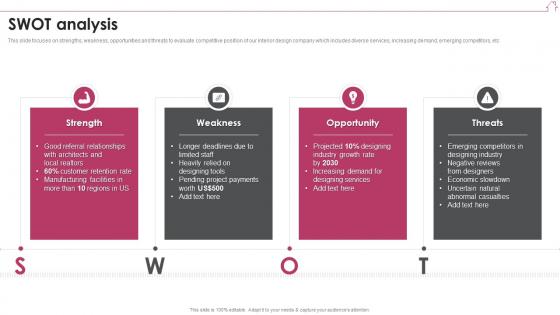
This slide focuses on strengths, weakness, opportunities and threats to evaluate competitive position of our interior design company which includes diverse services, increasing demand, emerging competitors, etc.
People who downloaded this PowerPoint presentation also viewed the following :
SWOT Analysis Interior Design Company Profile Ppt Formats with all 6 slides:
Use our SWOT Analysis Interior Design Company Profile Ppt Formats to effectively help you save your valuable time. They are readymade to fit into any presentation structure.





FAQs for SWOT Analysis Interior Design Company
SWOT has four parts - Strengths and Weaknesses are the stuff you control internally, while Opportunities and Threats are external market forces you can't really change. But here's the thing most people miss: you've gotta connect these pieces together. Like, use your strengths to grab those opportunities, or patch up weak spots before threats actually hurt you. Everyone just makes lists in boxes and thinks they're done. That's pretty useless tbh. The real trick? Map what you're actually good at against what's happening in your market right now.
Ask your customers what they actually value about you - you'll be surprised how often it's not what you think. Check your online reviews for patterns too. Get your team involved since they notice stuff leadership misses completely. Look at what you do better than competitors, but don't just focus on the obvious things like sales numbers. Your company culture or some weird process you've perfected might be your secret weapon. Honestly, we're terrible at seeing our own strengths sometimes. Make a list of everything, then back each one up with real examples or data to prove it's legit.
Start with internal audits and employee surveys - your team usually knows exactly where stuff breaks down. Customer complaints are pure gold since they show what's actually failing from the outside. Sometimes we're just too close to spot the obvious problems! Exit interviews work great too - people leaving give brutally honest feedback. Oh, and definitely benchmark against competitors to see where you're falling behind. Financial analysis reveals where you're hemorrhaging cash. Pick maybe 2-3 approaches and actually do something with what you discover instead of just making lists.
So you want to turn market changes into actual opportunities? Start by watching for trends you can jump on - new customer needs, tech shifts, regulations that help your business, or economic changes boosting demand for what you sell. I always tell people to study where competitors are screwing up because that's often your best opening. The trick is catching these trends early, before everyone else does. Keep tabs on industry reports and what customers are saying (boring but necessary). Then just ask yourself: "How can we ride this wave to grow?" Gap analysis helps too if you're into that kind of thing.
Start with a brain dump - get your team together and throw every possible threat on a whiteboard. Competitors, new regulations, market shifts, economic downturns, tech that could make you obsolete. Don't filter anything yet, just get it all out there. Then comes the fun part (okay, maybe not fun, but necessary) - figure out what's actually likely to happen versus what would absolutely wreck your business. The scary stuff that's both probable AND would hurt bad? Those go to the top of your list. Timing matters too, but honestly, focus on the high-probability disasters first.
You really can't do SWOT analysis alone - different people see totally different things. Your customers will call out weaknesses you don't even realize exist. Meanwhile, your sales team's spotting opportunities you'd never notice sitting at your computer all day. I've seen the best insights come from random conversations, honestly. Talk to people across departments, key customers, maybe some partners. Even suppliers sometimes have solid input (weird but true). Map out who should weigh in first, then actually go have those conversations. More perspectives = way better analysis.
Look, generic SWOTs are basically worthless. You need to match your categories to what actually drives success in your space. Tech companies should dig into IP and talent stuff, while retail focuses on location and supply chains. The threats part is huge - like regulatory nightmares for healthcare or those brutal seasonal swings in tourism. I always tell people to map out the 3-5 things that make or break companies in your industry first. Then build everything around those key factors. Otherwise you're just filling boxes with fluff that won't help anyone make real decisions.
Honestly, the worst thing you can do is stay super vague. Like, you'll just get worthless stuff like "our team is great" or whatever. Get specific about what actually makes you different. Also - and this is huge - don't just sit in a room guessing. Actually talk to your customers and employees first. I've seen so many companies do this once, then shove it in some file cabinet. Your SWOT needs to drive real decisions. Update it regularly too. Oh, and be brutal about the weaknesses part - that's where the gold is.
Honestly, once a year isn't enough anymore. I'd say quarterly is better, or whenever something big shifts - new competitors, regulations changing, that kind of stuff. Fast-moving industries especially need more frequent check-ins. Your strengths today could easily flip into weaknesses if you're not watching. Major strategic decisions? Definitely do a fresh one first. But really, the whole point is being responsive instead of just checking a box annually. Oh, and set those calendar reminders or you'll totally forget. Trust me on that one.
Okay so basically you gotta turn each section into actual action items with real deadlines and owners. Like if "strong customer loyalty" is one of your strengths, maybe start that referral program you've been talking about. Fix your weaknesses with measurable goals - none of that vague "improve communication" stuff. Most people totally mess this up and just stick the SWOT in a drawer somewhere, which drives me crazy. Turn threats into risk plans, opportunities into concrete next steps. Oh and definitely assign someone to own each item or nothing will happen. Set review dates too.
Honestly, most SWOTs I see are pretty useless because they skip the groundwork. Start with PESTLE to map out all the macro stuff happening around you - political changes, economic trends, whatever. Then dive into Porter's Five Forces for the competitive picture. Both of these directly feed your opportunities and threats sections with actual data instead of random guessing. Your internal analysis covers strengths and weaknesses, but without those external frameworks you're basically shooting blind. The sequence that works best for me: PESTLE first, then Porter's, then build your SWOT. Once it's done, you can actually prioritize which moves make sense strategically.
Honestly, SWOT analysis is great for getting everyone aligned on where you actually stand as a company. People feel way more invested when they're helping identify strengths and weaknesses instead of just getting orders from above. It builds real trust too - admitting your weak spots openly creates psychological safety. Teams start understanding the bigger picture together, which is honestly refreshing. The catch? You've gotta actually do something with what comes out of it. I've seen places where they collect all this input and then... nothing. That kills engagement faster than anything. But when it's done right, it really does bring people together around strategy.
SWOT analysis works great for risk stuff because it makes you dig into threats and weaknesses in an organized way. Your weaknesses? Those are basically internal vulnerabilities waiting to bite you later. Threats are your external warning system - competitors, market changes, new regulations, all that fun stuff. But honestly, the best part is using your strengths to actually counter those risks and turn opportunities into safety nets. I'd suggest making specific action plans for how you'll tackle each weakness and get ready for threats before they hit.
Honestly, tech makes SWOT analysis so much easier. Instead of dealing with messy sticky notes, try Miro or Mural for virtual sessions with your team. Way cleaner. Survey tools let you get input from way more people, and you can turn everything into actual charts that people will look at. There's even AI stuff now that spots patterns you'd probably miss - though I'm still figuring out how useful that really is. Don't go crazy with a million tools though. Pick like two that actually work with how your team operates and stick with those.
Stick with the basic 2x2 grid - don't overthink it. I'd put strengths and opportunities on top, weaknesses and threats below. Keep each section to like 3-5 bullet points max because people's attention spans are terrible. Color coding works well too - green for good stuff, red for problems. Oh, and make your font big enough! Can't tell you how many presentations I've sat through squinting at tiny text from the back row. Skip the fancy graphics - they're just distracting. You'll probably want to add a quick summary slide after that pulls out your main takeaways and next steps.
-
This design is not only aesthetically pleasing but it has many uses making the cost worthwhile. The graphics look stunning, and you can edit them as per your needs.
-
The templates are easy to get, and the chat customer support is excellent.