Swot analysis presentation powerpoint templates
Try Before you Buy Download Free Sample Product
Audience
Editable
of Time
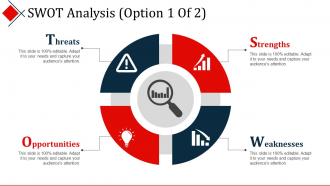
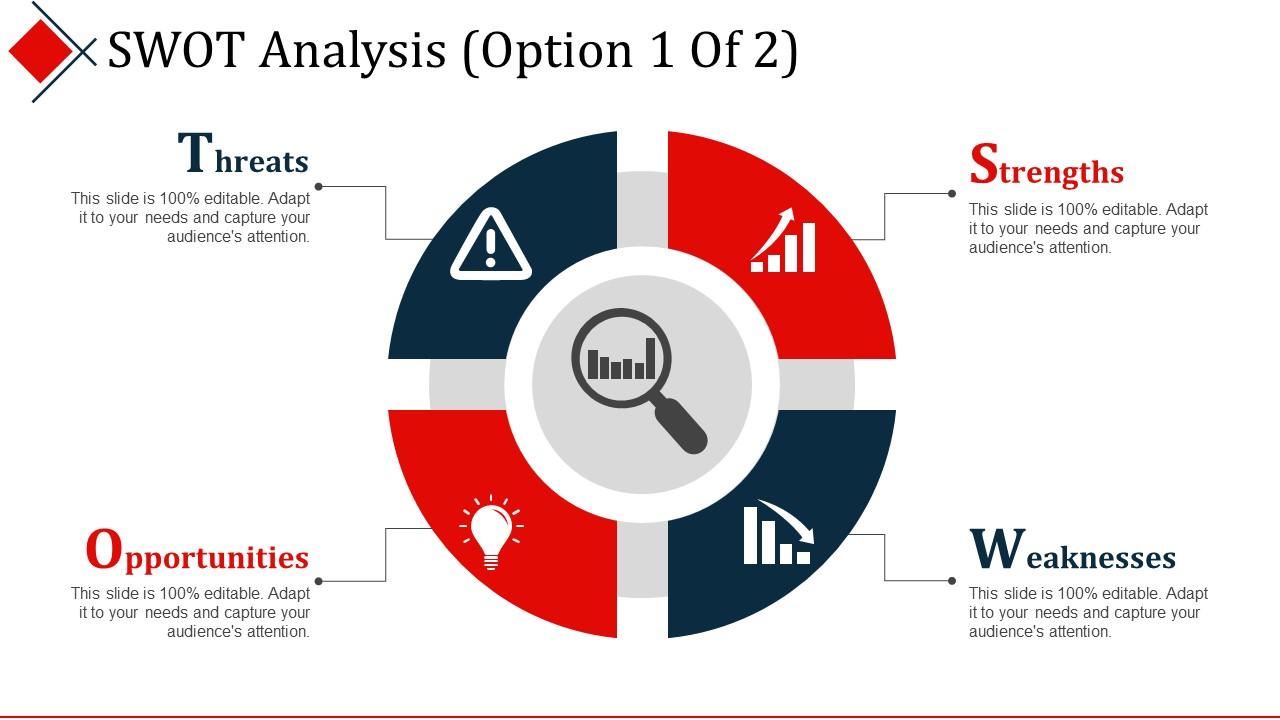
We bring to you our Swot Analysis Presentation PowerPoint Templates. This PPT presentation slide is a four-stage process and the stages are the strengths, the weaknesses, the opportunities and the various threats that are present in any field of work. This business template can be used to show an analysis of the various aspects mentioned in any project that is handed over to the employees of a company. This SWOT Analysis business template helps you build the assessment model that measures what an organization can and cannot do, and its potential opportunities and threats. If you download and use this deck of five professionally designed slides it will help you carve a sustainable position in your market. Whenever you want to enable your team or your companies to make a solid strategic plan for your business's growth it is highly recommended that you download this round donut shaped diagrammatic PPT presentation. Each arc in this circular template represents one of the SWOT Analysis feature. Business professionals like you do not have enough time to design PPTs that is why to reduce your workload we offer you this pre-designed slideshow. So just download it, edit it and present it. Our Swot Analysis Presentation Powerpoint Templates are truly contemporary. They bring out the state of the art.
People who downloaded this PowerPoint presentation also viewed the following :
Swot analysis presentation powerpoint templates with all 5 slides:
Feel the enthusiasm grow with our Swot Analysis Presentation Powerpoint Templates. They will be eager to get off the blocks.
FAQs for Swot analysis
You need those four basic boxes - strengths, weaknesses, opportunities, threats. Nothing fancy there. What actually helps though is having guiding questions in each section, stuff like "what do we crush compared to competitors?" or "what external things could mess us up?" Oh, and definitely include space for prioritizing everything. Trust me, you'll come up with like 20 different factors and can't tackle them all. The templates that work best have room for next steps too. Otherwise you just end up with another useless document. I've seen so many SWOT analyses that people spend hours on, then never look at again.
Honestly, color coding is a game changer for SWOT analysis. Different colors for each quadrant help people actually absorb the info instead of glazing over. Throw in some icons too - way better than staring at endless bullet points, which nobody enjoys anyway. Clean layouts matter more than you'd think. Your team can spot patterns between strengths and opportunities much easier when everything's organized visually. I'd grab a decent template or make your own with simple graphics. Trust me, it keeps everyone awake during presentations and makes the whole thing feel less like homework.
SWOT templates are everywhere - tech startups, retail, healthcare, consulting, you name it. Manufacturing companies use them constantly for strategic planning. Really, any business dealing with big decisions benefits from them. Launching a new product? Entering a different market? Facing crazy competition? Perfect time to break one out. The whole point is getting your team on the same page without reinventing the wheel each time. I'd grab a template that fits your industry's weird quirks and tweak it from there. Way easier than staring at a blank page trying to figure out where to start.
Honestly, just swap out the boring generic categories for stuff that actually matters to your business. Like instead of "Strengths," maybe use "Product Advantages" or whatever fits. Healthcare companies should throw in "regulatory challenges" - that's huge for them. Retail? Think seasonal trends. Don't overthink the format either. Sometimes a simple 2x2 grid works perfectly for quick brainstorming sessions. I've seen people go overboard and create these massive complicated templates that nobody wants to fill out. Start basic and tweak the wording as you go. Oh, and contractions make everything sound less corporate-y if that's your vibe.
Honestly, templates are a lifesaver for SWOT analysis. Your team will actually use the same criteria and format instead of everyone doing their own random thing. I've watched teams argue for hours trying to merge completely different analysis styles - such a mess. They speed things up too since no one's reinventing the wheel every time. Plus you can track changes over time way better when you're using consistent frameworks. Oh, and definitely start simple with just the basic four boxes, then tweak it based on what your team actually cares about evaluating.
Honestly, digital SWOT templates are so much better than those old Word docs we'd email back and forth forever. Your whole team can jump in at the same time and add their thoughts - no more waiting around for Karen from accounting to send her edits. The visual stuff helps too, you can actually see patterns and link to real data. Miro's pretty solid, or even just Google Docs works if that's what everyone's already using. Just pick whatever won't make people groan when you suggest it. You'll save yourself hours of version control headaches, trust me.
Honestly, the biggest screwup is being way too vague about everything. Like don't just say "good team" - actually specify "experienced marketing team with 10+ years in B2B." You need real data backing up your points. Also, definitely loop in other departments when you're doing this. Finance spots threats that marketing totally misses, you know? Another thing - I see people get obsessed with internal stuff and completely ignore what's happening in the market outside. Keep it balanced. Oh, and if you can't actually act on something, don't put it on there.
Get people from different departments involved - you don't want just the marketing team painting everything rosy! Back up your points with actual data instead of hunches. Be ruthlessly honest about the weak spots (this is where most teams chicken out). Take time to really dig into each section using a template so you don't miss obvious stuff. Here's the thing though - let it sit for a day or two, then come back with fresh eyes. Challenge every single point by asking "is this actually true?" and "what proves it?" Trust me, you'll catch things you missed the first time around.
Honestly, templates are a lifesaver. They give you a structure that actually works instead of staring at a blank page forever. All the formatting's done for you. Most decent ones have prompts and examples too, which is clutch when you're stuck. The downside? Less room to customize, but you can always tweak stuff later. I started using them for everything now – emails, presentations, whatever. Why stress about organizing your thoughts when someone already figured it out? Just grab a solid template and adjust it as you go.
Honestly, SWOT templates are a game changer because they stop you from just throwing ideas at the wall randomly. You work through each section - strengths, weaknesses, opportunities, threats - in order, which saves you tons of time. The cool thing is you'll start noticing patterns between different areas that you'd totally miss otherwise. When everyone on your team uses the same format, discussions get way more productive too. Start with a basic 2x2 grid and tweak it for whatever you're trying to figure out. Way better than staring at a blank page wondering where to even begin.
Honestly, SWOT templates are pretty solid for spotting risks because they make you face your weaknesses and outside threats directly. Way better than just panicking about "what if everything goes wrong?" You get this structured look at internal problems plus external stuff that could mess you up. The cool part is when you match your strengths against potential threats - suddenly you've got actual backup plans using skills you already have. I always forget how useful these are until I actually do one. Run your next project through a SWOT first. It's like having early warning radar or something.
Honestly, I'd do it quarterly if you can manage it. Markets move so fast now - something that was your edge six months ago is probably just expected now. Plus new competitors seem to pop up overnight. At minimum though, once a year for sure. Also worth doing whenever you launch something big or there's a major shift in your industry. I actually think it's smart to have different people lead it each time? You'll catch blind spots that way. Oh and just set a recurring reminder or you'll totally forget. Trust me on that one.
Your SWOT template's a good start, but you need real data to back it up. Grab some market research and see what competitors are actually doing. Financial stuff like revenue trends and profit margins will show if your "strengths" are legit or just wishful thinking - I've seen companies get humbled by this part! Customer feedback and social media sentiment catch blind spots you'll miss otherwise. For opportunities and threats, look at regulatory changes and tech trends coming down the pipeline. Surveys and sales data help too. Basically, take your template results and layer in actual facts so you're not just brainstorming in a vacuum.
Dude, get your whole team involved instead of doing SWOT analysis solo. Google Docs or Miro work great - just throw up a template and let everyone edit. Remote people can jump in whenever too. The weird thing is, your best insights usually come from whoever you least expect to have opinions about this stuff. Virtual whiteboards are clutch for this. Even Slack threads work if you're being lazy about it. Give everyone access and watch how much better your analysis gets when it's not just one person's brain doing all the work.
Amazon's probably the most famous example - they used SWOT early to spot how traditional retailers were totally missing the internet opportunity. Starbucks does them religiously for every expansion move, which honestly makes sense given how picky they are about locations. Before launching the iPhone, Apple ran SWOT analyses to scope out the market. Nike constantly uses it against Adidas and other competitors. I'd definitely check out their actual case studies when you're building your template. Way more helpful than just reading about the theory, you know? These companies prove it actually works in practice.
-
Topic best represented with attractive design.
-
Topic best represented with attractive design.