

Product portfolio analysis powerpoint images




Try Before you Buy Download Free Sample Product
 Impress Your
 Audience
 100%
100% Editable
 Save Hours
 of Time


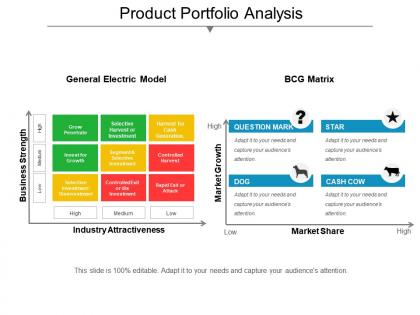
The product portfolio management PPT slide is useful to describe that product portfolio is compilation of products as well as services offered by an organization to the target market. The product portfolio analysis presentation template comprises of all set of products offered by an organization right from the ones that launched or offered during inception of the brand to the ones that launched currently along with ones that are in the pipeline too. A user can take help of the product portfolio strategy PowerPoint template to demonstrate that product portfolio comprises all the products which an organization has. It includes different categories of products, different product lines as well as finally the individual product itself. The product portfolio management slide design represents its requirement on all the three levels of a product portfolio such as managing individual products, managing product lines and finally the top level management as well which further manages the complete portfolio. Further, you can illustrate that product portfolio management is a vital element of the entire business strategy because it helps an organization to attain its overall business objectives and plan the future line of products accordingly. Guide the injudicious with our Product Portfolio Analysis Powerpoint Images. Advise them on how to decide correctly.
People who downloaded this PowerPoint presentation also viewed the following :
Product portfolio analysis powerpoint images with all 5 slides:
Our Product Portfolio Analysis Powerpoint Images are a worthwhile gamble. You will find them a great bargain.
FAQs for Product portfolio
Honestly, it's pretty eye-opening when you see everything mapped out like that. You'll quickly spot which products are your money-makers and which ones are just bleeding resources. The visual layout makes it super obvious what needs more investment vs. what should probably get axed. I do mine every quarter - helps you catch trends before they bite you in the ass. Oh, and it's great for budget decisions too. Like, suddenly you're not throwing marketing dollars at dead-end products anymore. Takes maybe an afternoon but saves you months of bad choices later.
Here's what I'd check first - are you spreading yourself too thin on products that barely make money? That's classic over-diversification. But if one product line makes up like 70%+ of your revenue, you're way too vulnerable when that market shifts. Your R&D efficiency matters too. Teams rarely share knowledge between products (honestly drives me crazy), so see if yours actually do. Customer overlap is huge - can you cross-sell or are you serving totally different markets? Oh, and run one of those portfolio matrix things to map growth vs profitability for each product.
So for portfolio analysis, start with the obvious stuff - revenue and profit margins show which products actually make money. Growth rate and market share tell you what's winning vs dying in the market. Customer acquisition cost matters too, especially if you're planning where to spend marketing dollars. Oh and definitely track customer satisfaction - pissed off customers bail fast. Lifetime value is clutch for figuring out long-term winners. Honestly I'd just pull these for your biggest products first since doing everything at once is a nightmare. You can always expand later.
Market demand basically drives your whole portfolio strategy. Pull the data for each product line and see what's actually selling vs. what's tanking. High demand = more investment, obviously. Declining stuff? Time to cut bait or pivot hard. The real challenge is predicting what's coming next instead of just chasing yesterday's numbers - I've seen too many companies get burned by that. Plot demand against profitability for each product. That combo beats guessing every time. Look for gaps where demand exists but you're not filling it yet.
Look, competitive analysis is your reality check for product planning. Shows you where you actually stand vs where you think you do. You'll find gaps in your lineup and spot products getting destroyed by competitors. Plus white space opportunities you totally missed - those are goldmines honestly. Think of it like having a battlefield map. Helps you figure out which products to invest in, what needs repositioning, and what should probably die. I'd run this every quarter (maybe I'm being too rigid here?) but use it to guide where you put your money and people.
So there are a few main ones you'll run into. BCG Growth-Share Matrix is the classic one - you know, cash cows and all that. Then there's the GE-McKinsey Nine-Box and Product Life Cycle stuff. Ansoff Matrix is good for growth strategies, plus some newer things like Three Horizons framework. BCG gets used way too much honestly, but it works great for a quick snapshot of your products. Really depends what you're trying to figure out though - resource allocation? Investment decisions? Growth plans? I'd say start with BCG since it's straightforward, then add others if you need them.
Start with the basics - sales revenue, profit margins, and market share trends. If those numbers are tanking or flat, that's your first clue. Contribution margins are honestly what I check first because they show what's actually profitable. Also look at customer complaints, return rates, and how much time/money you're pouring into each product compared to what comes back. Benchmarking against competitors helps too, though sometimes that data's hard to get. Set some clear cutoff points for "underperforming" so you're not just winging it. A monthly dashboard keeps everything visible - doesn't have to be fancy.
Look at your product lineup and be brutal about cutting the dead weight - those underperformers are just bleeding money. Pour resources into your winners that have real growth potential. Cash cows are tricky though, you can squeeze more life out of them with line extensions or hitting new markets. Honestly, the BCG matrix thing actually works pretty well for mapping this stuff out visually. Try bundling products together too - sometimes that boosts margins even when individual items aren't killing it. Start by plotting everything against market share and growth rate, then don't be afraid to axe the dogs.
Quarterly's probably your sweet spot to start with. Though honestly, if you're in something like tech where everything changes overnight, monthly might be better. Consumer goods? Quarterly works fine since those markets move slower. The real trick is making sure you're not just checking boxes - each review should actually drive decisions about where to spend money or what to kill off. I've seen too many companies waste time in these meetings without changing anything. Start quarterly and see how much your portfolio actually shifts between reviews. You can always adjust the timing from there.
Customer feedback is huge for portfolio decisions - way more telling than just revenue stats. Map those feedback themes to each product so you can spot which ones people genuinely love vs. the ones they're just putting up with. I've watched teams cling to products that seemed great on spreadsheets but customers absolutely hated. Short feedback surveys work, but don't skip the open-ended comments - that's where the real insights hide. You'll catch your winners, figure out what needs fixing, and honestly identify the stuff you should probably kill off. Sometimes the data hurts but it's better than guessing.
Honestly, you can't just set your portfolio and walk away anymore. Tech moves too fast - remember when smartphones basically killed the camera industry overnight? That's why I do quarterly reviews now, asking myself what's actually changed. Keep your money-makers running so they can fund the risky experimental stuff, but don't get sentimental about products that are clearly dying. It's brutal but necessary. The tricky part is timing when to shift resources from your reliable earners to new opportunities before competitors beat you to it.
Honestly, cannibalization is your biggest headache - the new product just ends up stealing from what you're already selling instead of actually growing anything. Then you've got to worry about how it meshes with your pricing and whether your sales people can even sell it properly (spoiler: they probably can't at first). Moving marketing budget around from stuff that's already working? Yeah, that gets messy real quick. Oh and don't get me started on the internal drama when product managers start getting all territorial about their stuff. My advice? Test it small first and nail down exactly what success looks like before going all in.
Honestly, just start by figuring out where each product sits - introduction, growth, maturity, or decline. Your growth products are gonna need serious cash for scaling up. Mature ones should be your money makers that fund the newer stuff. Declining products are tricky though - sometimes you revamp them, sometimes you cut them loose (but those cash cows can be worth keeping around even if they're past their prime). The whole point is not having everything in the same stage at once. You need some products bringing in revenue while others are set up for future growth. Makes sense, right?
Product cannibalization is when your new stuff eats into sales from what you already sell. Sometimes it's planned (like rolling out a fancier version), sometimes it just happens by accident. Look, margins might take a hit and customers could get confused about your brand. But here's the thing - controlled cannibalization can actually keep you ahead of competitors. I mean, better you do it to yourself than let someone else do it to you, right? Don't just track individual products. Watch your whole portfolio's contribution margin instead - that'll show you what's really going on with your bottom line.
Honestly, data analytics is a game changer for portfolio stuff. Real-time tracking shows you which products actually make money (not just look busy), and you can spot trends way before your competitors do. The predictive models are sick - they'll flag dying products early so you're not stuck holding the bag. Instead of relying on those stale quarterly reports, you get continuous updates on what's crushing it and what's flopping. Oh and don't go crazy with metrics at first. Pick like 2-3 key ones per product or you'll just confuse yourself with all the noise.
-
Colors used are bright and distinctive.
-
Excellent Designs.