


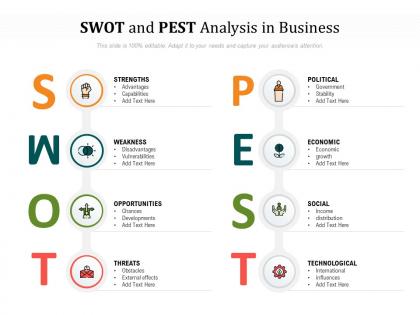
Swot and pest analysis in business




Try Before you Buy Download Free Sample Product
 Impress Your
 Audience
 100%
100% Editable
 Save Hours
 of Time


Our SWOT And PEST Analysis In Business are topically designed to provide an attractive backdrop to any subject. Use them to look like a presentation pro.
People who downloaded this PowerPoint presentation also viewed the following :
Swot and pest analysis in business with all 2 slides:
Use our SWOT And PEST Analysis In Business to effectively help you save your valuable time. They are readymade to fit into any presentation structure.
FAQs for Swot and pest
So SWOT stands for Strengths, Weaknesses, Opportunities, and Threats. Pretty basic stuff. Your strengths and weaknesses are internal - what you're good at vs where you suck. Opportunities and threats come from outside your company. Tech companies stress about keeping up with innovation, restaurants worry more about location and ingredient costs - totally depends on your industry. The hardest part? Actually being honest about what you're bad at instead of sugarcoating everything. Oh, and don't get too excited about opportunities that aren't realistic.
Honestly, you've gotta check in on all those PEST factors every quarter - markets change way too fast now. Set up Google alerts for your industry so stuff doesn't sneak up on you. Political changes might mess with regulations, economic shifts affect spending, social movements change what people want. Tech disruption is everywhere these days (ugh). But here's the thing - don't just look at each factor alone. The magic happens when you spot how they connect. Like new regulations hitting right when consumer values are shifting? That's where opportunities hide. Short bursts of monitoring beat doing one massive analysis once a year.
Don't get too generic with stuff like "we have good reputation" - be specific! Also watch out for putting the same thing in different boxes (super common mistake). Try not to let it become a big whining session about what sucks. Be real about your weaknesses instead of just hyping up strengths. Oh, and mix internal vs external factors properly. Honestly though? The worst thing is doing all this work then never looking at it again. I've seen so many companies spend hours on these things just to file them away forever. Actually follow through with what you discover or you're wasting everyone's time.
Basically, those external PEST factors force your hand - you've got to adapt internally or you're screwed. Economic shifts might completely change how you price things. Political stuff makes you rethink compliance (ugh, regulations). Social trends? They'll reshape your whole marketing game. And tech... honestly, that one's probably the scariest because it moves so fast. You can't control any of this external chaos, but you can control your response. I'd say review your PEST analysis pretty regularly and keep asking "okay, what do we actually need to change here?" That's really how you stay competitive instead of just reacting to everything.
So for SWOT analysis, different sections need different data. Market share and customer satisfaction work great for strengths - also profit margins and what makes you unique. Weaknesses? Look at turnover rates, bad reviews, sales drops, stuff like that. The opportunities section is honestly my favorite part - you're hunting for market growth, new trends, regulatory shifts, or gaps competitors are totally ignoring. Threats cover competitor moves, economic changes, and shifting consumer habits. Oh, and update this quarterly or it gets stale fast. Being brutally honest with your data is what actually makes this useful.
Honestly, I'd go with PEST first - it's way broader and gives you the big picture stuff. Map out all the political, economic, social, and tech factors hitting your industry. Then take those insights and plug them straight into your SWOT analysis. The external forces you found become your opportunities and threats. Your internal strengths and weaknesses show how you'll actually deal with those forces. Here's where it gets interesting though - overlay everything. Like if you've got solid tech capabilities and PEST showed emerging digital trends, boom, there's your sweet spot. Just make a simple matrix matching your internal stuff to external opportunities. Works every time.
Yeah, you definitely need competitor analysis for your SWOT. Without it, you're just guessing about your strengths and weaknesses. Maybe you think your pricing is competitive, but if three competitors are cheaper, well... that's not a strength anymore. The opportunities and threats sections are where competitor research really pays off though. Are they expanding somewhere you could follow? That's an opportunity. Launching a product that competes with yours? Threat. I usually look at 4-5 main competitors - gives you enough data without going crazy. It's honestly the difference between a useful SWOT and just wishful thinking.
Yeah, PEST totally works for nonprofits! Just tweak it for your mission instead of profits. Political stuff means tracking government funding shifts, policy changes hitting your cause, new regulations. Economic side covers donor patterns when the economy tanks, grant money availability, fundraising headaches. Social trends are huge - public opinion shifts about your issue, changes in who you're serving. Technology is donor databases, social media reach (honestly most orgs suck at this part). The trick is viewing everything through your impact goals, not revenue. Super useful for strategic planning or when you're writing grant apps.
Honestly, once a year is the absolute minimum for updating SWOT and PEST analyses. Tech or retail? You'll want quarterly updates since things move so fast. Big market changes or new competitors showing up means you should update immediately though - don't stick to some rigid schedule. I've watched companies use the same outdated analysis for like three years then act shocked when nothing works. Calendar reminders help, but stay flexible. Oh, and if something major happens internally (new leadership, whatever), that's another trigger to refresh everything right away.
Dude, you really need that outside perspective - it's like having blind spots when driving. Your employees might see weaknesses you're totally missing, while customers could point out strengths you didn't even realize you had. Suppliers know about market threats way before you do. Each group sees different pieces of the whole picture. I learned this the hard way when I thought our pricing was competitive until clients started complaining left and right. Don't just collect feedback after you're done though - weave it into the actual analysis process from day one.
So basically, cultural factors in PEST analysis are all about adapting your business to fit different markets. You've got to look at local values, how people communicate, buying habits - all that stuff. McDonald's is a perfect example - they do rice burgers in Taiwan and tons of veggie options in India because that's what works there. This stuff affects everything: your marketing, product design, pricing, even who you hire. Honestly, I think too many companies skip this step and wonder why they fail overseas. Always research the cultural stuff first, and definitely partner with locals who actually get it. They'll save you from so many mistakes.
Oh totally! Starbucks is probably the best example - they spotted that whole health trend early with PEST analysis, then used SWOT to figure out how their premium brand could work globally. Apple does this constantly when they're breaking into new markets, checking regulations while playing up their innovation rep. McDonald's is obsessed with this approach too, especially for menu stuff in different countries. Actually, Netflix might be my favorite case study here. When they ditched DVDs for streaming, they mapped all the tech trends happening externally against what they could actually pull off internally. Pretty genius move tbh.
For PEST analysis, you'll want to dig into the "T" part - technology factors. Start with emerging tech that's hitting your industry. What automation opportunities are out there? Check R&D developments and how fast digital transformation is moving. Patent filings are goldmines for this stuff, honestly - shows you what's around the corner before everyone else catches on. Don't forget tech adoption rates in your markets. Pick 3-5 major trends in your space, then figure out how each one might mess with (or help) your operations and competitive edge over the next couple years.
Honestly, I'd go with the classic 2x2 matrix thing - just throw your SWOT stuff into quadrants. Heat maps are clutch too, where you basically color-code everything by how urgent it is. For PEST, maybe try a radar chart? Shows the relative impact pretty well. I always end up making infographics with little icons and short summaries since stakeholders actually pay attention to those. Oh, and dashboards work if you want to highlight the big takeaways. Really depends who you're presenting to though - execs just want something they can glance at and get immediately. Don't overthink it.
Look, political stability is huge for investors - nobody wants to put money somewhere the government might flip the script tomorrow. Unstable places mean unpredictable policies, potential seizures, currency chaos. It's honestly pretty obvious when you think about it. Foreign money flows to countries like Singapore and Germany because they're boring in a good way - consistent rules, reliable courts, no surprises. Would you drop millions into a market where elections could change everything overnight? Hell no. When you're doing your analysis, be real about how stable things actually are. Recent policy shifts or shaky elections will definitely spook investors in your sector.
-
Great quality product.
-
Great product with highly impressive and engaging designs.
-
Understandable and informative presentation.
-
Use of different colors is good. It's simple and attractive.
-
Great designs, Easily Editable.
-
Unique design & color.
-
Good research work and creative work done on every template.
-
Design layout is very impressive.
-
The content is very helpful from business point of view.
-
Innovative and attractive designs.