Competitive landscape analysis for market size assessment

Rating:
90%
Competitive landscape analysis for market size assessment
Slide 1 of 2

or

Favourites Favourites

Try Before you Buy Download Free Sample Product

Audience Impress Your
Audience
Editable 100%
Editable
Time Save Hours
of Time
The Biggest Sale is ending soon in
0
0
:
0
0
:
0
0
Rating:
90%
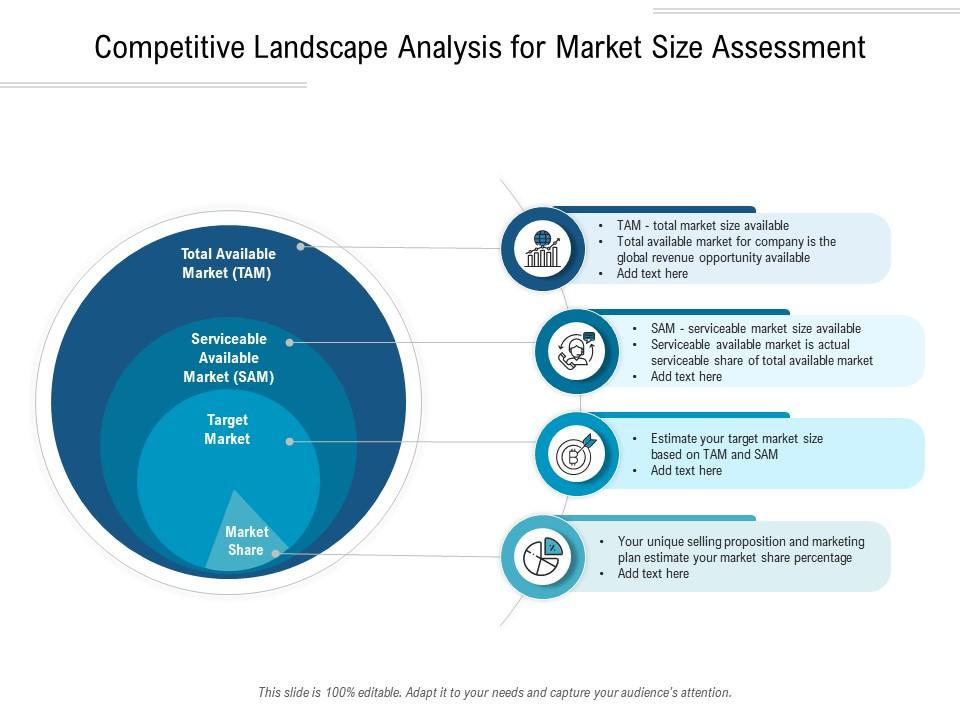
Introducing our premium set of slides with Competitive Landscape Analysis For Market Size Assessment. Ellicudate the four stages and present information using this PPT slide. This is a completely adaptable PowerPoint template design that can be used to interpret topics like Market Share, Target Market, Serviceable Available Market. So download instantly and tailor it with your information.

FAQs for Competitive landscape analysis for

Market share and revenue growth are your best starting points - they'll show you the real deal. Customer acquisition costs matter too. Honestly, pricing strategy is where a lot of companies either nail it or completely blow it. Check their retention rates and how people actually feel about the brand. Their website traffic and social media stuff can tip you off to trends before they hit the financials, which is pretty useful. Geographic reach and how diverse their products are also tell you a lot. Just start with earnings reports and industry databases, then dig deeper from there.

So basically when big competitors change their prices, everyone else has to react or they'll get screwed. Like if Amazon drops prices, suddenly you're either matching them or explaining why you're worth more money. Premium brands start pushing the "quality" angle harder, budget ones cut even deeper. It's messy but predictable - honestly feels like watching dominoes sometimes. The smart move? Keep tabs on what everyone's charging so you can adjust before you're scrambling to catch up. Otherwise you're always playing defense instead of actually planning ahead.

Honestly, start with the obvious stuff - their website, social media, press releases. Job postings are gold mines for figuring out what tech they're using and where they're headed. Check out customer reviews on G2 or Capterra too, that's where the real tea is. I always stalk their executives on LinkedIn - you'd be surprised what CEOs post when they think nobody's paying attention. Try their product yourself if you can, even just a free trial. Oh, and set up Google Alerts for their name and leadership team. But here's the thing - don't go crazy trying to do everything. Pick maybe 3 things you can actually stick with monthly. Consistency beats perfection every time.

Honestly, SWOT analysis is clutch for scoping out competitors. Map out everyone's strengths, weaknesses, opportunities, and threats - including your own. You'll spot exactly where they're vulnerable and where you might get crushed. The trick is being super honest about your own weaknesses (hardest part tbh). Once you've got all the SWOTs laid out, patterns jump out. Their weak spots become your openings. You can find those market gaps nobody's filling and figure out how to hit competitors where they can't defend. It's basically creating your own cheat sheet for the competition.

Honestly, customer feedback is like getting a backstage pass to see what your competitors actually deliver vs their shiny marketing. I'd start with G2 and Trustpilot reviews - people get brutally honest there about where companies fall short. Your own customers drop gold nuggets too during calls, like "oh, CompetitorX handles this totally differently." Set up Google Alerts for competitor names plus "review" or "complaint" - saves you tons of time hunting around. Industry forums are clutch too, though they can be hit or miss depending on your space.

Tech trends can flip entire industries on their heads pretty fast. Look at how smartphones destroyed Garmin and TomTom - nobody saw that coming. Cloud computing is another example - suddenly tiny startups could compete with IBM without buying servers. The thing is, technology doesn't just make things better, it creates totally new ways to win. GPS companies thought they were competing on accuracy, but Apple made the whole device irrelevant. You've gotta watch what's emerging in your industry and honestly ask: what happens if this tech makes our main advantage worthless? Or worse, gives our competitors superpowers we can't match?

Don't just stare at your obvious competitors - that's how you miss the real threats. Netflix blindsided Blockbuster because streaming wasn't even on their radar. Analysis paralysis is real too, trust me. You'll spend forever mapping every single player instead of actually doing something with what you learn. Keep your research current since things move crazy fast now. And here's the thing - stop copying competitors without understanding their "why." What works for them might totally backfire for you. Set yourself a hard deadline or you'll research forever and never act on it.

Honestly, social media is like having a backstage pass to your competitors' strategies. You can see what content they're pushing and which posts actually get people talking. Their comment sections? Pure gold - customers will straight-up roast or praise their products without any filter. I always check their posting schedules and who they're partnering with for influencer stuff. Set up some alerts so you know when people mention them online. Also track how they handle PR disasters because that tells you a lot. Check their numbers monthly and you'll start seeing patterns before they do.

Honestly, SEMrush and Ahrefs are your best friends here - they'll show you exactly what keywords your competitors rank for and who's linking to them. SimilarWeb's great for website traffic insights too. Set up Google Alerts for their company names so you catch news mentions. Social wise, Sprout Social tracks competitor posts pretty well, though I find manually checking their feeds works just as good half the time. Here's what most people miss though - actually browse their pricing pages and job listings regularly. You'd be surprised what you learn from seeing they're hiring a bunch of engineers or tweaking their packages. Pick maybe 2-3 tools max and do monthly check-ins.

So basically, entry barriers determine who gets to play and how brutal the competition gets. When barriers are sky-high - think huge startup costs, crazy regulations, or customers who'd rather die than switch brands - new competitors can't even get in the door. Existing players get fat and happy with nice profit margins. But low barriers? Total chaos. Everyone piles in trying to steal market share and profits get destroyed. Honestly, I always look at barriers first when analyzing any market because they tell you if you're dealing with a few stable players or some kind of constant price war nightmare.

M&As mess with markets in weird ways. Competition drops when rivals merge, so prices usually go up and innovation slows down - sucks for consumers. Though honestly, some deals actually make sense when smaller companies need to bulk up against giants. Market concentration is what you should watch for. Too few players controlling everything? That's when regulators freak out and start blocking deals. Also keep track of how this stuff shifts your own competitive spot and what you can charge. Sometimes I think the whole process moves way too slow though.

Regulations are basically the game rules that force companies to compete within certain limits. They create barriers for new players, mess with pricing strategies, and can even dictate what you're allowed to sell. Look at healthcare or finance - just the compliance costs alone can totally wreck your competitive position. Sometimes these rules actually help level things out (which is cool), but honestly they usually favor big established companies who can afford armies of lawyers and compliance teams. My advice? Map out the key regulations super early and bake compliance right into your strategy. Don't treat it like some boring checkbox at the end.

Honestly, everyone's ditching those painful quarterly audits for real-time monitoring now. AI sentiment analysis is huge too - way better than manually combing through data. Teams are finally looking beyond just pricing and features to track actual customer experience stuff. Makes sense, right? Also seeing way more collaboration between sales, product, and marketing instead of dumping everything on one poor analyst. Social listening is where it's at though - you get real customer opinions about competitors without the corporate fluff. Start with automated monitoring for your top 3 competitors and set up weekly alerts. Game changer.

Okay so you've got all this competitor data that's basically unreadable, right? Turn it into visuals instead. Heat maps show competitive intensity across market segments - executives eat this stuff up because they can instantly see where the gaps are. Try positioning maps for showing how competitors stack up, or feature comparison matrices. SWOT grids work great when you're comparing like 4-5 competitors side-by-side. Market share pie charts are pretty standard but they work. The trick is figuring out what story you're actually trying to tell first, then picking whatever visual format supports that. Way better than forcing people to read through pages of dense text.

Tell a story with your data instead of just throwing facts at people. Start big picture - main threats and opportunities - then get specific. Visuals are your friend here, like positioning maps or feature charts. Nobody wants to read paragraphs of text (learned this the hard way). Connect every insight to actual actions your team can take. Structure around business impact, not just "here's what competitors do." I'd probably throw in one random observation that surprised you - makes it feel more real. End with 2-3 concrete steps so everyone knows what's next.

Ratings and Reviews

90% of 100
Review Form
Write a review
Most Relevant Reviews
  1. 80%

    by Cristobal West

    Professional and unique presentations.
  2. 100%

    by Charlie Jones

    Excellent products for quick understanding.
  3. 80%

    by Cordell Jordan

    Top Quality presentations that are easily editable.
  4. 80%

    by William Martinez

    Awesome use of colors and designs in product templates.
  5. 100%

    by Daron Guzman

    Best way of representation of the topic.
  6. 100%

    by Darrick Simpson

    The content is very helpful from business point of view.
  7. 100%

    by Miller Rogers

    Illustrative design with editable content. Exceptional value for money. Highly pleased with the product.
  8. 80%

    by Dominique Vazquez

    Great designs, really helpful.

8 Item(s)

per page: