

Competitive landscape business strategy best practice tools and templates set 1




Try Before you Buy Download Free Sample Product
 Impress Your
 Audience
 100%
100% Editable
 Save Hours
 of Time


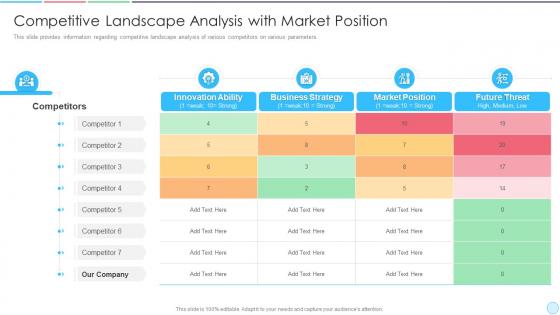
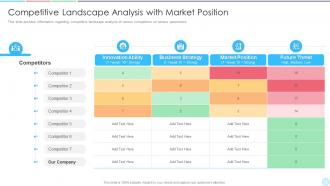
This slide provides information regarding competitive landscape analysis of various competitors on various parameters.
People who downloaded this PowerPoint presentation also viewed the following :
Competitive landscape business strategy best practice tools and templates set 1 with all 6 slides:
Use our Competitive Landscape Business Strategy Best Practice Tools And Templates Set 1 to effectively help you save your valuable time. They are readymade to fit into any presentation structure.





FAQs for Competitive landscape business strategy best practice tools and
Key factors driving industry competition include technological innovation, customer experience differentiation, pricing strategies, regulatory changes, market consolidation, and supply chain efficiency. These dynamics intensify as companies compete through digital transformation, personalized services, and operational streamlining, with many organizations finding that strategic combinations of these factors deliver sustainable competitive advantage in increasingly crowded markets.
Competitors typically differentiate through pricing strategies, unique feature sets, superior customer service, specialized market positioning, and innovative technology integration. Through comprehensive competitive analysis, businesses can identify gaps in service delivery, pricing advantages, and customer experience enhancements, while many organizations find that understanding these differentiators ultimately enables strategic repositioning and sustainable competitive advantage.
Market share data for primary competitors varies by specific industry sector, but typically requires analysis of revenue figures, customer acquisition rates, geographic presence, product portfolio strength, and strategic partnerships. Through comprehensive competitive intelligence gathering, organizations can track shifting market dynamics, identify emerging threats and opportunities, while benchmarking their own performance against industry leaders, ultimately enabling more strategic positioning and resource allocation decisions.
Emerging trends disrupting competitive landscapes include artificial intelligence automation, sustainability mandates, remote-first business models, blockchain transparency, and direct-to-consumer platforms. These technologies streamline operations, enhance customer experiences, and minimize traditional barriers, with many organizations finding that early adoption delivers significant competitive advantages and operational efficiency in increasingly dynamic markets.
Customer preferences drive competitor strategies through market research insights, product development decisions, pricing adjustments, and service enhancements that align with evolving consumer demands. Companies increasingly leverage customer feedback data, purchasing patterns, and satisfaction metrics to refine their offerings, with many organizations in retail, technology, and financial services finding that preference-driven adaptations deliver enhanced market positioning and sustainable competitive advantage.
Competitor strengths typically include market leadership positions, established customer bases, superior technology platforms, extensive distribution networks, and strong brand recognition. However, weaknesses often emerge through limited innovation capacity, higher operational costs, slower decision-making processes, and gaps in customer service delivery, with many organizations finding that targeted competitive analysis reveals specific market opportunities for strategic differentiation and advantage.
Pricing strategies among competitors typically vary through value-based positioning, cost-plus models, penetration pricing, premium positioning, and dynamic pricing approaches. These strategies reflect different market positioning goals, with some companies emphasizing affordability to capture market share while others focus on premium value propositions, ultimately creating distinct competitive advantages that influence customer acquisition and retention across market segments.
**INPUT**: What channels are our competitors using to reach their target audience effectively? **OUTPUT**: Competitors typically leverage digital marketing platforms, social media networks, content marketing, email campaigns, and strategic partnerships to reach their audiences effectively. These channels enable organizations to enhance brand visibility, streamline customer engagement, and deliver targeted messaging, with many companies finding that multi-channel approaches ultimately provide competitive advantage and improved market penetration. [Word count: 54 words]
Competitors typically respond to market shifts through strategic pivots, product innovation, pricing adjustments, enhanced customer engagement, and operational restructuring. Through data analytics and market intelligence, organizations accelerate decision-making, streamline resource allocation, and enhance competitive positioning, with many retail and financial services companies finding that agility ultimately delivers sustained market advantage.
**INPUT**: What innovations are our competitors introducing, and how might they impact our market position? **OUTPUT**: Competitor innovations typically include AI-driven personalization, automated customer service solutions, data analytics platforms, mobile-first experiences, and strategic partnerships across industries. These developments can significantly impact market position by accelerating customer acquisition, streamlining operational efficiency, and enhancing service delivery, ultimately requiring organizations to adapt quickly or risk losing competitive advantage in an increasingly dynamic business landscape. **Word count: 57 words**
Competitive geographical distribution reveals market concentration patterns, regional strengths, competitor density variations, and territory gaps that directly influence pricing strategies, customer acquisition costs, and market entry barriers. Companies with concentrated competitor presence often face intensified price competition and higher marketing expenses, while regions with sparse competition present expansion opportunities, enabling strategic market positioning and potentially higher margins through reduced competitive pressure.
Brand loyalty and customer experience significantly reshape competitive dynamics by creating differentiation beyond price and product features, establishing emotional connections, and building switching costs that protect market share. Companies with superior customer experiences, like Amazon in retail or Apple in technology, develop sustainable competitive advantages through repeat purchases, positive word-of-mouth, and reduced customer acquisition costs, ultimately transforming loyalty into long-term profitability.
Digital marketing and social media enable strategic brand positioning, targeted customer acquisition, real-time market intelligence, and direct competitor monitoring within your industry landscape. Through content marketing, social listening, and data analytics, companies streamline lead generation, enhance customer engagement, and accelerate market responsiveness, with many organizations finding that integrated digital strategies ultimately deliver measurable competitive advantage and sustained market differentiation.
New entrants pose threats through disruptive technologies, agile business models, lower operational costs, innovative customer experiences, and reduced legacy constraints that established players face. These startups often target underserved market segments or inefficient processes, ultimately forcing incumbents to accelerate digital transformation, enhance service delivery, and streamline operations to maintain competitive advantage.
Partnerships and collaborations among competitors create complex competitive dynamics by enabling shared resources, market expansion, and risk distribution while simultaneously blurring traditional competitive boundaries. These strategic alliances allow companies to access new technologies, enter untapped markets, and reduce operational costs, with many industries like telecommunications and pharmaceuticals finding that collaborative approaches ultimately deliver enhanced innovation capabilities and stronger market positioning.
-
Designs have enough space to add content.
-
The Designed Graphic are very professional and classic.